Ultra long range detection of dark objects enables safer night driving
Aeva Technologies, Inc., a leader in next generation 4D LiDAR sensing and perception systems, announced today that its industry-first 4D LiDAR now delivers beyond 500m detection range, significantly enhancing its previous performance with software improvements on existing hardware.
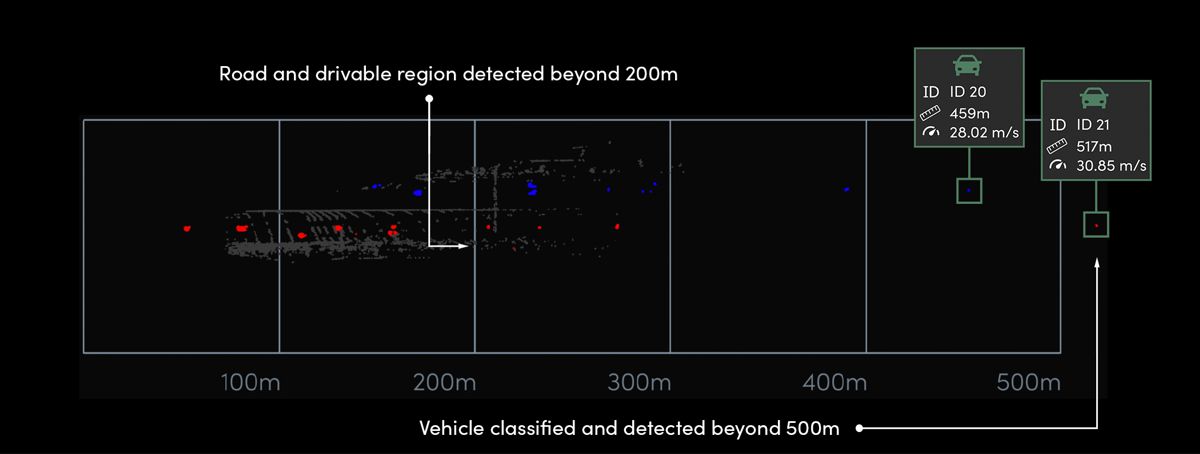
This breakthrough enables instant detection and identification of pedestrians beyond 350m and dark objects, including vehicles, beyond 500m of range.
This is a step change in capability in long range sensing and has the potential to provide crucial safety enhancements for automated driving, especially in applications where sufficient braking distance is safety-critical – including in highway driving – and challenging to achieve with existing technologies. Importantly, Aeva 4D LiDAR’s ultra long range performance also identifies the ground drivable regions beyond 200m.
The leading detection range is only possible by leveraging Aeva’s unique frequency-modulated continuous wave (FMCW) 4D LiDAR architecture that has superior sensitivity to detect a single photon, without being sensitive to sunlight or other interference.
By leveraging continuous measurements and raw instant velocity per pixel information, Aeva’s technology measures an object at long distances with higher confidence than a legacy, time-of-flight (ToF) LiDAR – enabling instant identification of dynamic objects with reflectivities below 10% at long distances.
“Our team continues to push the boundaries of what’s possible toward creating the best perception solution that is built on Aeva’s breakthrough FMCW 4D LiDAR on-chip technology, as we aim to offer a combination of performance and scalability that we believe to be unmatched in the industry,” said Mina Rezk, Co-founder and CTO of Aeva. “This is all accomplished using Aeva’s current 4D LiDAR hardware, providing a glimpse of the continuous improvements we aim to deliver to our customers through our proprietary FMCW technology and over-the-air software updates.”