TheiaCel Tech and Image Sensors deliver LED-flicker-free Exterior Cameras
OMNIVISION, a leading global developer of semiconductor solutions, including advanced digital imaging, analog and touch & display technology, today debuted its OX08D10 8-megapixel (MP) CMOS image sensor with TheiaCel™ technology at AutoSens Brussels. The new solution enhances automotive safety by providing enhanced resolution and image quality in exterior cameras for advanced driver assistance systems (ADAS) and autonomous driving (AD).
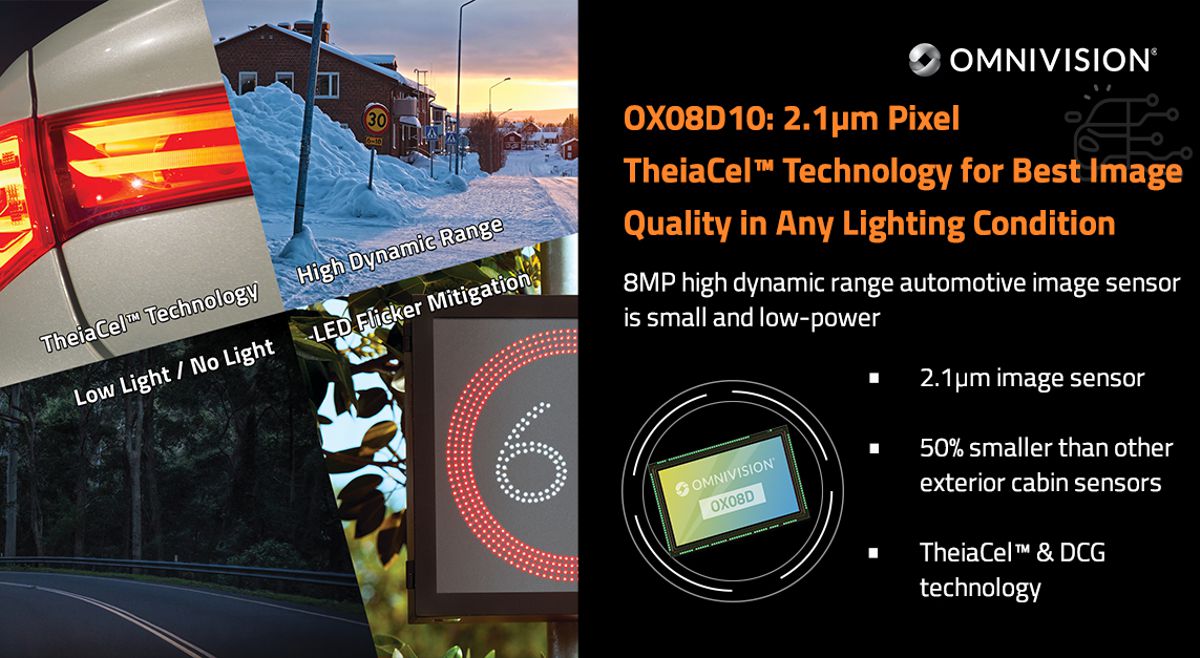
The OX08D10 features industry-leading lowlight performance and low power consumption in a compact size that is 50% smaller than other exterior cabin sensors in its class. It is the first image sensor that features OMNIVISION’s new 2.1-micron (µm) TheiaCel™ technology, which harnesses the capabilities of next-generation lateral overflow integration capacitors (LOFIC) and OMNIVISION’s DCG™ high dynamic range (HDR) technology to eliminate LED flicker regardless of lighting conditions.
TheiaCel™ enables the OX08D10 to achieve HDR image capture at up to 200 meters. This range is the sweet spot for delivering the best balance between SNR1 and dynamic range and is optimal for automotive exterior camera applications.
“The new OX08D10 image sensor provides automotive OEMs with one device that combines all of the most important features, including low-light performance, LED flicker mitigation (LFM), small size and low power, eliminating the need for our customers to make performance/design compromises to address LED flicker, as they have in the past,” said Paul Wu, automotive product marketing manager, OMNIVISION. “Additionally, we are excited to debut our new TheiaCel™ technology at AutoSens this year. TheiaCel™ brings a new era to single-exposure HDR in an easy-to-implement solution that yields dramatic improvements in image quality.”
“LFM, HDR and high resolution have become essential prerequisites in modern automotive image sensors to achieve higher autonomy vehicles,” said Anas Chalak, technology & market analyst, Imaging at Yole Intelligence, part of Yole Group. “OMNIVISION’s TheiaCel™ DCG + LOFIC solution fulfil these criteria, aligning with the trend of implementing more exterior cameras per car in the upcoming years. By 2028, we expect the ADAS camera market volume to reach around 105M units and the overall automotive image sensor market to expand to $3.7 billion, experiencing a CAGR22-28 of 8.7%.”
In the automotive market, flicker from LED traffic lights poses a serious challenge for imaging solutions, preventing ADAS and AD systems from correctly detecting lighted traffic signs. The industry has been clamouring for a solution that could be easily integrated into a CMOS image sensor to meet this challenge. Some previous approaches, while achieving satisfactory LFM, have resulted in reduced image quality, especially at high automotive temperatures.
OMNIVISION’s new 2.1µm single-pixel TheiaCel™ technology delivers high LFM without sacrificing image quality. TheiaCel™ leverages next-generation LOFIC capabilities together with the proven strength of OMNIVISION’s proprietary HDR technology (patented DCG and split-diode technology), which captures extremely high-contrast scenes for optimum content and image quality. OMNIVISION’s TheiaCel™ DCG + LOFIC solution achieves a wider dynamic range than earlier single-exposure HDR architectures.
The new OX08D10 achieves overall superior performance in key areas compared to its non-LOFIC-based predecessor – in particular, its LFM dynamic range is 3.3x higher and total dynamic range nearly 3x higher. It features upgraded cybersecurity to comply with the newest MIPI CSE version 2.0 standards, which adds functional safety to automotive image sensor data streams. The TheiaCel™ device features OMNIVISION’s a-CSP™ package technology for the smallest possible solution. Samples are available now, and the OX08D10 will be in mass production in the second half of 2024.