Augmented Reality is Revolutionising Firefighter Training
It sounds counterintuitive, but firefighting training can be just as dangerous as the real thing. In fact, the United States Fire Administration reported that a staggering 16.6% of firefighter fatalities in 2024 occurred during training. That statistic alone has prompted researchers and public safety officials to seek safer, smarter solutions. Leading the charge is George Mason University’s Craig Yu, an associate professor of computer science, whose career has long focused on harnessing emerging technologies to aid human development.
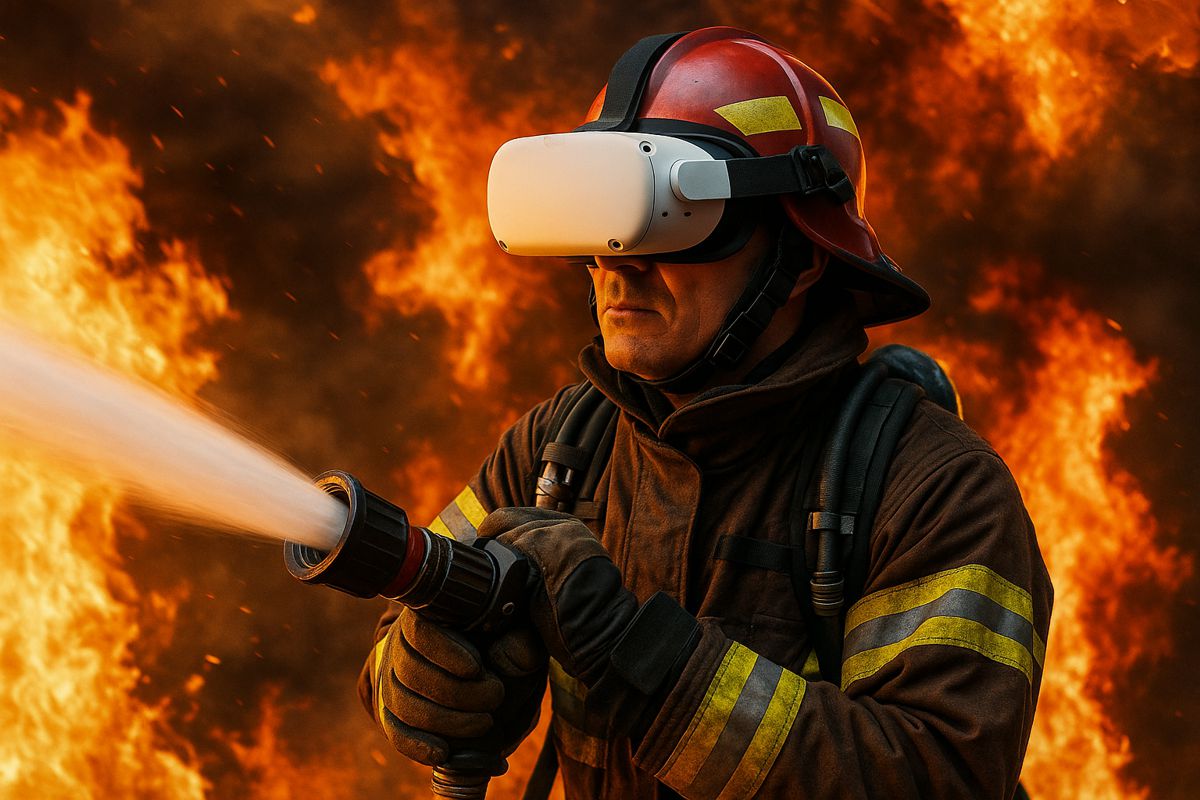
Working in tandem with Joel Martin, associate professor of kinesiology, Yu is using a grant from the National Science Foundation’s EAGER (EArly-concept Grants for Exploratory Research) programme to develop a new breed of training—one that leans on the power of augmented reality (AR) to simulate high-stress, high-risk environments without exposing trainees to actual danger.
Real Fires, Virtual Flames
The heart of the project is an innovative augmented reality system designed to replicate the chaos of fire emergencies. By using AI-driven 3D simulations built on digital twins of real-world locations, Yu and Martin aim to transform how fire crews are trained.
The software analyses room layouts, identifies potential ignition points, and calculates likely fire spread patterns. What’s more, it determines where civilians might be trapped and how best to rescue them. “The program understands the environment, and it will be refined with additional input from professional firefighters,” explained Yu.
This level of realism allows trainees to face an unfolding fire scenario in their actual surroundings—without a single spark being lit.
Tailored for Every Trainee
Yu’s system isn’t a one-size-fits-all solution. Instead, it adapts scenarios based on the user’s experience. For rookies, it might simulate a straightforward kitchen blaze. For seasoned firefighters, the challenges become more complex: multi-storey evacuations, hazardous materials, or electrical fires in crowded buildings.
The beauty of this setup is its flexibility. Trainers can dial up or down the complexity, and they can even create rare but critical scenarios that are impractical or impossible to replicate in real-life drills.
Martin added: “I think that technology such as immersive reality training can help to meet training needs while minimising the physical risks of performing certain drills.”
Cutting the Risk Without Cutting Corners
This isn’t about replacing traditional fire training, and Yu is quick to point that out. “I don’t ever see us replacing real fire training,” he said, “but this is a means to augment the training to improve the health and safety of the firefighters.”
In fact, by adding this virtual layer, trainers can broaden the scope of what they teach. Instead of waiting for ideal weather or building availability, they can fire up a headset and run a drill anywhere—in a school, office, warehouse, or underground station.
It also saves lives. Martin has been collaborating with Fairfax County Fire and Rescue for years to explore ways to reduce injury risks during training. With this AR approach, the potential to minimise physical strain is substantial.
From Pokémon to the Firehouse
While augmented reality has gained traction in everyday applications—think IKEA’s furniture previews or smartphone-based dinosaur exhibits—its leap into life-saving professions marks a pivotal shift.
Mixed reality, a blend of real-world views and virtual overlays, allows firefighters to see simulated flames licking across walls or dense smoke rolling in through doors. They react in real time, making decisions under pressure—just like they would in a real blaze.
Yu and Martin’s project, titled “Adapting Mixed Reality Training Programs to Real-World Scenes to Enhance Human-AI Teaming in Emergency Responses,” is all about pushing those boundaries.
AI in the Hotseat
The addition of artificial intelligence is what truly sets this training apart. AI doesn’t just generate fires; it observes how firefighters respond to them. It tracks movement, timing, decision-making, and even stress responses to identify strengths and weaknesses.
“AI allows us to rapidly analyse human performance and then adaptively synthesise training programmes to address weakness we observe,” said Yu. In short, the system learns as the firefighter learns.
This opens the door to highly personalised feedback and improvement plans—something traditional drills simply can’t offer at the same level.
Tomorrow’s Toolkit
Although still in the early phases of development, Yu and Martin have big ambitions. The next frontier? AR-powered headsets that can scan a room on entry and deliver real-time data: where exits are located, how fast smoke is building, whether structural integrity is at risk, and even a firefighter’s vital signs.
This kind of situational awareness could transform how fire crews operate inside dangerous environments, turning data into instinct.
Martin believes the key lies in collaboration: “More and more virtual and immersive reality training is being used [in kinesiology]. I think this project demonstrates the importance of collaboration and interdisciplinary teams to solve challenges in the field.”
Firefighting Meets the Future
As smart cities evolve and climate change fuels more frequent fires, there’s growing pressure to make emergency response smarter and safer. Training is the front line of that change. And with AR now crossing from living rooms into fire stations, a new era of firefighter preparation has begun.
Yu and Martin’s work may not put out actual fires, but it could help prevent the tragedies that come with unpreparedness. By blending cutting-edge tech with decades of field knowledge, they’re lighting the way to a safer future—without anyone getting burned.