Bohai Strait Tunnel Signals a New Era for Global Subsea Rail Infrastructure
China’s approval of the Bohai Strait subsea railway tunnel marks one of the most consequential transport infrastructure decisions of the decade. The proposed twin railway tunnels, exceeding 120 kilometres in total length with roughly 90 kilometres beneath the seabed, will link the cities of Dalian in Liaoning province and Yantai in Shandong province. In practical terms, the project will transform a sea crossing that currently depends on ferries into a fixed rail corridor operating year round.
The Bohai Strait sits at the heart of the Bohai Economic Rim, one of China’s most industrialised regions and home to major ports, steel production, petrochemicals and manufacturing clusters. Freight movements between the Liaodong and Shandong peninsulas currently detour hundreds of kilometres inland or rely on maritime routes vulnerable to weather disruptions. A permanent rail link reshapes logistics patterns overnight. Travel times that currently stretch to eight hours by combined road and ferry could fall to roughly one hour by train, dramatically changing labour mobility, tourism and freight scheduling.
From an infrastructure perspective, this is not simply a domestic transport improvement. It is an economic geography project. Fixed links historically trigger regional integration by removing natural barriers. The Channel Tunnel between the UK and France reoriented cross border trade in Europe, while Japan’s Seikan Tunnel linked Hokkaido to the mainland rail network and reshaped national logistics flows. China is now applying that same strategic logic to one of its busiest maritime corridors.
Engineering Beyond Existing Tunnel Limits
The Bohai Strait project immediately joins the shortlist of the most complex tunnelling schemes ever attempted. For comparison, the Seikan Tunnel in Japan measures 53.85 kilometres, and the Channel Tunnel connecting Britain and France stretches 50.45 kilometres. Even Norway’s proposed Stad Ship Tunnel and the Fehmarnbelt Fixed Link between Denmark and Germany operate on entirely different geological assumptions. The Bohai Strait tunnels will more than double the length of any existing subsea rail tunnel.
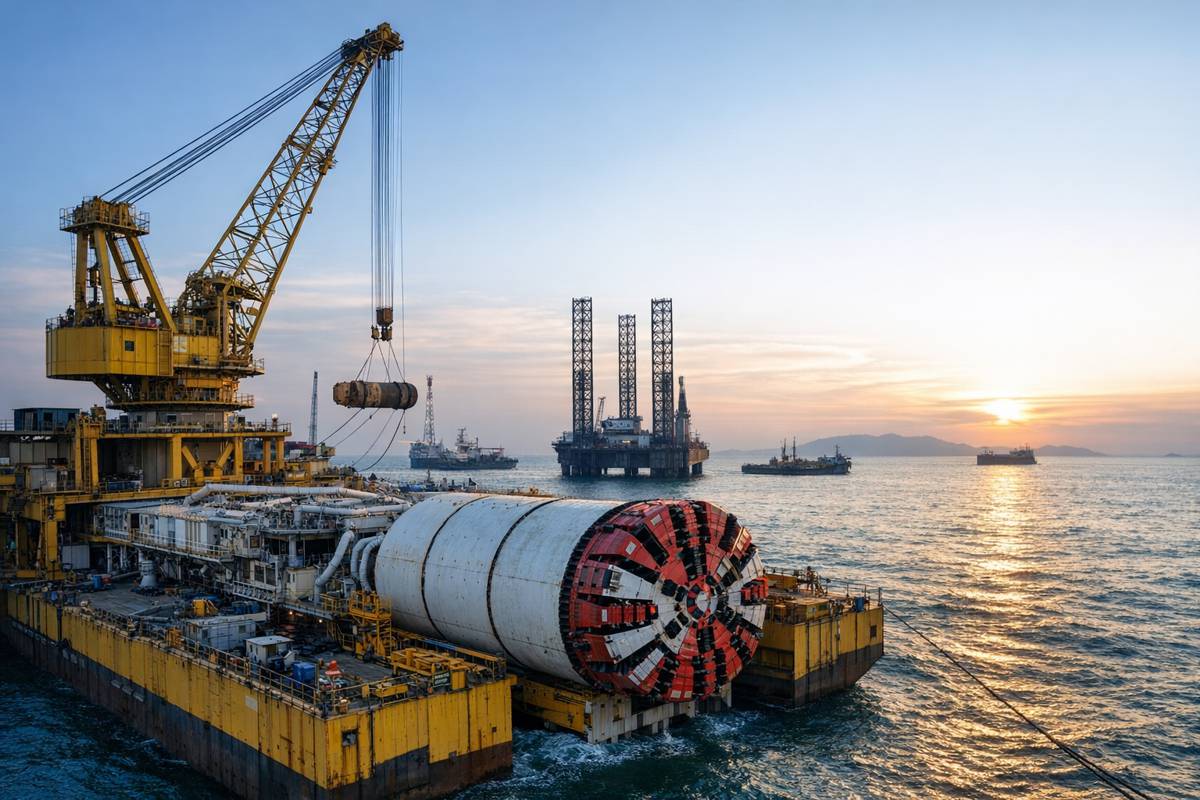
Length alone is not the only challenge. The strait contains mixed geology including fractured rock, fault zones and water bearing strata under significant hydrostatic pressure. Unlike mountain tunnels where groundwater inflow is localised, subsea tunnels operate beneath a continuous water column. Any failure in lining integrity risks rapid flooding. As a result, the project will depend heavily on next generation tunnel boring machines designed for high pressure conditions and advanced ground conditioning systems.
Modern slurry shield TBMs already operate under pressures exceeding 10 bar in projects such as Hong Kong’s Tuen Mun Chek Lap Kok Link. The Bohai Strait scheme will push this capability further, requiring sustained operation at extreme depths across unprecedented distances. Tool wear, cutter replacement logistics and hyperbaric interventions will become defining engineering considerations. The project therefore acts as a live laboratory for deep subsea mechanised tunnelling.
Digital Monitoring and Predictive Infrastructure
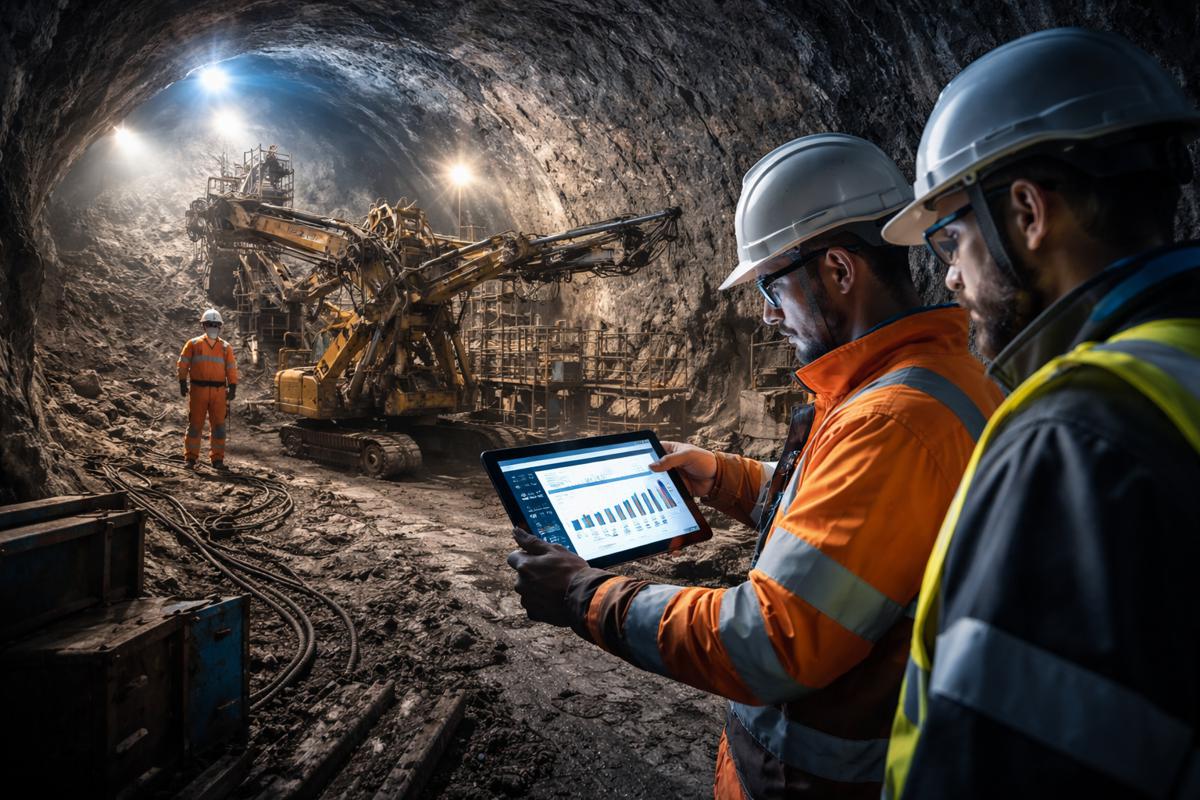
Large tunnels today are as much digital projects as physical ones. Continuous geotechnical monitoring, fibre optic sensing and real time deformation tracking will be central to construction safety. Long subsea tunnels accumulate tiny movements over time, and detecting millimetre scale displacement can prevent catastrophic incidents.
China has invested heavily in digital twin modelling for infrastructure, and the Bohai Strait link provides an ideal application. A tunnel digital twin allows engineers to integrate geological forecasts, TBM telemetry and lining stress measurements into predictive models. Instead of reacting to problems, engineers anticipate them hours or days ahead. For a tunnel extending across tens of kilometres underwater, that predictive capability becomes operationally essential rather than merely beneficial.
Operationally, rail safety systems will also require innovation. Ventilation, evacuation routes and emergency access must function over distances longer than many entire metro networks. The Channel Tunnel relies on a service tunnel between running tunnels for evacuation and maintenance. A similar multi bore concept is expected here, but scaled to a much larger environment, reinforcing the growing role of integrated safety engineering in megaprojects.
Maritime Engineering Meets Rail Infrastructure
Constructing a tunnel beneath an active shipping corridor introduces marine engineering challenges beyond conventional tunnelling. The Bohai Strait handles heavy commercial traffic, including oil tankers and bulk carriers serving northern Chinese ports. Construction staging must coexist with shipping without interrupting trade.
This requires offshore shafts, artificial islands or deep land based launch points designed to support TBM operations. Offshore construction platforms, geotechnical drilling campaigns and marine logistics will operate simultaneously. In many ways the project merges the disciplines of offshore oil engineering and railway construction. Contractors experienced in offshore foundations, jack up rigs and seabed stabilisation will be as critical as tunnelling specialists.
Environmental considerations also carry weight. Subsea excavation disturbs sediment and can affect marine ecosystems. Modern megaproject approvals increasingly depend on sediment plume control, acoustic monitoring and habitat mitigation strategies. China has implemented such measures on major coastal bridge projects including the Hong Kong Zhuhai Macau Bridge, and similar approaches are likely to apply here, especially given the scale and duration of excavation.
Logistics, Industry and Regional Development
Infrastructure at this scale rarely exists in isolation. The Bohai Economic Rim includes heavy manufacturing bases in Tianjin, Qingdao, Dalian and surrounding industrial cities. Transport reliability directly influences supply chain efficiency, particularly for bulk commodities and time sensitive manufacturing.
A fixed rail connection allows freight operators to schedule trains rather than wait for ferry departures or weather windows. That reliability reduces inventory storage needs and improves just in time manufacturing performance. Steel products, automotive components and petrochemical goods can move across the region as though the sea barrier never existed.
Passenger transport implications follow naturally. Labour markets expand when commute times shrink. Universities, ports and industrial parks effectively become part of a single metropolitan system. Similar patterns followed Japan’s Seikan Tunnel, which integrated northern regions into national economic networks, although passenger demand initially lagged freight utilisation. Over time, however, regional tourism and mobility expanded substantially.
A Catalyst for Global Tunnel Technology
Megaprojects tend to ripple outward into the global engineering industry. The Channel Tunnel accelerated cross border tunnelling standards in Europe, while the Gotthard Base Tunnel in Switzerland advanced long distance alpine TBM design. The Bohai Strait tunnel is poised to do the same for subsea railway engineering.
Contractors, machine manufacturers and sensor technology suppliers will refine equipment capable of operating continuously under high pressure marine conditions. Cutter materials, automated inspection robotics and remote intervention techniques are expected to evolve. These technologies rarely remain local. Once proven, they become exportable expertise applied to projects worldwide, from Nordic fjord crossings to potential future transnational links in Asia.
Financially, megaprojects also shape infrastructure investment models. Long subsea tunnels demand multi decade economic justification. Freight capacity, regional development and strategic resilience all factor into cost benefit analysis. Governments increasingly view such links as economic backbone assets rather than isolated transport improvements.
Strategic Infrastructure in a Changing Transport Landscape
Beyond engineering, the approval reflects broader transport policy shifts. As countries aim to decarbonise freight transport, rail is regaining prominence relative to road and short haul aviation. Electrified rail corridors offer predictable energy consumption and high capacity throughput, particularly for industrial regions.
A fixed rail crossing across the Bohai Strait reduces reliance on maritime fuel intensive ferries and supports modal shift toward rail. This aligns with wider global trends where governments invest in rail freight corridors and intermodal hubs to reduce emissions and congestion. Infrastructure planners worldwide are observing how large scale fixed links influence both economic productivity and environmental policy.
The Bohai Strait tunnel therefore represents more than a single project announcement. It signals confidence in long term infrastructure planning and a willingness to tackle geographic barriers once considered permanent. For the construction sector, it highlights the direction of travel for megaproject complexity. Future tunnels will not simply be longer. They will be smarter, digitally monitored and integrated into broader economic systems.