Volkswagen Commercial Vehicles Expands Portfolio as Electric Vans Gain Ground
The global market for light commercial vehicles has been anything but predictable in recent years. Rising costs, shifting emissions regulations and uncertain demand for electric vehicles have forced manufacturers to rethink strategies while continuing to serve fleets, logistics providers and tradespeople who rely on dependable transport.
Volkswagen Commercial Vehicles delivered a mixed but strategically significant performance in 2025, strengthening revenues and cash flow even as profitability came under pressure.
The division recorded sales of 428,000 vehicles worldwide, generating €16.9 billion in revenue, a rise of 11 percent compared with the previous year. Although operating profit declined to €245 million, strong financial discipline and improved working capital management enabled the company to produce net cash flow of around €1 billion, providing a solid financial foundation for upcoming product updates and technology investments.
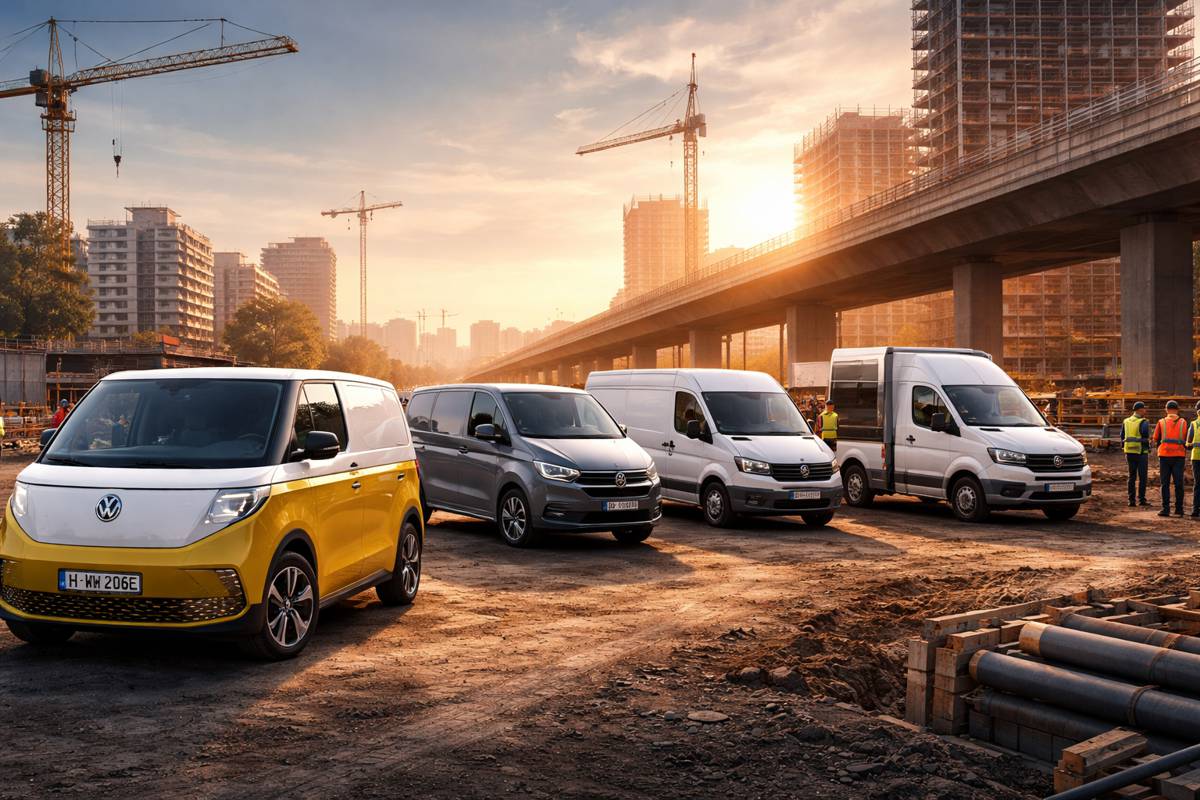
More importantly for the wider construction, infrastructure and logistics sectors, Volkswagen is preparing a new wave of vans and commercial vehicles scheduled for launch and updates through 2026. These vehicles form the backbone of countless industries, from construction contractors and infrastructure maintenance teams to urban delivery fleets and specialist service operators.
Strong Revenue Growth Signals Demand for High Value Commercial Vehicles
The headline figures from 2025 reveal a somewhat unusual pattern: revenues grew much faster than vehicle sales. While deliveries increased by around six percent to 428,000 units, revenue jumped by 11 percent, indicating that customers increasingly opted for higher value vehicles and more specialised configurations.
That trend reflects a broader shift across the commercial vehicle sector. Fleet operators are investing more heavily in vehicles equipped with advanced driver assistance systems, improved connectivity and electrified drivetrains. In sectors such as infrastructure construction, utilities and logistics, vehicles increasingly serve as mobile workspaces rather than simple transport tools.
Stefan Mecha, CEO of Volkswagen Commercial Vehicles, acknowledged the difficult environment but emphasised the importance of maintaining a broad and modern product portfolio: “2025 was a challenging year for our customers and for us – marked by volatile markets, uncertainties and noticeable reluctance to buy, especially in the field of electric mobility. It is therefore even more important that we offer the youngest and most versatile product portfolio on the market compared to our competitors. These products will give us the momentum we need for 2026.”
Despite the pressures, Volkswagen Commercial Vehicles continued to dominate its domestic German market and retained leadership positions in eleven other European countries, demonstrating the brand’s continued strength in a highly competitive segment.
Electric Vans Gain Momentum Even as the Market Hesitates
Electric mobility remains one of the most debated topics in the commercial vehicle industry. While passenger EV adoption continues to accelerate in many markets, uptake among light commercial vehicles has been slower due to operational constraints such as range, charging infrastructure and higher upfront costs.
Yet one model in Volkswagen’s portfolio continues to attract strong interest. The ID. Buzz, an all electric reinterpretation of the classic Microbus concept, delivered particularly strong results in 2025. Global deliveries exceeded 60,000 vehicles, more than double the previous year’s total.
The vehicle has become the market leader in its segment in Europe, benefiting from strong demand among fleet operators, urban logistics companies and mobility services seeking zero emission transport solutions.
The success of the ID. Buzz reflects a wider industry trend. According to data from the European Automobile Manufacturers Association (ACEA), electric vans accounted for roughly 7 percent of new light commercial vehicle registrations in the EU during 2024, up from just over 5 percent the year before. While still a relatively small share, growth is accelerating as cities introduce low emission zones and governments tighten climate targets.
For infrastructure and construction firms operating in urban areas, electric vans are increasingly becoming a necessity rather than a novelty.
Multivan Achieves Best Sales Year in Its History
While electric models captured much of the attention, one of Volkswagen’s longest running vehicle families quietly delivered a record breaking year. The Multivan, widely used by businesses, tradespeople and passenger transport operators, recorded 38,700 deliveries, representing a 31 percent increase compared with the previous year.
That performance marked the strongest sales year in the model’s history.
The Multivan’s popularity highlights the continued demand for flexible vehicles that can serve multiple roles. Construction companies often use such vehicles for crew transport, equipment hauling and mobile site operations. The vehicle’s modular interior configurations and increasing levels of digital connectivity have helped maintain its relevance in an evolving market.
Transporter Family Faces Temporary Slowdown
Not all segments experienced growth in 2025. Sales within the Transporter family were somewhat weaker during the year, largely due to a phased market rollout of new models and derivatives.
Vehicle launches in the commercial sector are rarely simultaneous across global markets. Regulatory requirements, local homologation procedures and production capacity often lead to staggered introductions. In the case of the Transporter line up, this gradual release affected delivery numbers during the year.
However, Volkswagen expects the situation to improve significantly in 2026 as additional variants enter production and reach international markets.
Profit Margins Under Pressure from Regulation and Market Shifts
Although revenue increased, operating profit declined sharply from €743 million in 2024 to €245 million in 2025, resulting in a return on sales of 1.5 percent.
Several external factors contributed to the drop.
One major influence was the European Union’s increasingly strict CO₂ regulations, which require manufacturers to meet fleet wide emissions targets or face potential financial penalties. Slower than expected adoption of electric vans meant that some manufacturers, including Volkswagen Commercial Vehicles, had to set aside provisions for possible compliance costs.
The North American market also created difficulties. Changes to electric vehicle subsidy programmes and customs related challenges affected sales dynamics, particularly for vehicles like the ID. Buzz that depend on supportive policy environments to remain competitive.
Nevertheless, the company managed to stabilise its finances through strict cost controls and disciplined investment planning.
Michael Obrowski, CFO of Volkswagen Commercial Vehicles, highlighted the importance of financial management in maintaining long term stability: “Our vehicles are well received by our customers, and the increase in unit sales and order intake is impressive proof of this. The strong net cash flow demonstrates the effectiveness of our consistent cost and expenditure discipline and secures the necessary long-term investments in new vehicle generations. At the same time, the return of 1.5 per cent is still far too weak – we are working hard on this in 2026.”
Strong Order Book Suggests Momentum for 2026
Despite the mixed financial performance, the outlook for Volkswagen Commercial Vehicles appears relatively positive. Incoming orders during 2025 were almost one third higher than the previous year, creating a substantial order backlog that will continue to feed production during 2026.
For industries dependent on commercial vehicles, that backlog reflects steady underlying demand even during uncertain economic conditions.
Construction contractors, infrastructure operators, municipal services and delivery fleets rarely have the luxury of postponing vehicle purchases indefinitely. Ageing fleets must be replaced and new projects require reliable transport capacity. As a result, the commercial vehicle market often demonstrates resilience even when broader economic conditions fluctuate.
Major Product Updates Planned Across the Portfolio
Looking ahead, Volkswagen Commercial Vehicles is preparing a wide range of model updates and new derivatives scheduled for 2026.
Updated versions of the Caddy and Multivan will feature redesigned exterior styling and improved interior functionality aimed at both business users and private buyers.
The ID. Buzz range will expand with several new capabilities designed to improve its versatility. Planned additions include Vehicle to Load functionality, allowing external electrical devices to draw power from the vehicle battery. For construction and field operations, such features could transform electric vans into mobile power sources for tools and equipment.
Additional lifestyle and commercial features are also planned, including Camp Mode, the Good Night Package and a long wheelbase version of the ID. Buzz Cargo, broadening the model’s appeal across multiple use cases.
Meanwhile, the Transporter and Caravelle will gain plug in hybrid variants, offering a transitional solution for fleet operators who are not yet ready to fully commit to electric vehicles.
Expanding Solutions for Commercial Customers
Beyond passenger and leisure vehicles, Volkswagen Commercial Vehicles is strengthening its offerings for professional operators.
The Crafter, a widely used large van among trades and construction firms, will soon be available in several new specialised configurations. These include a three way tipper, a box body version, and a liftgate equipped variant, enabling the vehicle to serve industries such as logistics, infrastructure maintenance and construction supply.
Such configurations play a critical role in day to day operations across the infrastructure sector. Whether transporting road repair materials, delivering construction tools or supporting utility maintenance crews, these vehicles form an essential part of the operational ecosystem.
Manufacturing Milestones Reflect Long Term Commitment
While new models capture headlines, manufacturing capacity remains just as crucial to the long term strategy.
The Volkswagen Commercial Vehicles plant in Hanover, Germany, will celebrate its 70th anniversary in 2026. The site continues to serve as a major hub for van production and is already preparing for the future, with pre series production of the ID. Buzz AD autonomous vehicle platform underway.
Meanwhile, the Września facility in Poland marks ten years of production, having grown into one of the most advanced manufacturing plants within the Volkswagen Group. The site is also preparing for expansion to support future e Crafter production, signalling continued investment in electric commercial vehicles.
A Strategic Pivot Toward the Future of Mobility
The broader strategy behind Volkswagen Commercial Vehicles reflects the transformation currently sweeping through the automotive and infrastructure sectors.
Commercial vehicles are evolving into digitally connected platforms integrated with fleet management systems, predictive maintenance tools and energy management solutions. Electrification, autonomous driving technology and data driven logistics are rapidly reshaping how businesses deploy vehicle fleets.
Stefan Mecha highlighted the importance of collaboration within the wider Volkswagen Group in navigating this transformation: “From family and leisure vehicles through to the wide portfolio for commercial customers and the special-purpose vehicle for autonomous driving: this range is unique within the Group. We create space – and that’s what makes us strong.”
For the construction, logistics and infrastructure industries, the evolution of commercial vehicles will continue to shape how projects are delivered and maintained. Whether through electrification, digital integration or new specialised vehicle configurations, the humble work van is quietly becoming one of the most technologically advanced tools in the modern industrial toolkit.