X Ray Breakthrough Reveals How Sandstone Fractures Under Pressure
Understanding how rocks fracture has long been one of the quiet but critical puzzles underpinning modern infrastructure, energy production and geotechnical engineering. From tunnels and foundations to oil reservoirs and underground waste storage, the behaviour of rock under stress determines whether projects succeed or fail. Now, a team of researchers working at one of the world’s most advanced X-ray facilities has shed unprecedented light on the microscopic mechanics of rock failure.
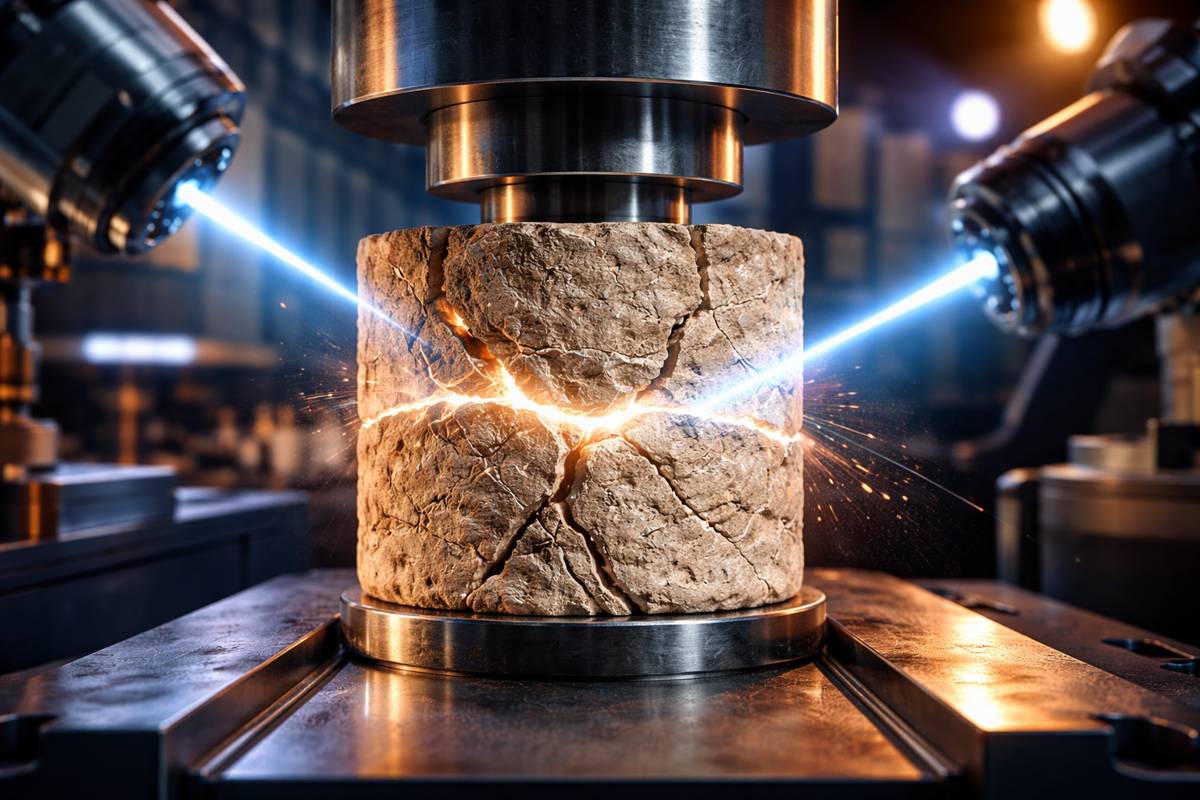
Using a powerful combination of advanced X-ray imaging and diffraction tools, scientists have visualised how sandstone fractures in three dimensions while under compression. The research, conducted at the Advanced Photon Source (APS) in the United States, reveals that sandstone behaves far more like a granular material such as compressed sand than previously understood.
By mapping internal stresses and structural changes as the rock sample was compressed, the team uncovered how pores and grains interact during the fracturing process. The results provide a detailed picture of how stress propagates through rock, offering valuable insights for industries ranging from infrastructure construction and geothermal energy to oil extraction and geological carbon storage.
This kind of understanding is more than academic. It provides the scientific foundation needed to predict how rock formations will behave under pressure, improving safety, efficiency and environmental stewardship.
Rock Fracture effects on Infrastructure and Energy
Rock fracture is not simply a geological curiosity. It governs the movement of fluids underground, which in turn influences a wide range of industrial and environmental processes.
In the oil and gas sector, for example, fractures determine how hydrocarbons flow through reservoirs. Similarly, geothermal energy projects rely on controlled rock fracturing to circulate water through hot formations deep underground. The same principles apply to carbon capture and storage, where injected CO₂ must remain securely trapped within geological formations.
Civil engineering projects also depend on understanding rock stability. Large tunnels, underground caverns, hydroelectric dams and transportation infrastructure frequently pass through sandstone formations. Engineers must assess how rock will respond to excavation, pressure and environmental change.
When fractures propagate unpredictably, the consequences can be severe. Ground instability, uncontrolled fluid flow or structural failure may occur. That is why accurate models of rock deformation remain central to modern geotechnical design.
Earthquake science provides another example. Although tectonic events occur on vastly larger scales, the fundamental physics of rock stress and fracture remains closely related. Understanding how stresses accumulate and release within rocks can help scientists better interpret the mechanics of seismic activity.
Against this backdrop, the new research offers a valuable breakthrough by revealing precisely how stress evolves within sandstone before and during fracture.
Advanced X Ray Techniques Unlock a Hidden World
To uncover the internal behaviour of sandstone, the researchers turned to one of the most powerful experimental facilities available to scientists studying materials under extreme conditions.
The work was carried out at the Advanced Photon Source, a synchrotron facility operated by the U.S. Department of Energy’s Office of Science. Synchrotrons generate extremely intense X-ray beams capable of penetrating dense materials while capturing microscopic structural information.
The research team combined three sophisticated techniques:
- Near-Field High Energy Diffraction Microscopy (nf-HEDM)
- Far-Field High Energy Diffraction Microscopy (ff-HEDM)
- X-Ray Tomography (XRT)
Each technique provides a different window into the structure and behaviour of materials.
Near-field diffraction microscopy reveals crystal orientations and grain structures at very fine scales. Far-field diffraction microscopy measures stress distributions within those grains. X-ray tomography, meanwhile, produces three-dimensional images showing pores, cracks and internal geometry.
By combining these approaches, the researchers were able to build a complete picture of the sandstone sample before and during compression.
This multi-modal imaging approach represents a major step forward in experimental rock mechanics. Historically, researchers could either observe structural features or measure stresses, but rarely both at the same time. Integrating these measurements allowed the team to track how the rock’s internal architecture evolved as pressure increased.
Watching Sandstone Fracture in Real Time
The experiment began by fully characterising the sandstone sample before any mechanical stress was applied.
Using nf-HEDM, ff-HEDM and X-ray tomography, the team mapped the rock’s internal grain orientations, stress state and pore structure. This provided a detailed baseline of the rock’s microstructure.
Once the initial measurements were complete, the sample was gradually compressed while the researchers continued monitoring it with the same X-ray tools. By capturing images and stress data at different stages of loading, the team was able to observe how the rock responded to increasing pressure.
The results revealed a dynamic internal process that had never been visualised in such detail.
As compression increased, stresses within the sandstone reorganised and aligned with the direction of loading. Meanwhile, tensile stresses developed in perpendicular directions, effectively resisting catastrophic failure.
At the same time, the rock’s pore structure evolved in response to the applied pressure. Pores gradually closed in the direction of compression while opening in directions perpendicular to the load.
This behaviour closely resembles that of granular materials such as sand, where particles rearrange and redistribute stress as pressure increases.
Such insights challenge the traditional view of sandstone as a uniform solid. Instead, the rock behaves more like a packed collection of grains interacting through complex mechanical forces.
Grain Scale Insights Reveal Hidden Complexity
One of the most revealing findings emerged from the near-field diffraction microscopy measurements, which provided detailed information about crystal orientations within individual grains.
The data showed that larger grains exhibited greater internal misorientation compared with smaller ones. Researchers attribute this phenomenon to the presence of surface cements binding the grains together.
These cements introduce subtle distortions within the crystal lattice, creating variations in orientation even within a single grain. Although these distortions are microscopic, they influence how stress distributes throughout the rock.
Understanding this internal complexity is essential for building accurate models of rock behaviour. Traditional geomechanical models often treat rock as a homogeneous material, but the new findings highlight the importance of grain-scale interactions.
In other words, the way individual grains deform, rotate and interact ultimately determines how the rock fractures.
This level of insight could help improve predictive models used in energy extraction, underground construction and geological storage projects.
A Blueprint for Future Rock Mechanics Research
Beyond its immediate findings, the study establishes a new experimental framework for investigating rock deformation and fracture.
By combining diffraction microscopy with three-dimensional imaging, researchers can now observe how rock microstructure and stress evolve simultaneously during mechanical loading. This capability opens the door to more accurate studies of various geological materials, including shale, limestone and crystalline rocks.
The methodology could also be applied to engineered materials such as concrete, ceramics and composites, which share similar granular structures.
For infrastructure engineers, the implications are significant. More accurate models of rock behaviour allow designers to better predict ground stability, optimise excavation strategies and reduce the risk of unexpected failures.
In energy systems, the research could improve reservoir modelling and enhance the efficiency of resource extraction while reducing environmental impact.
The ability to visualise pore evolution during compression may help scientists better understand fluid transport through fractured rock. This knowledge is crucial for applications such as groundwater management, geothermal energy production and underground hydrogen storage.
Illuminating the Mechanics of the Earth
The experiments were supported by the U.S. Department of Energy Office of Science, specifically through the Office of Basic Energy Sciences Geosciences programme. Additional support for data analysis software came from a Johns Hopkins University Catalyst Award, and the work was carried out at the Advanced Photon Source beamline ID-1, one of the most advanced X-ray beamlines dedicated to materials research.
As synchrotron facilities around the world continue to expand their capabilities, scientists are gaining unprecedented access to the hidden mechanics of materials.
For the infrastructure and energy sectors, these insights offer practical value. By understanding how rocks fracture at the microscopic level, engineers can design safer underground structures, improve energy extraction techniques and better manage geological resources.
In the end, what happens inside a tiny rock sample under an X-ray beam can ripple outward into major advances in infrastructure resilience and resource management.
The deeper researchers look into the microscopic world of rocks, the clearer it becomes that the Earth’s most fundamental materials still hold many secrets waiting to be uncovered.