Hyundai Translead Advances Trailer Intelligence for Fleet Operations
In the increasingly data-driven world of logistics, visibility has become currency. For fleet operators managing tight margins, rising safety expectations, and mounting regulatory scrutiny, the ability to see more, know more, and act faster is no longer a luxury. It is a necessity.
Now, Hyundai Translead has expanded its trailer technology portfolio with a suite of systems designed to bring intelligence directly to the trailer itself, shifting the industry’s focus from truck-centric innovation to a more holistic approach.
The introduction of HT ReadyVue, Trailer Blind Spot Monitoring, and the enhanced HT LinkVue+ platform marks a notable step forward in how trailers contribute to safety, efficiency, and operational awareness. Rather than relying solely on tractor-based systems, these solutions embed intelligence into the trailer, effectively turning it into an active participant in fleet operations. It is a subtle but significant shift that reflects broader trends across the global transport and infrastructure ecosystem.
Why Trailer Intelligence Matters in Modern Logistics
For decades, trailers have been treated as passive assets. While trucks have evolved with advanced driver assistance systems, telematics, and increasingly autonomous capabilities, trailers have lagged behind, often limited to basic tracking and maintenance functions. Yet, in reality, trailers represent a substantial portion of operational risk, particularly in urban environments, tight delivery zones, and high-traffic corridors.
According to research from the European Transport Safety Council and the US National Highway Traffic Safety Administration, blind spot incidents and low-speed manoeuvring collisions remain persistent contributors to road accidents involving heavy goods vehicles. Many of these incidents stem from limited visibility around trailers, especially during lane changes and reversing operations. As urban logistics intensifies with e-commerce growth, these risks are only becoming more pronounced.
Hyundai Translead’s latest technologies respond directly to these challenges. By focusing on trailer-based intelligence, the company is addressing a gap that has long been overlooked. More importantly, it is doing so in a way that aligns with real-world fleet operations, where mixed equipment, varying tractor units, and legacy systems are the norm rather than the exception.
HT ReadyVue Tackles an Overlooked Operational Risk
Among the newly introduced solutions, HT ReadyVue stands out for its focus on a seemingly simple yet costly issue: brake release readiness. In conventional trailer operations, drivers often rely on experience or assumption to determine whether the trailer’s air system has reached sufficient pressure to release the brakes. When this process goes wrong, the consequences can be expensive, particularly in the form of flat-spotted tyres.
HT ReadyVue introduces an early warning system that visually alerts drivers when the trailer’s air system has not fully pressurised. This proactive approach reduces the likelihood of moving a trailer prematurely, helping fleets avoid unnecessary tyre damage and associated downtime. While it may not carry the same technological complexity as AI-driven systems, its practical impact is difficult to ignore.
What makes the system particularly relevant is its standalone design. It does not require modifications to the tractor unit, making it suitable for fleets operating diverse equipment. In an industry where standardisation is often elusive, this level of flexibility can significantly accelerate adoption.
Expanding Driver Awareness with Trailer Blind Spot Monitoring
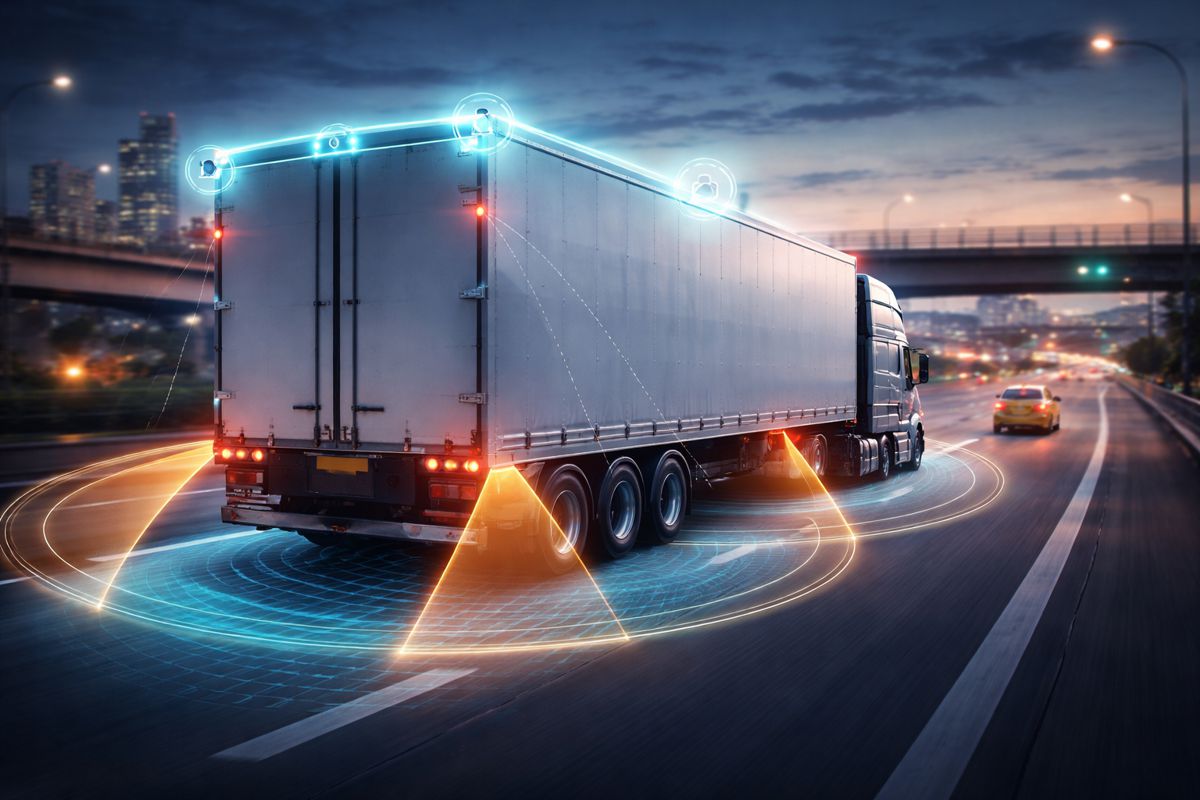
Visibility remains one of the most critical factors in heavy vehicle safety, and Hyundai Translead’s Trailer Blind Spot Monitoring system addresses this head-on. By detecting vehicles in areas that are typically obscured from the driver’s view, the system provides real-time alerts during lane changes and low-speed manoeuvres.
This capability is especially important in urban and peri-urban environments, where cyclists, pedestrians, and smaller vehicles frequently occupy blind spots. European regulations, such as the General Safety Regulation (GSR), have already begun mandating advanced safety features for heavy vehicles, including blind spot detection systems. While these regulations primarily target trucks, extending similar capabilities to trailers enhances overall system effectiveness.
The decision to design the system as a standalone solution again reflects an understanding of fleet realities. Operators are not required to overhaul their existing tractors, reducing both cost and complexity. Instead, the intelligence resides within the trailer, ensuring consistent functionality regardless of the tractor it is paired with.
HT LinkVue+ Brings AI into Everyday Fleet Operations
While HT ReadyVue and Blind Spot Monitoring address specific operational challenges, HT LinkVue+ represents a broader leap into AI-enabled trailer intelligence. Building on the foundation of Hyundai Translead’s existing 360-degree camera system, the enhanced platform introduces a range of features designed to provide deeper insights and improved situational awareness.
At the core of HT LinkVue+ is the integration of artificial intelligence to interpret visual data in real time. Moving Object Detection, for instance, identifies and tracks objects around the trailer, offering alerts that support safer manoeuvring and heightened driver awareness. This is particularly valuable in congested environments such as distribution centres, ports, and urban delivery zones, where multiple moving elements create complex risk scenarios.
Equally significant is the inclusion of Object Height Detection. Infrastructure constraints such as low bridges, overhead structures, and loading bays continue to pose risks for high-profile vehicles. By identifying potential height restrictions, the system helps drivers avoid costly and potentially dangerous collisions. This aligns with broader infrastructure safety initiatives, where preventing bridge strikes has become a priority for road authorities worldwide.
The addition of an interior cargo camera further extends the system’s capabilities. By providing visual confirmation of cargo status, fleets gain an additional layer of accountability and operational reassurance. In sectors such as cold chain logistics or high-value goods transport, this visibility can play a crucial role in maintaining compliance and customer trust.
Integrating with the Wider Fleet Technology Ecosystem
Technology in isolation rarely delivers its full potential. Recognising this, Hyundai Translead has focused on integrating its trailer intelligence systems with established fleet management platforms. Partnerships with Lytx, Netradyne, Platform Science, and Samsara enable data from HT LinkVue to be incorporated into existing operational workflows.
This approach reflects a broader industry trend towards interoperability. Fleets are increasingly seeking solutions that complement, rather than replace, their existing systems. By enabling seamless integration, Hyundai Translead is positioning its technologies as an extension of the fleet’s digital ecosystem rather than a standalone add-on.
“With Hyundai Translead’s ever increasing capabilities, our customer driven portfolio continues to grow with a focus on creating real, observable value for fleets,” said James Oh, Director of Technology & Solutions Development at Hyundai Translead. “These latest offerings solve real-world problems in a very visible way for our customers. As with our other solutions, these are all designed to work with existing and new trailers.”
“Our partnerships with leading fleet technology platforms are a critical part of this evolution,” said Cory Bogler, Senior Lead Technical Account Executive at Hyundai Translead. “By integrating HT LinkVue with the systems fleets already rely on, we’re helping extend capabilities across their operations.”
From Passive Assets to Intelligent Infrastructure
The implications of these developments extend beyond individual fleets. As trailers become more intelligent, they effectively form part of a broader connected transport infrastructure. Data generated at the trailer level can contribute to traffic management systems, safety analytics, and even infrastructure planning.
This evolution aligns with the wider push towards smart mobility and intelligent transport systems. Governments and industry stakeholders are investing heavily in digital infrastructure, from connected highways to autonomous vehicle ecosystems. In this context, trailers equipped with advanced monitoring and AI capabilities become valuable data nodes within a larger network.
Moreover, as sustainability becomes an increasingly important consideration, operational efficiency gains from improved visibility and reduced incidents can contribute to lower emissions. Avoiding unnecessary tyre damage, reducing collisions, and optimising routes all play a role in minimising the environmental footprint of logistics operations.
Strengthening Hyundai Translead’s Position in a Changing Market
Founded in 1989 and headquartered in San Diego, Hyundai Translead has established itself as a leading manufacturer of van trailers in North America. As a subsidiary of Hyundai Motor Company, it benefits from access to advanced engineering capabilities and a broader vision that spans both manufacturing and mobility solutions.
The company’s involvement in distributing hydrogen-powered XCIENT Fuel Cell trucks further underscores its commitment to future-focused transport solutions. By combining hardware innovation with intelligent software systems, Hyundai Translead is positioning itself at the intersection of manufacturing, digital technology, and sustainable mobility.
In a market where differentiation is increasingly driven by technology rather than hardware alone, this strategy could prove decisive. Fleets are no longer simply purchasing trailers; they are investing in integrated solutions that enhance safety, efficiency, and operational insight.
A Practical Step Towards Smarter Freight Networks
Hyundai Translead’s latest technology portfolio does not attempt to reinvent logistics overnight. Instead, it focuses on practical, scalable solutions that address everyday challenges faced by fleets. By embedding intelligence into the trailer, the company is helping to close a long-standing gap in the transport ecosystem.
As the industry continues to evolve, the role of the trailer is likely to become more prominent. No longer just a passive component, it is emerging as an active contributor to safety, efficiency, and data-driven decision-making. In that sense, Hyundai Translead’s latest developments are not just product launches. They are a reflection of where the industry is heading.