Rewiring Urban Mobility with AI Powered Infrastructure Intelligence
Urban mobility is approaching a tipping point. Cities are expanding, traffic volumes are rising, and road networks are being asked to accommodate an increasingly complex mix of vehicles, cyclists, pedestrians, and micromobility users.
The introduction of Aeva’s CityOS platform signals a meaningful shift in how transport infrastructure is monitored, managed, and ultimately optimised.
Rather than relying on fragmented data sources or reactive systems, CityOS positions itself as a real-time intelligence layer embedded directly into the road network. Built on NVIDIA’s AGX Orin computing platform, the system combines high-resolution 4D LiDAR sensing with edge-based artificial intelligence, offering continuous situational awareness at intersections and across corridors. The result is a move away from passive infrastructure towards a responsive, data-driven mobility ecosystem.
This matters because traditional approaches are increasingly falling short. With congestion costing economies billions annually and road safety remaining a persistent global challenge, the ability to understand traffic dynamics in real time is no longer a luxury. It is becoming a fundamental requirement for cities seeking to meet sustainability targets, reduce fatalities, and improve network efficiency.
Moving Beyond the Limits of Legacy Traffic Systems
For decades, intelligent transportation systems have relied on a mix of cameras, radar, and inductive loop sensors embedded in the road surface. While these technologies have served a purpose, they come with inherent limitations. Cameras depend heavily on lighting conditions, radar lacks detailed spatial resolution, and loop detectors provide only binary information about vehicle presence within fixed zones.
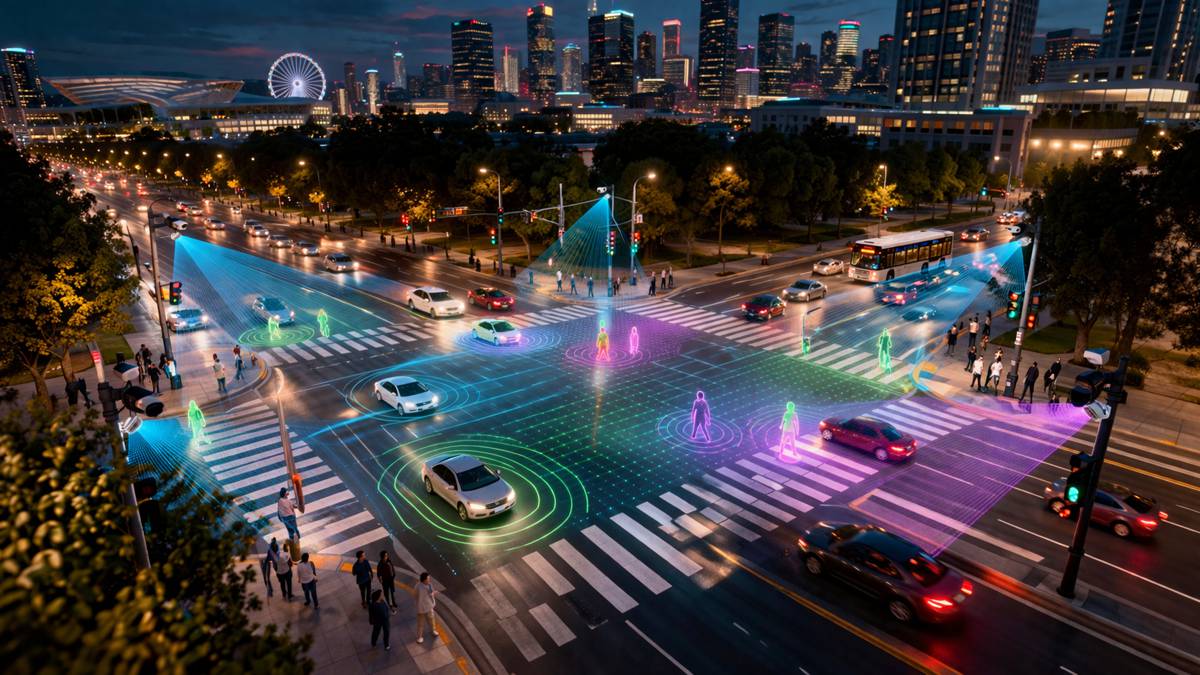
CityOS introduces a different architectural approach. By deploying Aeva’s Atlas Orion 4D LiDAR sensors at intersections, the platform captures both the position and velocity of objects simultaneously, delivering a far richer understanding of how road users behave. This is not just about detecting vehicles but about interpreting movement patterns, trajectories, and interactions in real time.
Such granularity opens the door to a more nuanced form of traffic management. Instead of reacting to congestion after it occurs, systems can anticipate bottlenecks, identify risky behaviours, and adjust traffic signals dynamically. It also enables a level of coverage that extends beyond traditional detection zones, providing a full picture of intersection activity rather than isolated data points.
Importantly, this shift aligns with broader industry trends. Cities worldwide are investing in digital twins, connected infrastructure, and data-driven planning tools. High-fidelity perception systems such as 4D LiDAR are becoming a cornerstone of these initiatives, offering the accuracy and reliability needed to support next-generation transport strategies.
Real Time Intelligence at the Edge
One of the defining features of CityOS is its reliance on edge computing. By processing data locally using NVIDIA’s AGX Orin platform, the system avoids the latency and bandwidth constraints associated with cloud-based architectures. This enables near-instantaneous decision-making, which is critical for applications such as traffic signal optimisation and safety alerts.
Edge processing also enhances resilience. In scenarios where connectivity is limited or disrupted, the system continues to operate independently, ensuring uninterrupted monitoring and analysis. This is particularly relevant for cities with ageing infrastructure or those operating in environments where network reliability cannot be guaranteed.
The integration of AI-powered perception software further strengthens the platform’s capabilities. By continuously classifying and tracking road users, the system can generate actionable insights for traffic engineers and operators. These insights are delivered through dashboards, alerts, and reporting tools, transforming raw sensor data into meaningful intelligence.
Applications range from real-time traffic flow monitoring to more advanced use cases such as near-miss detection and conflict analysis. These capabilities are increasingly important as cities adopt Vision Zero policies aimed at eliminating traffic fatalities. By identifying potential hazards before they result in accidents, systems like CityOS offer a proactive approach to road safety.
Enhancing Safety in a Multimodal World
The rise of multimodal transport is reshaping urban mobility. E-scooters, bicycles, buses, and autonomous vehicles are sharing the same road space, often leading to unpredictable interactions. Managing this complexity requires a level of visibility that traditional systems simply cannot provide.
CityOS addresses this challenge by delivering continuous, high-resolution perception of all road users. This includes vulnerable groups such as pedestrians and cyclists, whose safety is a growing concern in urban environments. By tracking movement trajectories and identifying potential conflicts, the system enables targeted interventions that can reduce the likelihood of collisions.
This capability is particularly relevant in the context of Vision Zero initiatives, which are being adopted by cities across Europe, North America, and Asia. These programmes aim to eliminate road deaths through a combination of infrastructure design, policy measures, and technology. High-precision sensing platforms play a crucial role in achieving these goals by providing the data needed to inform decision-making.
Moreover, the privacy-by-design approach of LiDAR-based systems offers a significant advantage over camera-based solutions. By avoiding the capture of personally identifiable information, CityOS addresses growing concerns around data privacy while still delivering detailed insights into traffic behaviour.
Driving Efficiency Through Data Driven Traffic Management
Beyond safety, efficiency remains a central concern for transport authorities. Congestion not only affects travel times but also contributes to increased emissions and economic losses. According to various transport studies, urban congestion costs can account for a significant percentage of GDP in major cities, underscoring the need for more effective traffic management solutions.
CityOS enables a shift from static signal timing to adaptive, real-time optimisation. By analysing traffic flow continuously, the system can adjust signal phases dynamically to reduce delays and improve throughput. This is particularly valuable in high-density urban areas where traffic patterns can change rapidly throughout the day.
The platform also supports long-term planning by providing detailed analytics on traffic trends, intersection performance, and road usage. These insights can inform infrastructure investments, helping cities prioritise projects that deliver the greatest impact. In an era of constrained budgets, the ability to make data-driven decisions is becoming increasingly important.
Additionally, the system’s compatibility with future vehicle-to-everything communication frameworks positions it as a building block for connected and autonomous mobility. As vehicles become more intelligent and interconnected, infrastructure will need to play an active role in facilitating safe and efficient interactions.
A Scalable Foundation for Smart Cities
Scalability is often a stumbling block for smart city initiatives. Pilot projects may demonstrate potential, but scaling solutions across an entire network can prove challenging. CityOS has been designed with this in mind, offering a modular platform that can be deployed across individual intersections, corridors, or entire transportation networks.
This flexibility allows cities to adopt the technology incrementally, starting with high-priority locations and expanding over time. It also enables integration with existing infrastructure, reducing the need for costly replacements. By enhancing rather than replacing legacy systems, CityOS provides a more practical pathway to modernisation.
The broader implications extend beyond traffic management. As cities continue to digitise their infrastructure, platforms like CityOS could serve as a foundation for a wide range of applications, from environmental monitoring to emergency response coordination. The convergence of sensing, AI, and connectivity is creating new opportunities to improve urban living conditions and support sustainable growth.
Infrastructure That Thinks and Responds
What sets CityOS apart is not just the technology itself but the philosophy behind it. The platform reflects a shift towards infrastructure that is not only connected but also intelligent and responsive. By embedding perception and analytics directly into the road network, cities gain the ability to understand and influence mobility in ways that were previously impossible.
This approach aligns with the broader evolution of infrastructure as a service. Roads, bridges, and intersections are no longer static assets but dynamic systems that generate and act on data. For policymakers and investors, this represents both a challenge and an opportunity. The challenge lies in adapting to new models of infrastructure delivery, while the opportunity lies in unlocking new value through improved efficiency, safety, and sustainability.
As urbanisation continues to accelerate, the need for smarter infrastructure will only grow. Platforms like CityOS offer a glimpse into what the future of mobility could look like, where data-driven insights enable cities to operate more effectively and respond to changing conditions in real time.