Bellevue’s Floating Rail Breakthrough Reshapes Regional Mobility
The opening of Sound Transit’s Crosslake Connection marks a decisive shift in how people move across the Puget Sound region, placing Bellevue at the centre of a newly integrated, low-carbon transport network. For the first time, a continuous light rail journey links Bellevue directly with Seattle, extending onward to Seattle-Tacoma International Airport and key economic and cultural districts across the metropolitan area.
This is not merely a transport upgrade. It is a structural change in regional accessibility, with implications for urban development, tourism flows, and commuter behaviour. By eliminating the need for car travel between major hubs, the system addresses long-standing congestion challenges across Lake Washington while aligning with broader decarbonisation targets set across Washington State and the wider United States infrastructure sector.
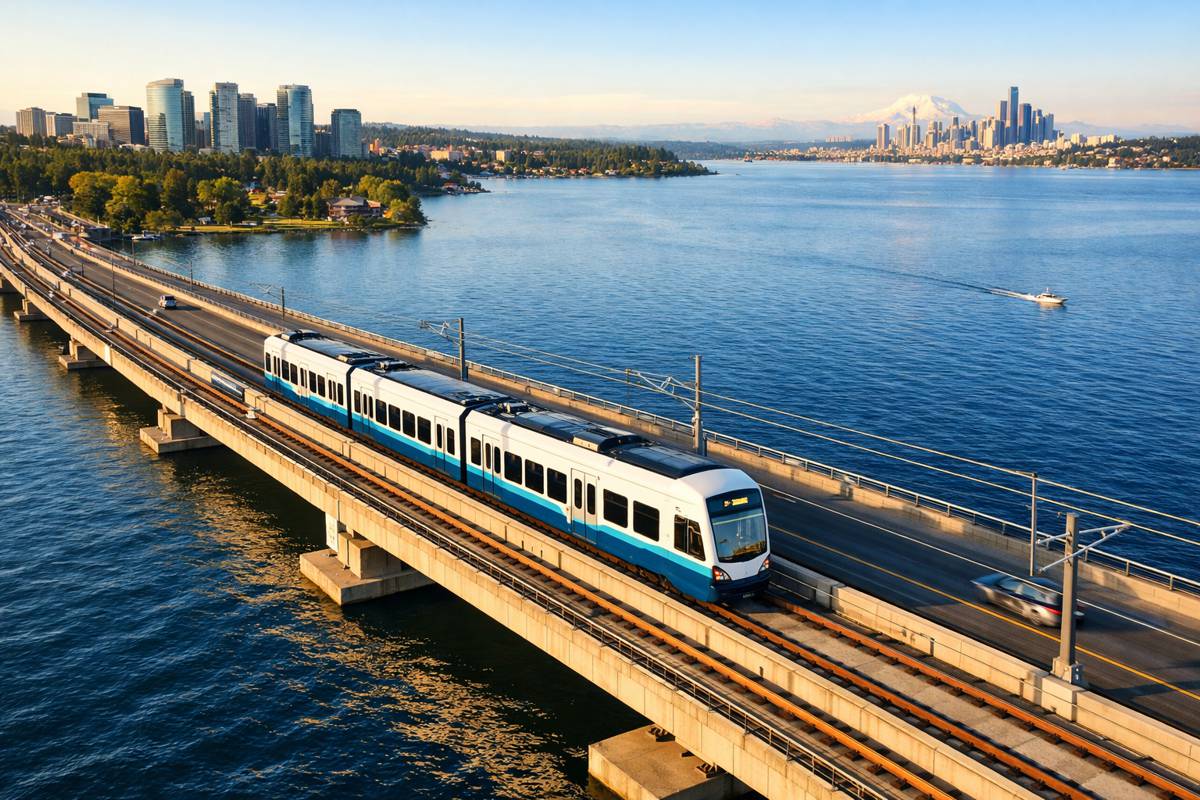
At the centre of the project is a world-first engineering milestone. Light rail trains now operate across the Lacey V. Murrow Memorial Bridge, a floating structure that forms part of the Interstate 90 corridor. This innovation alone elevates the project from a regional transit scheme to a globally relevant case study in infrastructure design and resilience.
“This is a game changer for how people access and experience Bellevue and our region,” said Brad Jones, Executive Director of Visit Bellevue. “Bellevue is now one of the region’s most convenient hubs, offering seamless, car-free connections to the airport, our sports stadiums, major attractions, and employment centers. Whether visiting or working, Bellevue is one of the easiest places to stay connected across all of the Puget Sound and Pacific Northwest.”
Briefing
- Direct light rail connection now links Bellevue, Seattle and SEA Airport
- First-ever light rail system operating across a floating bridge
- Capacity of up to 16,000 passengers per hour across Lake Washington
- Supports low-carbon, car-free regional mobility and tourism growth
- Positions Bellevue as a strategic base for major events including FIFA World Cup 2026
A New Spine for Regional Connectivity
The Crosslake Connection fundamentally reshapes travel patterns across the Puget Sound region. Historically, movement between Bellevue and Seattle has relied heavily on road-based infrastructure, with the Interstate 90 corridor frequently operating at or beyond capacity during peak periods. By introducing high-frequency rail service, Sound Transit has created a parallel mobility corridor that removes pressure from congested highways while offering predictable journey times.
This shift matters for more than commuters. For investors and policymakers, the integration of Bellevue into a seamless rail network enhances its attractiveness as a business hub. Reliable access to Seattle’s financial districts, technology clusters, and port infrastructure reduces friction in labour mobility and strengthens regional economic cohesion. In practical terms, the ability to move between employment centres, airports, and residential zones without reliance on private vehicles signals a maturing metropolitan transport system.
At the same time, the connection opens new opportunities for transit-oriented development. With stations acting as anchors for mixed-use growth, Bellevue’s urban core stands to benefit from increased footfall, higher land values, and a more vibrant commercial environment. Such outcomes mirror patterns seen in other global cities where high-capacity rail has catalysed densification and long-term economic uplift.
Engineering a Railway on Water
Delivering rail infrastructure across a floating bridge presents a unique set of engineering challenges. Unlike fixed structures, floating bridges are subject to continuous movement caused by wind, water currents, and changing loads. Designing a rail system capable of maintaining alignment and passenger comfort under these conditions required extensive modelling, testing, and innovation.
Engineers working on the Interstate 90 alignment developed specialised track bridge technology capable of adapting to the bridge’s natural motion. This includes flexible track systems, expansion joints, and structural interfaces that absorb movement while maintaining precise rail geometry. Tens of thousands of engineering hours were invested to ensure operational safety, reliability, and longevity under variable environmental conditions.
The result is a system capable of transporting up to 16,000 passengers per hour across Lake Washington, placing it firmly within the category of high-capacity urban transit. From a global perspective, the successful integration of rail on a floating structure provides a reference point for other regions facing similar geographic constraints, particularly where deep-water crossings or seismic considerations limit conventional bridge design.
Decarbonising Regional Mobility
The Crosslake Connection arrives at a time when cities worldwide are under increasing pressure to reduce transport-related emissions. In the United States, transportation remains one of the largest contributors to greenhouse gas output, making modal shifts toward electrified public transport a policy priority.
By offering a carbon-free alternative to car travel, the new light rail line directly contributes to emissions reduction across the Puget Sound region. Electrified rail systems typically produce significantly lower lifecycle emissions compared to internal combustion vehicles, particularly when powered by increasingly renewable energy grids, as is the case in Washington State.
Bellevue has positioned itself to complement this transition. The city’s broader mobility ecosystem includes bike-friendly infrastructure, walkable neighbourhoods, and initiatives such as BellHop, an all-electric shuttle service that connects key destinations with rail stations. Together, these elements create an integrated transport network that supports first-mile and last-mile connectivity, often cited as a critical barrier to public transport adoption.
From a policy standpoint, this integrated approach demonstrates how infrastructure investment must extend beyond core assets. Rail alone does not guarantee modal shift. It is the combination of accessibility, convenience, and urban design that ultimately determines whether users abandon private vehicles in favour of public transport.
Supporting Global Events and Visitor Economies
The timing of the Crosslake Connection aligns with growing international attention on the region, particularly as the United States prepares to host matches during the FIFA World Cup 2026. Major events of this scale place extraordinary pressure on transport networks, requiring efficient, high-capacity systems capable of handling surges in demand.
Direct rail access between Bellevue and Seattle’s stadium district, including venues such as Lumen Field and T-Mobile Park, reduces reliance on road transport during peak event periods. This is particularly significant in a region where event-day congestion has historically been a limiting factor for visitor experience.
For the hospitality sector, Bellevue emerges as a strategic alternative to central Seattle accommodation. With a walkable urban core, extensive green space, and now direct rail connectivity, it offers a different proposition for international visitors seeking both accessibility and a less congested environment. This redistribution of visitor flows can ease pressure on central districts while spreading economic benefits more evenly across the region.
Urban Identity Meets Infrastructure Investment
Beyond transport, the project reinforces Bellevue’s positioning as a “City in a Park”, characterised by extensive green space and waterfront access. While such branding may appear peripheral to infrastructure discussions, it plays a tangible role in shaping urban attractiveness and liveability metrics.
Cities that combine high-quality transport with accessible public space tend to perform well in global rankings for quality of life, investment appeal, and talent retention. Bellevue’s more than 100 parks, 14 miles of waterfront, and thousands of acres of open space contribute to a balanced urban environment that supports both economic activity and wellbeing.
Recognition such as the 2026 Good Housekeeping Travel Awards reflects this dual identity. However, the underlying driver is not branding alone but the alignment of infrastructure, planning, and environmental policy. The Crosslake Connection strengthens this alignment by ensuring that accessibility improvements do not come at the expense of sustainability goals.
From Infrastructure to Experience
Looking ahead, the Crosslake Connection is expected to influence not only how people move but how they experience the region. Initiatives such as the Light Rail Discovery Trail aim to transform transit corridors into curated visitor journeys, linking neighbourhoods, businesses, and cultural attractions along the route.
There is also scope for integrating digital storytelling into the passenger experience. Concepts such as audio-guided journeys across Lake Washington could provide context on the engineering achievement behind the floating bridge, turning a routine commute into an educational and engaging experience. Such approaches reflect a broader trend in infrastructure, where user experience is increasingly considered alongside technical performance.
For infrastructure professionals, this signals a subtle but important shift. Transport systems are no longer judged solely on capacity and efficiency. They are also evaluated on how they contribute to place-making, tourism, and broader economic narratives.
A Blueprint for Future Infrastructure
The Crosslake Connection stands as more than a regional milestone. It offers a blueprint for how cities can integrate engineering innovation, sustainability, and economic strategy into a single infrastructure investment.
By combining a technically complex solution, namely rail on a floating bridge, with a clear focus on user experience and environmental impact, the project demonstrates what can be achieved when infrastructure planning is approached holistically. It reinforces the idea that transport systems are not isolated assets but foundational components of urban ecosystems.
For global construction and infrastructure stakeholders, the lessons are clear. Ambitious engineering can unlock new possibilities where traditional approaches fall short. Yet success depends on aligning that innovation with broader policy objectives, urban planning frameworks, and user needs. In Bellevue and the wider Puget Sound region, that alignment is now visible in motion, quite literally, across the waters of Lake Washington.