Turning Marine Mud into a Low Carbon Construction Resource
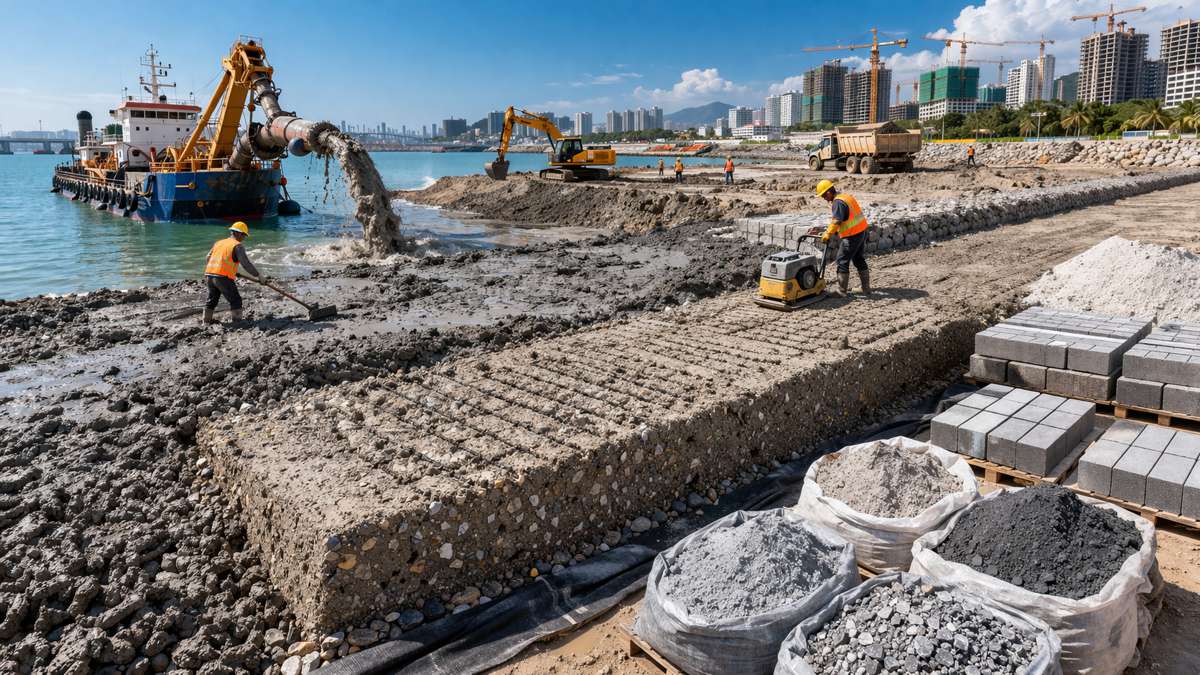
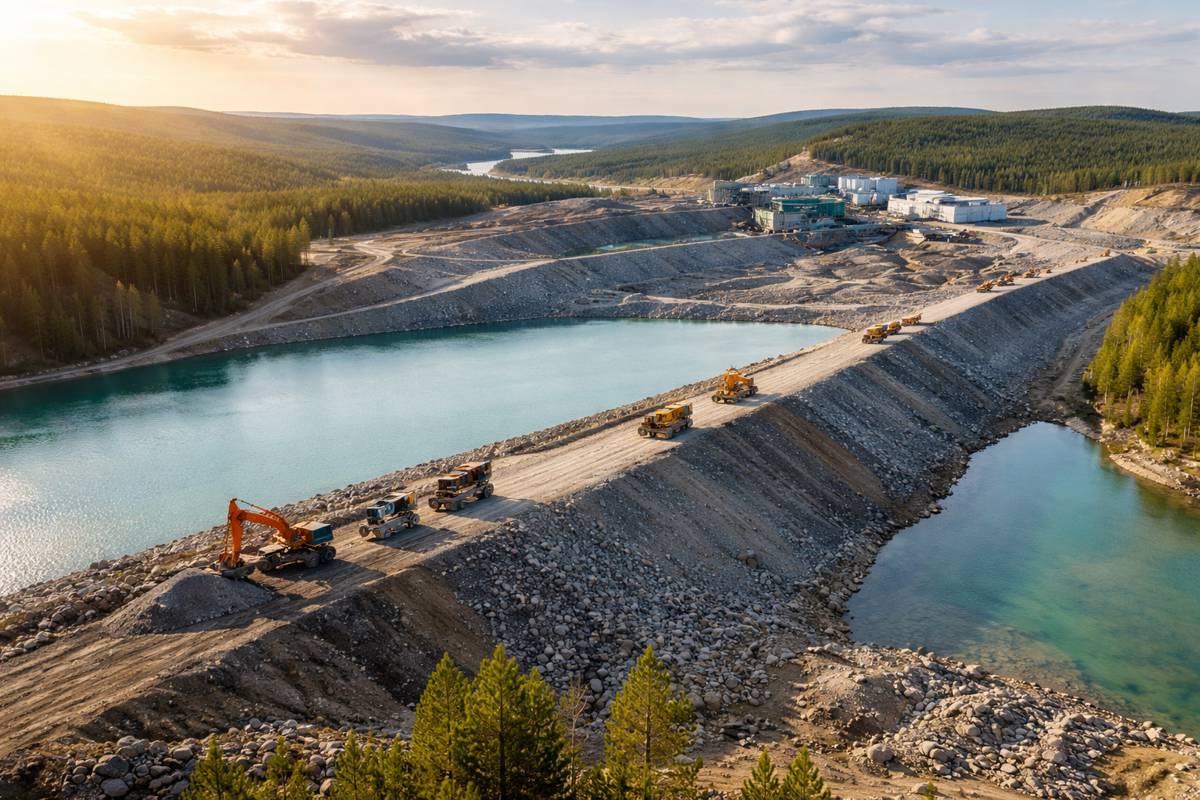
Coastal construction has always come with a hidden by-product: vast quantities of dredged marine mud. From port expansions to land reclamation schemes, this sediment accumulates quickly, and disposing of it has become a growing logistical and environmental challenge. In fast-developing coastal regions, the problem is particularly acute. Marine mud is not only waterlogged and difficult to transport, but it frequently carries contaminants such as arsenic, cadmium, chromium and lead, making safe handling even more complex.
Traditionally, stabilising this material has meant relying heavily on Portland cement. While effective in improving strength and usability, cement-based treatment comes at a cost. It is energy-intensive, carbon-heavy, and increasingly out of step with global decarbonisation targets in construction. Alternative geopolymer solutions have been explored, yet many depend on expensive or corrosive chemical activators and struggle to consistently lock in contaminants. The sector has been left searching for something more practical: a solution that balances performance, safety, cost and environmental impact.
New research published in ENGINEERING Environment highlights a shift in thinking. A collaboration between the Harbin Institute of Technology, Tsinghua University Shenzhen International Graduate School, the University of Abomey-Calavi and the Beninese Office for Geological and Mining Research demonstrates that contaminated marine mud can be treated and reused directly on-site using low-carbon mineral formulations. Rather than treating the material as waste, the study reframes it as a viable construction resource.
Briefing
- Marine mud from coastal construction can be stabilised and reused as engineered backfill
- Low-carbon formulations using fly ash, slag and minimal cement achieved strong performance
- Heavy metal leaching was significantly reduced, with lead fully immobilised in all mixes
- Optimised mixtures exceeded strength thresholds required for construction backfill
- In-situ reuse reduces transport, landfill dependency and overall project emissions
Rethinking Waste as a Construction Asset
The study addresses a longstanding inefficiency in infrastructure delivery. Marine mud has typically been excavated, transported, treated off-site or disposed of in landfills, all of which adds cost, carbon emissions and project delays. By contrast, in-situ treatment offers a way to convert a problematic by-product into a functional material within the same project footprint.
This shift is more than a technical improvement. It reflects a broader move towards circular construction practices, where waste streams are repurposed rather than discarded. Across Europe and Asia, regulators and project owners are already pushing for reduced landfill use and lower embodied carbon in infrastructure. Materials that can be reused on-site without extensive processing are becoming increasingly valuable.
In that sense, the research aligns with global efforts to reduce dependence on virgin aggregates and minimise construction waste. River sand, for example, remains one of the most heavily extracted natural resources worldwide, with environmental consequences ranging from riverbank erosion to ecosystem disruption. Substituting even a portion of that demand with treated marine sediment could have meaningful environmental benefits.
Engineering a Practical Treatment Approach
Rather than focusing purely on laboratory optimisation, the research team structured their work around real-world construction conditions. Marine mud samples were collected from a construction site in Macao, ensuring that the material reflected the complexities encountered in active projects.
The treatment process combined several widely available materials: Portland cement, fly ash, ground granulated blast furnace slag, river sand, water and low-concentration sodium hydroxide. Each component played a role in balancing strength, workability and contaminant control. Importantly, the use of low-concentration NaOH avoided the safety and handling concerns associated with stronger alkaline activators often used in geopolymer systems.
This pragmatic approach stands out. Many alternative binders perform well in controlled environments but struggle to translate into large-scale construction settings due to cost, complexity or safety risks. By contrast, the materials used in this study are already familiar to contractors and readily available in most markets.
The staged methodology allowed the team to refine mix designs while assessing both mechanical and environmental performance. Samples were prepared, cured and subjected to a range of tests, including compressive strength, unconfined compressive strength and leaching toxicity. Advanced analytical techniques such as X-ray fluorescence, X-ray diffraction, scanning electron microscopy and transmission electron microscopy provided insight into the material’s internal structure.
Strength Performance Meets Construction Requirements
One of the key barriers to reusing marine mud has always been strength. For backfill applications, materials must meet minimum performance thresholds to ensure stability and long-term durability. The study’s results suggest that this barrier can be overcome with carefully designed formulations.
Optimised mixtures delivered unconfined compressive strength values well above the 1 MPa benchmark typically required for backfill use. Slag-based mixes achieved the highest performance at 8.69 MPa, while Portland cement blends reached 7.75 MPa. Fly ash and river sand formulations also exceeded the required threshold, demonstrating that multiple pathways exist depending on local material availability.
These results matter because they provide flexibility. Contractors can adjust formulations based on cost, supply chains and environmental considerations without compromising structural performance. In regions where industrial by-products such as fly ash or slag are readily available, reliance on cement can be reduced further, lowering overall emissions.
From a project delivery perspective, achieving consistent strength using locally sourced materials simplifies logistics and reduces dependency on imported construction inputs. That, in turn, can help stabilise costs and improve resilience in supply chains.
Contaminant Immobilisation and Environmental Safety
Strength alone is not enough. Marine mud often contains heavy metals that pose environmental and health risks if released into surrounding soil or groundwater. Effective stabilisation must therefore address both mechanical and chemical performance.
The study found that the treatment significantly reduced the leaching of arsenic, barium, cadmium, chromium and lead. Notably, lead was completely immobilised across all tested mixtures. This level of contaminant control is critical for regulatory compliance and long-term environmental protection.
Microstructural analysis revealed the mechanisms behind this performance. The formation of mineral and gel phases, including silica-rich compounds and complex silicate structures, created a dense matrix that physically encapsulated contaminants while also enabling chemical binding. The presence of calcium carbonate and mixed metal oxides further contributed to stability.
This dual mechanism, combining physical encapsulation with chemical immobilisation, is particularly important in coastal environments where fluctuating water tables and salinity can challenge material stability. By locking contaminants into stable phases, the treated material becomes safer for use in construction applications.
Lower Carbon Pathways for Coastal Infrastructure
Reducing reliance on Portland cement is central to lowering the carbon footprint of construction. Cement production accounts for a significant share of global CO2 emissions, largely due to the calcination process and energy-intensive manufacturing.
By incorporating industrial by-products such as fly ash and slag, the study demonstrates a pathway to reduce cement content without sacrificing performance. These materials are already widely used in blended cements and concrete, but their application in marine sediment stabilisation opens up new opportunities.
In addition, in-situ reuse eliminates the need for transporting large volumes of waste material to disposal sites. Transport emissions, often overlooked in project carbon calculations, can be substantial, particularly in urban coastal areas where suitable landfill sites may be located far from construction zones.
Taken together, these factors contribute to a more balanced carbon profile. While not eliminating emissions entirely, the approach offers a meaningful reduction compared to conventional treatment and disposal methods.
Scaling the Approach for Global Use
The implications extend beyond a single case study in Macao. Coastal cities worldwide face similar challenges, from sediment management in Southeast Asia to dredging operations in European ports and land reclamation projects in the Middle East.
Adapting the approach to different regions will depend on local material availability and regulatory frameworks. For example, access to fly ash may vary as coal-fired power generation declines in some markets, while slag availability is linked to steel production. Nevertheless, the underlying principle remains applicable: combining locally available materials with simplified activation chemistry to achieve both strength and environmental performance.
There is also potential for integration into broader infrastructure strategies. Treated marine mud could be used not only for backfill but also for site levelling, embankment construction and land restoration. In regions facing land scarcity, the ability to reclaim and reuse material on-site could support more efficient urban expansion.
From Liability to Resource
“This work shows that contaminated marine mud does not have to remain an environmental liability,” the study notes. The statement captures the essence of the shift. Rather than viewing marine sediment as a problem to be managed, it becomes part of the solution.
For construction professionals and policymakers, the message is straightforward. Waste streams are no longer peripheral to project planning. They are central to how infrastructure is designed, delivered and evaluated. Materials that can be reused safely and efficiently will play an increasingly important role in meeting both economic and environmental objectives.
The research does not claim to solve every challenge associated with marine mud. Variability in sediment composition, site conditions and regulatory requirements will continue to shape implementation. Yet it provides a credible, practical framework that can be adapted and refined.
As coastal development continues to accelerate, the pressure on resources and disposal systems will only increase. Solutions that reduce waste, lower emissions and improve material efficiency are not optional. They are becoming part of the baseline expectation for modern infrastructure.