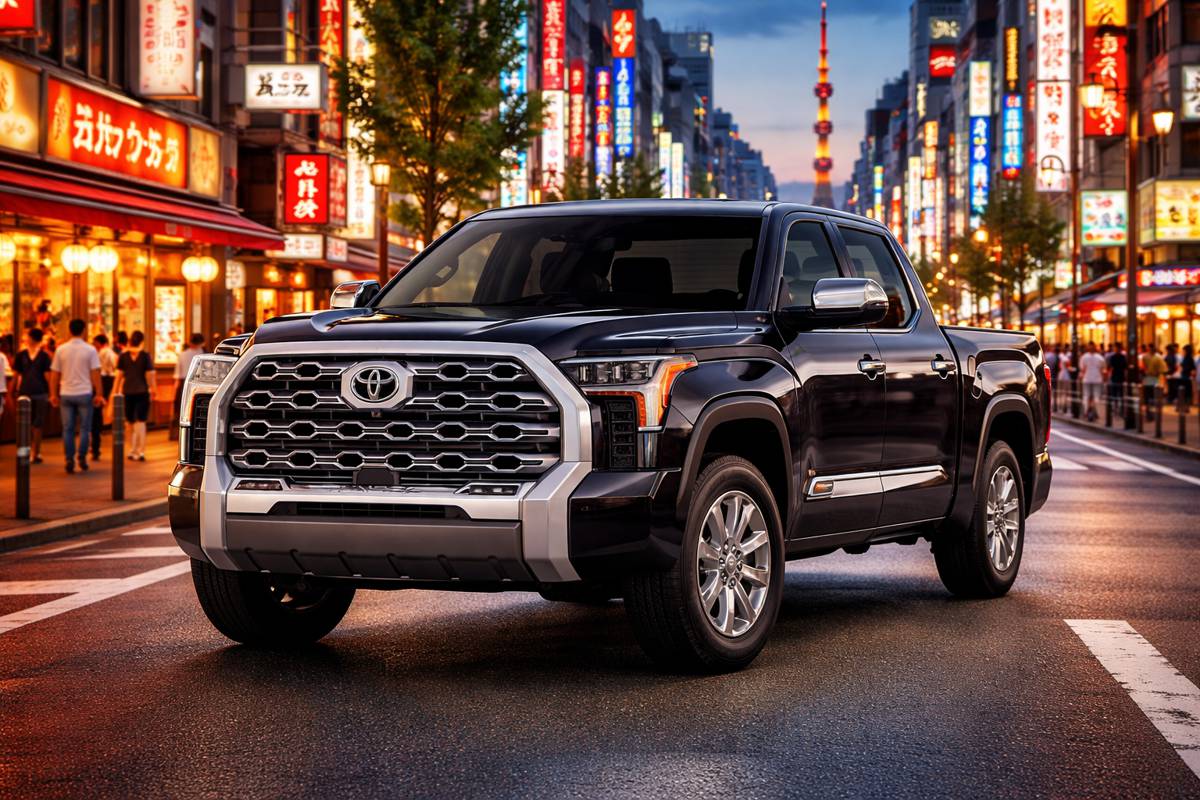
Toyota Opens a New Trade Lane with US Built Vehicles Entering Japan
Toyota’s decision to introduce U.S.-manufactured vehicles into the Japanese domestic market marks a notable shift in how global automotive supply chains are evolving. From April 2026, the company will begin selling the Toyota Tundra pickup and Toyota Highlander SUV in Tokyo, with nationwide availability scheduled for later in the year. While the move may appear modest in volume, its implications stretch well beyond product placement, touching on trade policy, manufacturing strategy and the broader direction of international automotive flows.
At the centre of this development is a newly implemented certification framework agreed between Japan and the United States. The system allows vehicles produced in the U.S. to be sold in Japan without undergoing additional Japan-specific testing, provided they meet defined standards. For manufacturers, this removes a longstanding technical barrier that has historically limited the reverse flow of vehicles into Japan. For policymakers, it signals a tangible outcome from bilateral negotiations aimed at easing automotive trade friction between the two economies.
Toyota has been assessing the viability of this pathway for some time. By selecting the Tundra and Highlander as its first entrants, the company is effectively testing whether vehicles designed primarily for North American consumers can carve out a niche in a market traditionally dominated by compact, domestically tailored models. The inclusion of the Toyota Camry at a later stage suggests a phased approach, balancing commercial caution with strategic ambition.
Briefing
- Toyota will sell U.S.-built Tundra and Highlander models in Japan from April 2026
- A new certification system removes the need for additional Japan-specific testing
- Initial sales begin in Tokyo, with nationwide rollout planned for summer
- The move reflects broader Japan-U.S. trade cooperation and supply chain flexibility
- Limited volumes indicate a strategic market test rather than mass deployment
Trade Policy Meets Industrial Strategy
The automotive sector has long been a focal point in Japan-U.S. trade discussions, often characterised by asymmetrical flows. Japan exports significant volumes of vehicles to the U.S., while American-built models have struggled to gain traction in Japan. Structural factors such as vehicle size preferences, regulatory differences and consumer expectations have all played a role.
This new certification system begins to address one of those structural barriers. By recognising U.S. standards within the Japanese regulatory framework, it reduces duplication in compliance processes. From an industry perspective, that translates into lower costs, shorter lead times and greater flexibility in product allocation. For a global manufacturer like Toyota, which operates extensive production networks across both countries, the ability to redirect vehicles between markets without extensive re-engineering is commercially significant.
It also reflects a broader shift in how automotive supply chains are being configured. Rather than strictly regional production for regional consumption, manufacturers are increasingly seeking to optimise global capacity utilisation. This is particularly relevant as the industry navigates electrification, supply chain disruptions and fluctuating demand patterns across different markets.
Testing Market Appetite in Japan
Japan’s domestic automotive market has historically favoured smaller vehicles, with kei cars and compact models accounting for a substantial share of sales. Larger vehicles, particularly full-size pickups like the Toyota Tundra, occupy a relatively niche segment. That makes Toyota’s decision to introduce such models domestically both unconventional and strategically revealing.
The Tundra, produced at Toyota Motor Manufacturing Texas, represents a distinctly North American interpretation of utility vehicles. Its dimensions alone set it apart from typical Japanese offerings, with a length approaching six metres and a width exceeding two metres. Built on a ladder-frame platform, it is engineered for durability and heavy-duty use, characteristics that resonate strongly in the U.S. but are less commonly prioritised in Japan’s urban environments.
Yet, there are emerging niches where such vehicles may find traction. Outdoor recreation, construction logistics and specialised commercial applications are areas where demand for larger, more capable vehicles has been gradually increasing. In addition, lifestyle-oriented consumers seeking differentiation may also be drawn to vehicles that stand out from the conventional domestic lineup.
The Role of the Highlander in Bridging Markets
If the Tundra represents a bold experiment, the Toyota Highlander offers a more measured entry point. Manufactured at Toyota Motor Manufacturing Indiana, the Highlander occupies a segment that is more aligned with global SUV trends. Its three-row configuration, hybrid powertrain and all-wheel-drive capability position it as a versatile option for families and long-distance travel.
Since its introduction in 2001, the Highlander has achieved cumulative global sales exceeding 3.6 million units, underscoring its established market acceptance. Bringing this model into Japan allows Toyota to leverage that track record while introducing features that are increasingly relevant to domestic consumers, including hybrid efficiency and flexible interior space.
The hybrid system, combining a 2.5-litre engine with an electric motor, delivers a balance between performance and fuel efficiency. With all models equipped with E-Four all-wheel drive, the vehicle is designed to maintain stability across varying road conditions, from urban streets to rural and mountainous terrain. Such capabilities align with Japan’s diverse geography, where driving conditions can change rapidly.
Manufacturing Footprint and Capacity Strategy
The decision to source these vehicles from U.S. plants highlights the importance of Toyota’s North American manufacturing base within its global strategy. Facilities such as Toyota Motor Manufacturing Texas and Toyota Motor Manufacturing Indiana are not only key production hubs for the U.S. market but are now being leveraged to support international distribution.
This approach reflects a broader industry trend towards flexible manufacturing systems capable of serving multiple markets. By exporting vehicles from the U.S. to Japan, Toyota can optimise production volumes at these plants while also testing the viability of cross-market distribution under the new certification regime.
The relatively modest projected sales volumes, 80 units per month for the Tundra and 40 units for the Highlander, suggest a cautious rollout. Rather than pursuing scale from the outset, Toyota appears to be prioritising market feedback, operational learning and regulatory validation. This measured approach reduces risk while providing valuable insights that could inform future expansion.
Pricing, Positioning and Consumer Perception
Pricing for the imported models places them firmly in the premium segment of the Japanese market. The Tundra is positioned at approximately ¥12 million, while the Highlander hybrid variant is priced around ¥8.6 million. These levels reflect not only the vehicles’ size and specifications but also the costs associated with importing and positioning them as distinctive offerings.
For consumers, the appeal may lie less in price competitiveness and more in differentiation. Imported vehicles, particularly those with strong associations to American automotive culture, can carry a certain cachet. At the same time, Toyota’s brand familiarity may help mitigate some of the perceived risks associated with purchasing non-traditional models.
From an infrastructure perspective, the introduction of larger vehicles also raises questions about compatibility with existing urban environments. Parking, road width and fuel consumption considerations all play a role in shaping consumer adoption. These factors will likely influence how widely such models are embraced beyond niche segments.
Implications for the Global Automotive Landscape
Toyota’s move provides a glimpse into how regulatory alignment can unlock new possibilities for global automotive trade. If the certification system proves effective, it could pave the way for a broader range of vehicles to move between markets with fewer barriers. This has implications not only for manufacturers but also for suppliers, logistics providers and policymakers.
In the context of an industry undergoing rapid transformation, flexibility is becoming increasingly valuable. Electrification, digitalisation and shifting consumer preferences are all reshaping demand patterns. The ability to respond quickly by reallocating production across regions can provide a competitive advantage.
Moreover, the initiative underscores the interconnected nature of modern automotive ecosystems. Vehicles produced in one country, designed for another and sold in a third are becoming more common. As regulatory frameworks adapt to this reality, the boundaries between domestic and international markets continue to blur.
A Subtle but Significant Step Forward
Toyota’s introduction of U.S.-built vehicles into Japan may not immediately reshape the domestic market, but it represents a meaningful step in the evolution of global automotive trade. By leveraging a new regulatory pathway, the company is testing the limits of cross-market integration while maintaining a cautious, data-driven approach.
For industry observers, the development offers insight into how trade agreements can translate into tangible operational changes. For competitors, it highlights the potential benefits of aligning production and regulatory strategies across regions. And for policymakers, it serves as a case study in how targeted reforms can facilitate more balanced and efficient trade flows.