Ancient Engineering Shaping Modern Flood Resilience in Asian Cities
Across Asia, cities are facing mounting pressure from intensifying rainfall, ageing drainage systems, and relentless urban expansion. Impervious surfaces are spreading faster than drainage capacity can keep up, while climate variability is pushing storm events beyond the limits of legacy infrastructure. It’s a familiar story from People’s Republic of China to South Asia, where urban flooding is no longer an occasional disruption but an increasingly structural risk to economic stability and public safety.
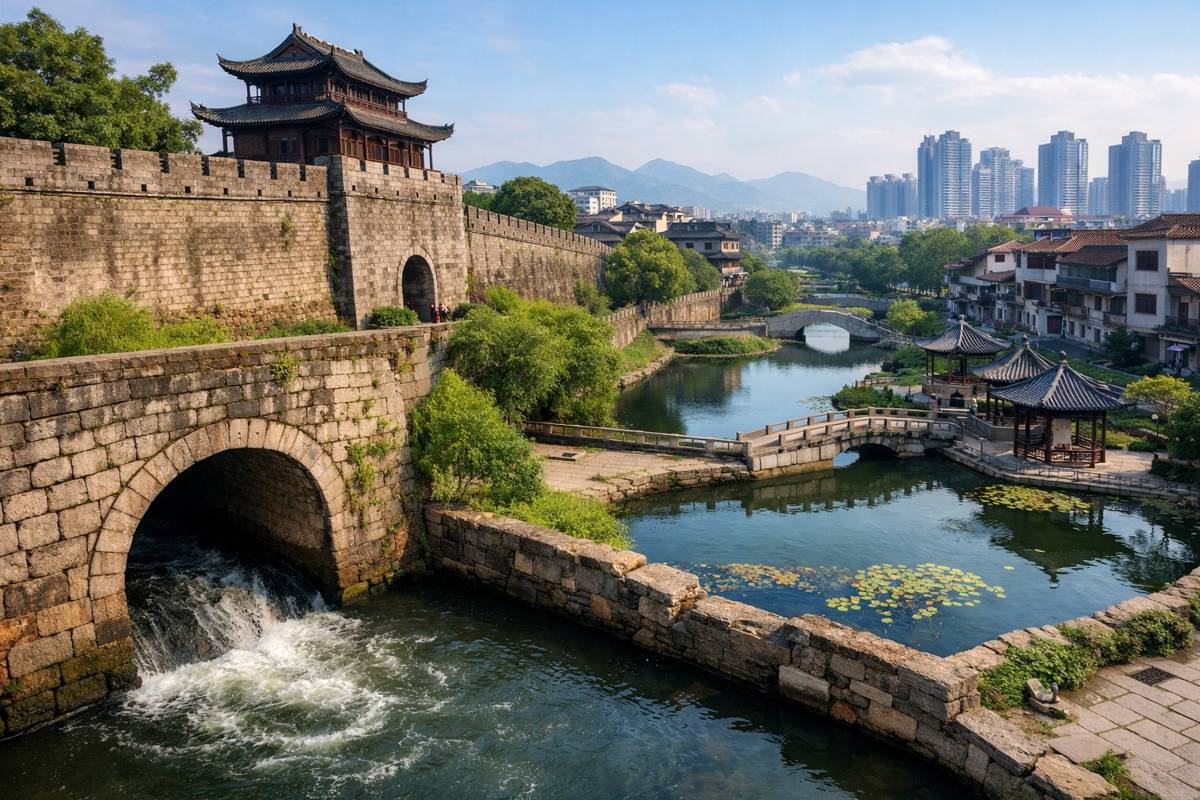
Yet long before contemporary engineering frameworks took shape, the city of Ganzhou developed a remarkably sophisticated response. The Fushougou drainage system, constructed during the Song Dynasty nearly a millennium ago, integrated engineered channels, hydraulic controls, and natural storage into a cohesive urban water network. While detailed performance metrics are scarce, historical continuity suggests a system that delivered practical, long-term resilience. Its design principles now echo strongly in modern approaches such as sponge city planning and nature-based infrastructure.
This article draws on the work of Xiaoyan Yang, Principal Project Officer at the Asian Development Bank, whose research into historical water systems highlights how ancient infrastructure continues to inform modern flood resilience strategies. With nearly two decades of experience across Asia, Yang’s work spans ecological restoration, disaster risk management, and nature-based solutions, bringing a grounded, cross-regional perspective to urban water challenges.
Briefing
- Ancient Fushougou system in Ganzhou demonstrates integrated urban water management dating back nearly 1,000 years
- Gravity-driven drainage and passive hydraulic controls reduced reliance on mechanical systems
- Interconnected ponds functioned as distributed stormwater storage, similar to modern detention systems
- Key design principles align with today’s nature-based solutions and sponge city strategies
- Lessons offer practical insights for resilient, low-maintenance urban infrastructure worldwide
Designing with Nature Rather Than Against It
Ganzhou’s geographical position at the confluence of the Gong and Zhang Rivers has always made it vulnerable to seasonal flooding. With annual rainfall exceeding 1,500 mm and the majority concentrated in a few months, managing runoff has long been critical to the city’s survival. Rather than attempting to overpower nature, the Fushougou system worked with it.
The network was designed around the city’s natural topography, using gravity to drive water flow across roughly 3 square kilometres of urban space. More than 12 kilometres of underground drainage channels were integrated with an 8-kilometre city wall, forming a unified hydraulic system. Historical accounts credit the Northern Song Dynasty engineer Liu Yi with refining the network’s connectivity and capacity, improving its ability to handle both stormwater and river flooding.
What stands out is the system’s holistic approach. Instead of separating drainage, wastewater, and flood control into distinct functions, Fushougou combined them into a single, adaptable network. That level of integration is only now being re-embraced in modern urban planning, particularly in regions adopting nature-based solutions to reduce infrastructure strain.
Engineering Simplicity with Long-Term Performance
The physical infrastructure of Fushougou reveals a clear understanding of hydraulic behaviour. Brick-lined channels, some reaching nearly two metres in height, were constructed to balance durability with flow efficiency. Smaller conduits were capped with stone slabs, creating a layered network capable of handling varying volumes of water.
Depth played a crucial role. Many pipelines were positioned approximately two metres below ground, increasing storage capacity within the system and reducing surface flooding during peak rainfall. At the same time, relatively steep gradients, in some cases exceeding 4%, ensured that water moved quickly enough to prevent sediment build-up.
This self-cleansing characteristic is particularly notable. Modern drainage systems often struggle with maintenance due to sediment accumulation, requiring regular intervention. Fushougou’s design mitigated that issue through velocity management, allowing debris to be naturally flushed through the network. It’s a reminder that durability isn’t just about materials, but about how systems behave over time.
Passive Hydraulic Control Without Energy Demand
One of the system’s most intriguing features lies in its “water windows” positioned along the city wall. These outlets functioned as passive hydraulic regulators, allowing water to discharge when river levels were low while preventing backflow during floods.
Under normal conditions, stormwater would flow outward through the windows into surrounding rivers. As external water levels rose, pressure would force the openings closed, effectively sealing the system against incoming floodwaters. No pumps, no sensors, no manual intervention.
This approach aligns closely with contemporary thinking around resilient infrastructure. Passive systems reduce operational risk, eliminate energy dependency, and provide inherent reliability. In an era where cities are seeking to cut emissions while improving resilience, such principles are gaining renewed attention.
Distributed Storage Through Urban Water Landscapes
Beyond pipes and channels, Fushougou incorporated an extensive network of ponds distributed throughout the city. Historical accounts suggest more than one hundred interconnected water bodies, serving both functional and ecological roles.
These ponds acted as temporary storage basins during heavy rainfall, absorbing excess runoff and reducing peak flow within the drainage network. Water could then be released gradually, moderating downstream flood risk. At the same time, the ponds supported irrigation, aquaculture, and nutrient recycling, forming a closed-loop system that benefited local communities.
From a modern perspective, this resembles decentralised stormwater management, a cornerstone of sponge city design. Rather than relying solely on centralised infrastructure, water is managed across multiple points in the urban landscape. The added benefit is environmental. These systems contribute to biodiversity, improve microclimates, and enhance urban liveability, delivering value far beyond flood control.
Resilience Proven Over Centuries
By the late 1960s, approximately 12.6 kilometres of the Fushougou system remained operational, serving around 100,000 residents in Ganzhou’s historic district. While urban expansion has since reduced the system’s footprint, key elements continue to function today.
Only fragments of the original network remain intact, including sections of drainage channels, two ponds, and two water windows. Even so, their continued operation speaks volumes about the system’s robustness. Infrastructure rarely survives intact for centuries, particularly in rapidly urbanising environments.
Several factors contributed to this longevity. Gravity-driven flow removed reliance on mechanical systems prone to failure. High hydraulic capacity ensured the system could handle extreme conditions. Distributed storage reduced stress on any single component. And perhaps most importantly, the design worked in harmony with natural processes rather than attempting to override them.
Relevance for Today’s Urban Flood Challenges
Modern cities are significantly larger and more complex than ancient Ganzhou, but the underlying challenges remain strikingly similar. Increasing rainfall intensity, ageing infrastructure, and constrained urban space are universal issues. The question is how to respond without escalating costs and complexity.
Fushougou offers a set of principles rather than a blueprint. Integrating natural and engineered systems is one of the most immediate takeaways. Urban planners are increasingly recognising that green infrastructure, such as wetlands, retention basins, and permeable surfaces, can complement traditional drainage systems.
Multifunctionality is another key lesson. Infrastructure that serves multiple purposes delivers greater value and resilience. In Fushougou’s case, the same system supported flood control, agriculture, and urban water management. Today, similar thinking is being applied to projects that combine flood protection with recreation, biodiversity, and climate adaptation.
A Quiet Shift Towards Simpler, Smarter Systems
There’s a growing recognition across the infrastructure sector that complexity isn’t always the answer. Highly engineered systems can deliver impressive performance, but they often come with higher costs, energy demands, and maintenance requirements. In contrast, passive and nature-based solutions offer a different path.
The principles demonstrated in Ganzhou are increasingly reflected in urban policy across Asia. Cities in the People’s Republic of China, for example, have been advancing sponge city initiatives that prioritise infiltration, storage, and reuse of rainwater. Similar approaches are being explored globally, from Europe to Southeast Asia.
What makes Fushougou particularly relevant is its longevity. It wasn’t designed for a single lifecycle or funding cycle. It evolved as part of the city’s fabric, adapting to changing conditions while maintaining core functionality. That’s a quality modern infrastructure often struggles to achieve.
Building Forward by Looking Back
The story of Ganzhou’s ancient drainage system isn’t about nostalgia or romanticising the past. It’s about recognising that some of the most effective solutions are grounded in fundamental principles that transcend time. Gravity, flow, storage, and integration remain as relevant today as they were a thousand years ago.
As cities grapple with the realities of climate change and rapid urbanisation, there’s value in revisiting these principles. Not to replicate ancient systems outright, but to reinterpret them using modern materials, data, and planning frameworks.
Infrastructure, after all, is about continuity. The systems built today will shape cities for generations to come. Fushougou stands as a reminder that when infrastructure is designed with foresight and respect for natural processes, it can endure far longer than expected, quietly doing its job while cities grow and change around it.