Unlocking Electric Transport Across the Silk Road Region
Across the Central Asia region, the transport sector is fast becoming one of the most stubborn sources of emissions. Vehicle ownership is rising sharply, urbanisation is accelerating, and fossil fuel dependency remains deeply embedded in national economies. Left unchecked, this trajectory points to worsening air quality in major cities and a steady climb in greenhouse gas emissions.
The research, published by the Central Asia Regional Economic Cooperation Institute (CAREC) and based on the work of Khalil Raza, presents a clear- assessment of the challenge. Raza, who serves as Programs Manager for Energy and Climate at the ECO Science Foundation, brings a background shaped by work with the World Bank, United Nations Development Programme, and Pakistan’s Planning Commission. His experience in energy transition, industrial decarbonisation, and electric mobility lends weight to the findings, which move well beyond surface-level analysis.
At its core, the study frames electric mobility not as a silver bullet, but as a critical component within a broader systemic shift. Electric vehicles are positioned as a practical pathway to cut emissions and reduce reliance on imported fuels. Yet, the report makes it clear that without structural reforms, policy alignment, and infrastructure investment, adoption will remain patchy and slow.
Briefing
- Electric mobility offers a viable route to reduce emissions and fossil fuel dependence across CAREC countries
- High upfront costs, limited infrastructure, and policy inconsistencies remain major barriers
- Carbon-intensive electricity grids in several countries reduce the climate benefits of EVs
- Policy tools such as subsidies, tax incentives, and import duty waivers are proving effective where implemented
- A wider “avoid-shift-improve” strategy is essential to achieve meaningful decarbonisation
Structural Barriers Holding Back EV Adoption
The transition to electric mobility in Central Asia is not simply a matter of consumer preference or technological readiness. It is shaped by deeper structural constraints that differ markedly from those seen in more mature EV markets.
One of the most pressing challenges is cost. While global battery prices have fallen significantly over the past decade, largely driven by economies of scale and manufacturing advances, these savings have not fully translated into affordability across CAREC countries. The region’s reliance on imported vehicles and components keeps prices elevated, making it difficult for electric vehicles to compete with conventional internal combustion engine models.
This import dependence also limits the development of local supply chains. Without domestic manufacturing or assembly capacity, countries remain exposed to global price fluctuations and supply disruptions. The contrast with the People’s Republic of China is stark. China’s sustained use of subsidies, tax incentives, and industrial policy has driven down costs and accelerated adoption, offering a model that other countries in the region are now examining closely.
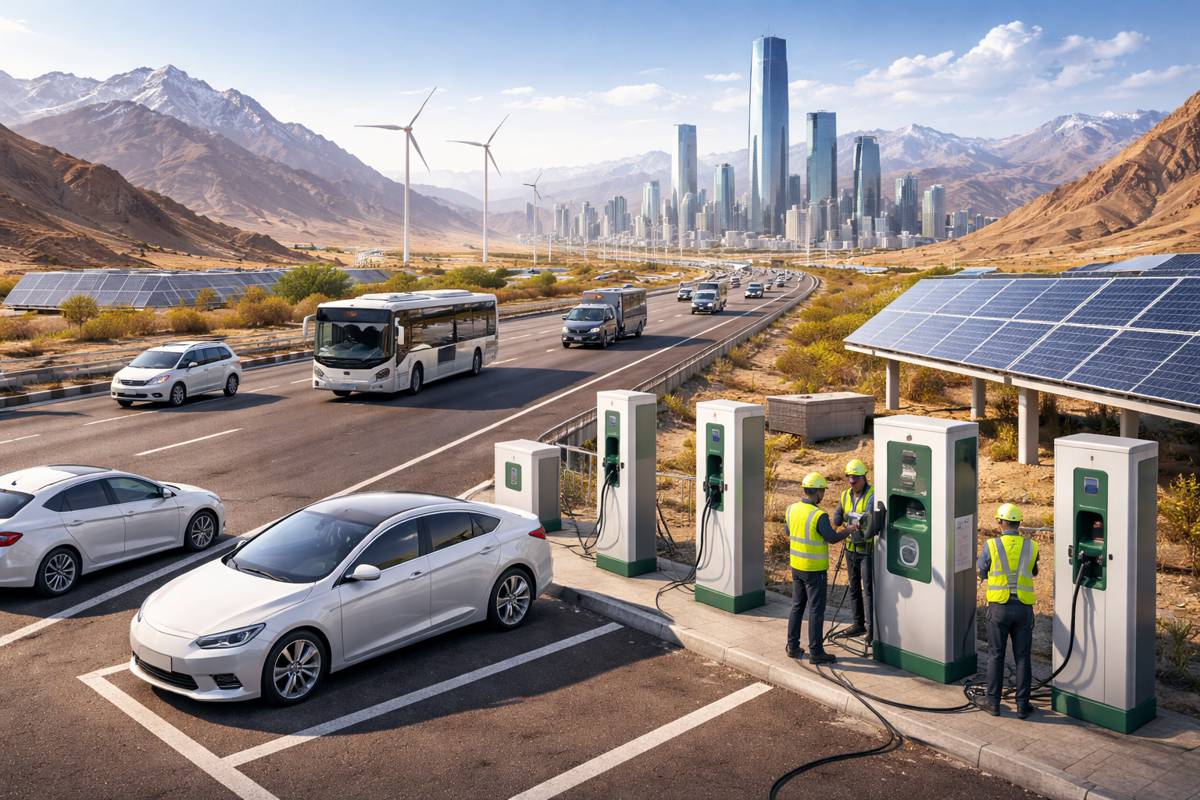
Infrastructure presents another hurdle. Charging networks remain sparse, particularly outside major urban centres. Investors are hesitant to fund infrastructure without sufficient vehicle uptake, while consumers are reluctant to purchase EVs without reliable charging access. This familiar chicken-and-egg dilemma is amplified in smaller markets where returns on investment are less certain.
The Energy Mix Problem and Its Climate Implications
Even where electric vehicles are deployed, their environmental benefits depend heavily on the source of electricity. In several CAREC countries, power generation remains carbon-intensive, dominated by coal and natural gas.
The study highlights a telling example in Turkmenistan, where lifecycle emissions from EVs are only marginally lower than those of conventional vehicles. This finding underscores a critical point often overlooked in public discourse. Electrification alone does not guarantee decarbonisation. Without parallel efforts to clean up the power sector, the climate gains from EV adoption can be limited.
Countries such as Kazakhstan, Mongolia, Turkmenistan, and Uzbekistan face this dual challenge. They must not only expand EV uptake but also accelerate the transition towards renewable energy and cleaner grids. By contrast, nations like Georgia and Tajikistan, with relatively low-carbon electricity systems, are better positioned to realise immediate environmental benefits from electric mobility.
This interplay between transport and energy policy reinforces the need for integrated planning. Treating EV adoption as a standalone initiative risks undermining its effectiveness.
Policy Signals and Market Confidence
Policy consistency, or the lack of it, plays a decisive role in shaping EV markets. The CAREC study finds that countries with clear, long-term policy frameworks tend to see stronger adoption rates and greater investor confidence.
China again provides a benchmark. Its combination of national targets, purchase subsidies, tax incentives, and infrastructure investment has created a stable environment for both consumers and manufacturers. Targets such as achieving 45 percent electric vehicle sales by 2027 and 60 percent by 2030 send a clear signal to the market.
Elsewhere in the region, progress is uneven. Countries including Azerbaijan, Georgia, Pakistan, and Uzbekistan have begun to set national EV targets, signalling intent. However, others, such as Kazakhstan, the Kyrgyz Republic, and Tajikistan, have yet to establish formal goals, leaving a degree of uncertainty that can deter investment.
Import duty waivers and tax exemptions have emerged as relatively effective tools in markets without domestic production. By lowering the upfront cost of vehicles, these measures can stimulate demand and kickstart market development. In parallel, preferential financing schemes, such as low-interest loans, can broaden access to electric vehicles in price-sensitive markets.
Beyond Vehicles A Systemic Approach to Mobility
Perhaps the most important insight from the study is that electric vehicles alone cannot deliver the scale of emissions reduction required. A more comprehensive strategy is needed, one that addresses how people and goods move through cities and across regions.
The report advocates for an “avoid-shift-improve” framework. This approach focuses first on reducing the need for travel through smarter urban planning, then shifting journeys towards more efficient modes such as public transport, and finally improving vehicle technology through electrification and efficiency gains.
Investments in public transport infrastructure, including buses and rail systems, are highlighted as particularly impactful. Electrifying public transport fleets can deliver significant emissions reductions while also improving urban air quality. Similarly, encouraging walking and cycling through better urban design can reduce reliance on private vehicles altogether.
These measures are not new, but their integration with EV policy is often lacking. The CAREC study suggests that aligning these strategies could unlock far greater benefits than pursuing them in isolation.
Financing the Transition and Managing Future Risks
Scaling up electric mobility will require substantial investment, not only in vehicles but also in infrastructure, grid upgrades, and supporting systems. Public funding will play a crucial role in the early stages, particularly in de-risking infrastructure projects and attracting private capital.
Public–private partnerships are identified as a practical mechanism to bridge funding gaps. By sharing risks and returns, these arrangements can accelerate the deployment of charging networks and related infrastructure.
At the same time, the study raises an issue that is only beginning to gain attention globally. The lifecycle of EV batteries presents both a challenge and an opportunity. As batteries reach end-of-life over the next decade, systems for recycling, reuse, and second-life applications will become increasingly important.
Developing these capabilities early could position CAREC countries to capture value from the circular economy while mitigating environmental risks. It also aligns with broader trends in resource efficiency and sustainable industrial development.
A Turning Point for Regional Collaboration
The CAREC framework itself offers a platform for coordinated action. With 11 member countries spanning a diverse range of economic and geographic contexts, the organisation is well placed to facilitate knowledge sharing and policy alignment.
Regional collaboration can help address common challenges, from harmonising standards to developing cross-border infrastructure corridors. It can also support the creation of larger, more integrated markets, making investment more attractive and reducing costs through scale.
The study suggests that such cooperation will be essential in overcoming the structural barriers that individual countries may struggle to address alone. In a region shaped by historic trade routes and growing economic ties, the transition to electric mobility could become a unifying project with far-reaching implications.
Setting the Pace for a Lower Carbon Future
Electric mobility in Central Asia is no longer a distant prospect. It is emerging as a practical necessity driven by environmental pressures, economic considerations, and global technological trends. The CAREC study does not present an easy path forward, but it does offer a roadmap grounded in evidence and regional realities.
Progress will depend on a combination of policy clarity, infrastructure investment, and energy sector reform. It will also require a willingness to rethink mobility systems as a whole, rather than focusing narrowly on vehicle technology.
For governments, investors, and industry stakeholders, the message is straightforward. The transition is underway, but its pace and impact will be determined by the decisions made today. With the right mix of ambition and pragmatism, the region has an opportunity to reshape its transport systems and position itself within the global shift towards low-carbon mobility.