Bruce Highway Safety Push Accelerates With Contract Releases Across Queensland
Australia’s most critical north–south freight artery is entering a decisive phase of investment, with 22 new contracts released to market under the $9 billion Bruce Highway Targeted Safety Program. Stretching across vast sections of Queensland between Gympie and Cairns, the latest procurement wave signals a coordinated push to address long-standing safety risks on one of the country’s most economically vital transport corridors.
For construction firms and infrastructure investors, this is more than another bundle of roadworks. It represents a structured, multi-year pipeline of upgrades aimed squarely at improving road safety outcomes, strengthening freight reliability and unlocking regional economic performance. With procurement now accelerating and delivery mechanisms refined, the programme is shifting from intent to tangible impact.
The Bruce Highway has long been both a lifeline and a liability. Carrying the bulk of Queensland’s freight movements and connecting regional communities over thousands of kilometres, it has also recorded persistent safety challenges due to narrow lanes, ageing pavements and limited overtaking opportunities. These newly released contracts mark a step-change in how those issues are being tackled, with targeted engineering interventions rolled out at scale.
Briefing
- 22 new contracts released under the $9 billion Bruce Highway Targeted Safety Program
- Works span over 100 km of safety treatments and 50 km of pavement upgrades
- Five bridge upgrades planned in North Queensland
- Programme funded on an 80:20 split between federal and state governments
- Contractors to be appointed from April 2026, with construction to follow
A Strategic Infrastructure Programme Gains Momentum
The Bruce Highway Targeted Safety Program is no small undertaking. Backed by an 80:20 funding partnership between the Australian Government and the Queensland Government, the initiative concentrates every dollar of its budget on regional sections of the highway outside the south-east corner. That focus alone sets it apart, redirecting investment to areas where infrastructure gaps have historically constrained growth.
Progress is already visible. Eight projects have been completed, 17 are currently underway, and a further 13 construction projects are scheduled to roll out through 2026. The addition of 22 new contracts builds a robust pipeline that contractors can plan around, rather than a fragmented sequence of isolated tenders. For the construction sector, that continuity matters. It supports workforce planning, equipment utilisation and long-term supplier engagement.
The programme’s structure also reflects a shift towards more disciplined delivery. Dedicated designer and constructor panels have been established, streamlining procurement and reducing administrative friction. In practical terms, that means faster mobilisation, clearer accountability and improved cost control across the lifecycle of each project.
Engineering Interventions Focused on Safety Outcomes
The scope of works being delivered under this latest contract release is deliberately targeted. Rather than large-scale realignments, the programme focuses on proven, high-impact safety measures applied consistently across priority stretches of the highway.
More than 100 kilometres of wide centre line treatments will be installed, a relatively low-cost intervention with a strong track record of reducing head-on collisions. These treatments increase the separation between opposing traffic flows, offering drivers greater margin for error on long, fatigue-prone routes.
Alongside that, approximately 50 kilometres of pavement strengthening will address structural weaknesses that contribute to vehicle instability and maintenance risks. New overtaking lanes will also be introduced, easing congestion and reducing the dangerous build-up of platooned traffic behind slower-moving vehicles, particularly heavy freight.
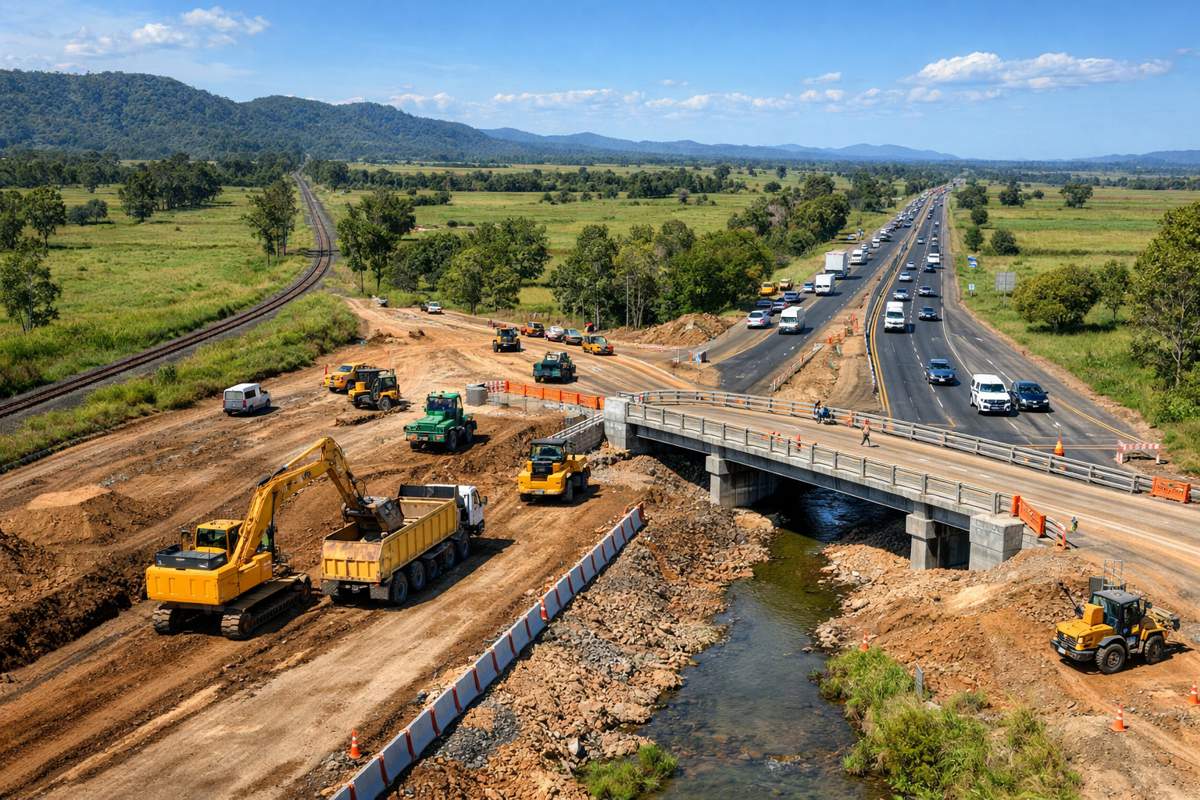
Bridge infrastructure has not been overlooked. Five narrow bridge upgrades in North Queensland are included in the package, tackling known bottlenecks where restricted widths create both safety hazards and operational inefficiencies. In regional networks, these pinch points often carry disproportionate risk, making their upgrade a high priority.
From Surface Treatments to Network Performance
Beyond the headline interventions, the programme includes a broad mix of supporting works that collectively enhance network performance. Road widening, audio-tactile line marking and resurfacing activities are scheduled across multiple sections, including works south of Miriam Vale and between Maryborough and Gin Gin.
Intersection upgrades form another critical component. These are often the sites of the most severe incidents, particularly where high-speed traffic interacts with local access points. By redesigning layouts and improving visibility, the programme aims to reduce conflict points and improve traffic flow.
Rest area improvements are also part of the package, a detail that carries more weight than it might first appear. Driver fatigue remains a significant factor in road incidents across long-distance corridors. Providing safe, accessible rest areas supports compliance with fatigue management regulations and encourages safer driving behaviour among freight operators.
A Freight Corridor Under Pressure
The Bruce Highway is more than a road. It is a backbone of Queensland’s economy, linking agricultural regions, mining operations and coastal ports. Any disruption along its length has a direct impact on supply chains, export capacity and regional livelihoods.
Freight volumes along the corridor have been steadily increasing, driven by population growth and expanding industrial activity. According to Australian transport data, heavy vehicles account for a significant share of traffic on regional highways, placing additional strain on infrastructure not originally designed for current load demands.
This context explains the programme’s emphasis on pavement strengthening and overtaking infrastructure. Without these upgrades, congestion and deterioration would continue to escalate, increasing both operational costs and safety risks. With them, the highway can better accommodate modern freight demands while maintaining acceptable service levels.
Procurement Model Signals Industry Opportunity
From a market perspective, the release of 22 contracts offers a clear signal to the construction industry. The mix of five construction procurement packages and 17 design contracts creates opportunities across the value chain, from engineering consultancies through to civil contractors and specialist suppliers.
Importantly, the staged nature of the programme allows firms to engage at different points depending on capability and capacity. Design contracts provide early entry into the pipeline, while construction packages offer near-term revenue opportunities as projects move into delivery.
Contractors will be appointed progressively from April 2026, providing a rolling schedule that avoids the boom-and-bust cycles often associated with large infrastructure programmes. For regional contractors in particular, this approach supports sustained employment and skills development, reinforcing local industry capacity.
Contract Pipeline Across the Bruce Corridor
The latest procurement package is spread across multiple districts between Wide Bay Burnett and Far North Queensland, combining immediate construction works with a broader design pipeline that will feed future delivery. Taken together, the contracts show that the Bruce Highway Targeted Safety Program is not being treated as a one-off burst of activity, but as a structured programme of staged upgrades aimed at reducing risk across some of the corridor’s most heavily used and vulnerable sections.
For industry watchers, the breakdown is useful because it shows where work is moving straight into delivery and where planning and design activity is laying the groundwork for the next wave of upgrades. That matters for contractors, consultants, suppliers and regional stakeholders tracking where opportunities and site activity are likely to emerge over the coming months.
| District | Route Section | Location or Package | Scope | Contract Type |
|---|---|---|---|---|
| Wide Bay Burnett | Bruce Highway (Gin Gin – Benaraby) | E Claxton Road and Rickards Road | Intersection upgrade | Construction |
| Wide Bay Burnett | Bruce Highway (Gin Gin – Benaraby) | Kalpower Road | Intersection upgrade and heavy vehicle rest area | Construction |
| Wide Bay Burnett | Bruce Highway (Maryborough – Gin Gin) | Howard to Doghole Creek | Pavement strengthening | Construction |
| Fitzroy | Bruce Highway (Gin Gin – Benaraby) | House Creek to Miriam Vale | Wide centre line treatment | Construction |
| Fitzroy | Bruce Highway (Rockhampton – St Lawrence) | Etna Creek Road to Plentiful Creek Road | Planning and design for wide centre line treatment | Design |
| Mackay Whitsunday | Bruce Highway (Bowen – Ayr) | Big Jack Creek to Armstrong Creek and Slater Creek to Wangaratta Creek | Planning and design for wide centre line treatment | Design |
| Mackay Whitsunday | Bruce Highway (Proserpine – Bowen) | Proserpine–Shute Harbour Road to Gregory–Cannon Valley Road and Adelaide Point Road to Don Street | Planning and design for wide centre line treatment | Design |
| Mackay Whitsunday | Bruce Highway (Rockhampton – St Lawrence) | Granite Creek to St Lawrence Connection Road | Planning and design for wide centre line treatment | Design |
| Mackay Whitsunday | Bruce Highway (St Lawrence – Mackay) | Flaggy Rock Creek to West Hill Creek | Planning and design for wide centre line treatment | Design |
| Mackay Whitsunday | Bruce Highway (Mackay – Proserpine) | Mackay Ring Road to Farleigh | Planning and design for wide centre line treatment | Design |
| Far North | Bruce Highway (Ingham – Innisfail) | Mourilyan Harbour Road | Intersection upgrade | Construction |
| Far North | Bruce Highway (Innisfail – Cairns) | Anderson Road (Aloomba Turn Off) | Intersection upgrade | Design |
| Far North | Bruce Highway (Innisfail – Cairns) | Babinda to Deeral | Planning and design for wide centre line treatment and intersection upgrades | Design |
| Far North | Bruce Highway (Innisfail – Cairns) | Eubenangee to Josephine Creek | Planning and design for wide centre line treatment and intersection upgrades | Design |
| Far North | Bruce Highway (Innisfail – Cairns) | Fishery Falls to Behana Creek | Planning and design for wide centre line treatment and intersection upgrades | Design |
| Far North | Bruce Highway (Innisfail – Cairns) | Mill Road and Thomson Road | Intersection upgrades | Design |
| Far North | Bruce Highway (Innisfail – Cairns) | Mill Road to Swallow Road | Intersection upgrades | Design |
| Northern | Bruce Highway (Ayr – Townsville) | Julago Street to Stuart Rail Overpass | Planning and design for wide centre line treatment and pavement strengthening | Design |
| Northern | Bruce Highway (Ayr – Townsville) | Palm Creek to Alligator Creek | Planning and design for replacement of five bridges | Design |
| Northern | Bruce Highway (Bowen – Ayr) | Wangaratta to Home Hill | Planning and design for wide centre line treatment, pavement strengthening and intersection improvements | Design |
| Northern | Bruce Highway (Townsville – Ingham) | Mutarnee to Helens Hill | Planning and design for wide centre line treatment, pavement strengthening, intersection improvements and overtaking lanes | Design |
| Northern | Bruce Highway (Townsville – Ingham) | Yabulu to Bluewater | Planning and design for wide centre line treatment and pavement strengthening | Design |
Government Commitment and Industry Confidence
The political backing behind the programme remains strong, with consistent messaging from federal and state leaders reinforcing its importance. Federal Minister for Infrastructure, Transport, Regional Development and Local Government Catherine King stated: “This latest activity signals significant progress in delivering the Bruce Highway Targeted Safety Program.”
She added: “The Australian Government is proud to be funding 80 per cent of this $9 billion program, because improving safety on the Bruce Highway will help save lives and support the communities and industries that rely on this critical route.”
Queensland Minister for Transport and Main Roads Brent Mickelberg emphasised delivery momentum, noting: “We’re keeping the momentum up with 22 new contracts moving to market to boost safety along the Bruce Highway.”
Assistant Minister for Regional Development Anthony Chisholm highlighted the broader pipeline: “These works will make a real difference for drivers, freight operators and regional Queenslanders, and form part of a long-term pipeline of upgrades that will squarely benefit the people who live here.”
Regional Impact Extends Beyond the Road
While safety remains the central objective, the programme’s economic implications are equally significant. Infrastructure investment of this scale injects capital into regional economies, supporting jobs, local businesses and supply chains.
Communities along the corridor stand to benefit from improved connectivity, reduced travel times and enhanced access to services. For industries such as agriculture and tourism, more reliable transport links can translate directly into increased competitiveness and growth.
There is also a long-term resilience dimension. Upgraded infrastructure is better equipped to withstand extreme weather events, an increasingly important consideration in northern Australia where flooding and cyclones can disrupt transport networks for extended periods.
Building a Safer and More Reliable Future Corridor
The release of these 22 contracts marks another step in reshaping the Bruce Highway into a safer, more resilient transport corridor. It is not a single project but a sustained programme of incremental improvements, each contributing to a broader transformation.
For the construction sector, it offers visibility and continuity. For policymakers, it demonstrates a targeted approach to infrastructure investment. And for the communities and industries that rely on the highway every day, it promises a network that is safer, more reliable and better aligned with modern demands.
With procurement now underway and construction activity set to ramp up, attention will turn to delivery performance. The framework is in place, the funding committed and the pipeline defined. The next phase will determine how effectively these plans translate into safer journeys across one of Australia’s most important roads.