Isuzu and Toyota Move Hydrogen Trucks Toward Commercial Reality
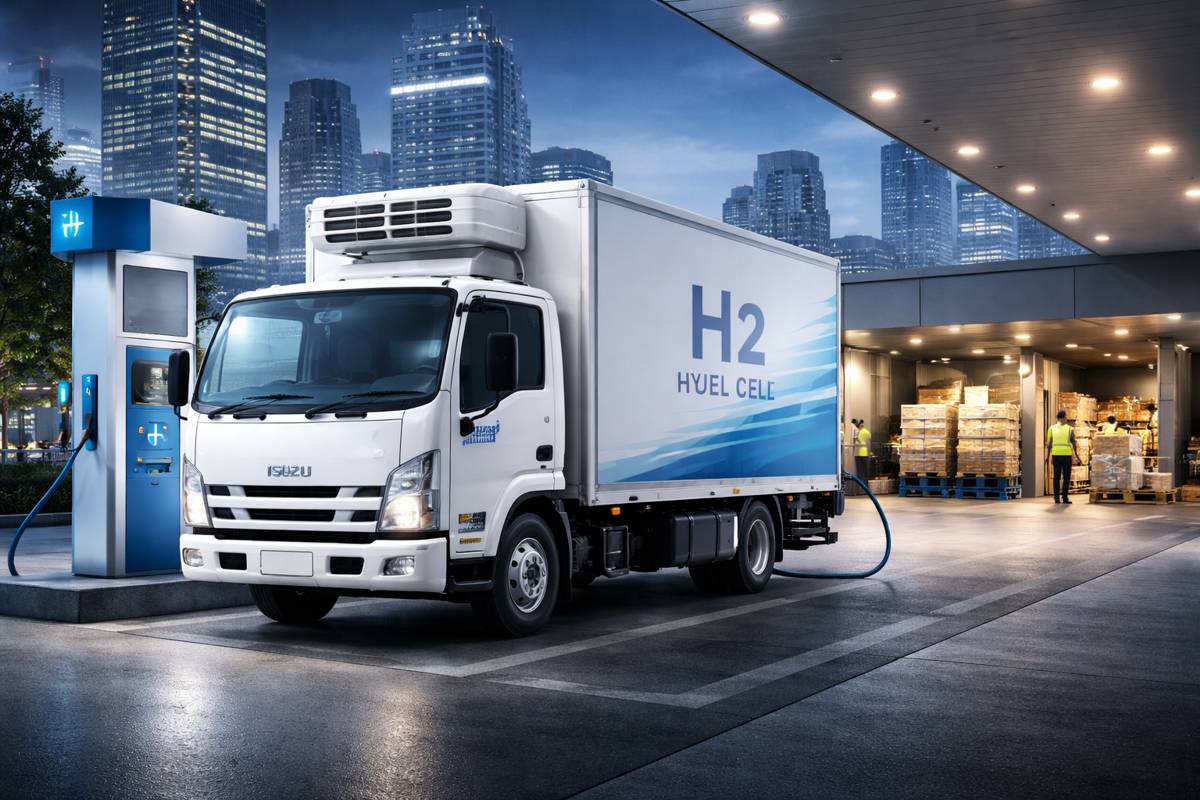
The race to decarbonise freight transport has entered a decisive phase, with Isuzu Motors Limited and Toyota Motor Corporation aligning their engineering capabilities to develop a next-generation light-duty fuel cell truck. Designed for mass production by fiscal year 2027, the programme reflects a growing recognition that battery-electric solutions alone won’t meet the operational demands of high-utilisation logistics.
At the centre of the collaboration is a hydrogen-powered variant of Isuzu’s ELF platform, already established in battery-electric form. By integrating Toyota’s third-generation fuel cell system, the partners are attempting to tackle one of the most persistent bottlenecks in zero-emission freight: balancing range, uptime, and operational efficiency without compromising payload or durability.
For the construction, infrastructure and logistics sectors, the implications are considerable. Light-duty trucks underpin urban supply chains, from supermarket deliveries to construction site logistics. Their decarbonisation has been slower than passenger vehicles, largely due to demanding duty cycles. This initiative signals a shift from pilot projects to scalable industrial solutions.
Briefing
- Isuzu and Toyota target mass production of hydrogen fuel cell light-duty trucks by FY2027
- The vehicle combines the ELF EV platform with Toyota’s third-generation fuel cell system
- Focus is on high-utilisation logistics requiring fast refuelling and long range
- Cost reduction and durability improvements are central to commercial viability
- Builds on prior collaboration including fuel cell buses and pilot deployment projects
Engineering for Real-World Logistics Demands
Light-duty commercial vehicles occupy a unique niche in the transport ecosystem. Unlike passenger cars, they rarely sit idle. Instead, they operate on tight delivery schedules, often running multiple shifts per day across dense urban environments. Refrigerated transport adds another layer of complexity, placing continuous demand on onboard energy systems.
Under these conditions, traditional battery-electric vehicles face limitations. Charging downtime, even when optimised, can disrupt tightly orchestrated logistics networks. Operators must either invest in additional fleet capacity or accept reduced utilisation rates. Neither option is particularly attractive in a cost-sensitive sector.
Fuel cell electric vehicles, by contrast, offer a different operational profile. Hydrogen refuelling can be completed in minutes, closer to diesel refuelling times, while still delivering zero tailpipe emissions. The higher energy density of hydrogen also enables longer ranges without significantly increasing vehicle weight, preserving payload capacity which is critical for commercial viability.
Building on the ELF EV Platform
The new hydrogen truck is rooted in Isuzu’s ELF EV, introduced in 2023 as part of a broader electrification strategy. Developed using the company’s I-MACS architecture, the platform was designed from the outset to accommodate multiple powertrain configurations. That flexibility now proves valuable as hydrogen technology is layered into the design.
By adopting Toyota’s third-generation fuel cell stack, the vehicle is expected to achieve notable gains in durability and service life. Fuel cell longevity has long been a concern for fleet operators, particularly in high-mileage applications. Improvements in stack design and system integration are aimed at addressing precisely that issue.
The collaboration also reflects a pragmatic engineering approach. Rather than developing an entirely new vehicle from scratch, the partners are leveraging existing platforms and proven technologies. This reduces development risk and accelerates the path to market, both crucial factors in an industry where timing often determines success.
Cost Reduction Remains the Critical Barrier
Despite technical progress, fuel cell vehicles continue to face a fundamental challenge: cost. High production costs, particularly for fuel cell stacks and hydrogen storage systems, have limited widespread adoption. Addressing this issue is central to the Isuzu-Toyota collaboration.
Isuzu is focusing on optimising vehicle body structures and refining manufacturing processes to reduce overall costs. Meanwhile, Toyota is working to simplify fuel cell system design and improve production efficiency. These parallel efforts are essential if hydrogen trucks are to compete with both diesel and battery-electric alternatives on total cost of ownership.
Industry analysts have consistently pointed out that cost parity is the tipping point for adoption. According to research from organisations such as the International Energy Agency, scaling production volumes and advancing manufacturing techniques are key to bringing hydrogen technologies into the mainstream. The current project aligns closely with that trajectory.
Lessons from Buses and Pilot Projects
This isn’t the first time the two companies have worked together on hydrogen mobility. Their joint development of the ERGA fuel cell bus provided valuable insights into system integration, durability, and operational performance in real-world conditions. Public transport, with its fixed routes and predictable usage patterns, has served as a proving ground for hydrogen technology.
In addition, the partners have participated in pilot programmes aimed at deploying fuel cell trucks in commercial settings. These initiatives, coordinated through industry consortia, have highlighted both the potential and the challenges of hydrogen logistics. Data gathered from these trials is now feeding directly into the next-generation truck programme.
One area of particular focus is control system optimisation. Managing energy flows, thermal conditions, and system performance under varying loads is critical to ensuring reliability. Incremental improvements in these areas can have a disproportionate impact on vehicle uptime and maintenance costs.
Hydrogen Infrastructure and Policy Momentum
The success of hydrogen-powered transport depends on more than vehicle technology. Infrastructure development remains a decisive factor. Without a robust network of hydrogen refuelling stations, even the most advanced vehicles struggle to gain traction.
Governments in Japan, Europe, and parts of Asia are stepping up investment in hydrogen infrastructure as part of broader decarbonisation strategies. National hydrogen roadmaps increasingly include provisions for commercial vehicle deployment, recognising the sector’s outsized contribution to emissions.
Japan, in particular, has positioned hydrogen as a cornerstone of its energy policy. Both Isuzu and Toyota are closely aligned with this national strategy, collaborating with local governments and industry partners to expand hydrogen utilisation. These efforts extend beyond transport to include production, storage, and distribution systems.
Competing Pathways in Commercial Vehicle Decarbonisation
The development of hydrogen trucks sits within a broader debate about the future of commercial vehicle powertrains. Battery-electric vehicles have gained significant momentum, particularly in urban delivery applications. However, their suitability diminishes as range requirements and utilisation rates increase.
Hydrogen offers a complementary pathway rather than a direct replacement. The concept of a multi-pathway approach, embraced by both companies, reflects the diversity of use cases within the transport sector. No single technology is likely to dominate across all applications.
For fleet operators, this means greater flexibility. Vehicles can be selected based on operational requirements rather than constrained by a one-size-fits-all solution. In practice, this could lead to mixed fleets where battery-electric and hydrogen vehicles coexist, each serving specific roles.
Implications for the Construction and Infrastructure Sector
While the announcement focuses on logistics, the ripple effects extend into construction and infrastructure. Urban construction projects rely heavily on light-duty vehicles for material transport, equipment movement, and site logistics. Decarbonising these fleets is an increasingly important component of sustainable construction practices.
Moreover, the expansion of hydrogen infrastructure presents opportunities for the construction sector itself. Building refuelling stations, upgrading energy networks, and integrating hydrogen production facilities all require significant engineering and construction expertise. In this sense, the shift toward hydrogen mobility is as much an infrastructure story as it is a transport one.
Contractors and developers who position themselves early in this emerging ecosystem stand to benefit from new revenue streams. At the same time, policymakers will need to ensure that regulatory frameworks support rapid deployment while maintaining safety and reliability standards.
Toward a Practical Hydrogen Economy
The collaboration between Isuzu and Toyota reflects a broader transition from experimentation to implementation in hydrogen mobility. While challenges remain, particularly around cost and infrastructure, the direction of travel is becoming clearer.
By targeting mass production within a defined timeframe, the partners are signalling confidence in both the technology and the market. The focus on real-world operating conditions, rather than laboratory performance, suggests a maturing approach to development.
For the global construction and infrastructure community, the message is straightforward. Hydrogen is moving beyond pilot projects and into the realm of practical, scalable solutions. As that transition unfolds, the industry will play a central role in shaping how this new energy vector is deployed across transport networks worldwide.