The Republic of Angola

Angola is one of sub-Saharan Africa’s larger economies and remains heavily shaped by hydrocarbons, with oil still dominating exports and public revenues even as the government pushes diversification into mining, agriculture, logistics and industry. Growth rebounded strongly in 2024, helped by oil and non-oil activity, but the country still faces structural constraints including infrastructure gaps, high logistics costs and uneven access to power, water and transport services.
For construction and infrastructure, Angola matters because of its scale, Atlantic coastline and role as a gateway between southern Africa, Central Africa and inland mineral belts in the DRC and Zambia. Government priorities continue to centre on transport integration, electricity transmission, water supply, airport and port modernisation, and the Lobito Corridor as a strategic freight route linking the Atlantic to regional hinterlands. A 20-year transport investment programme is focused on moving people and goods more efficiently across all 18 provinces and strengthening regional connectivity.
The Republic of Angola Infrastructure Dashboard
Top Infrastructure Projects


Infrastructure Strategy
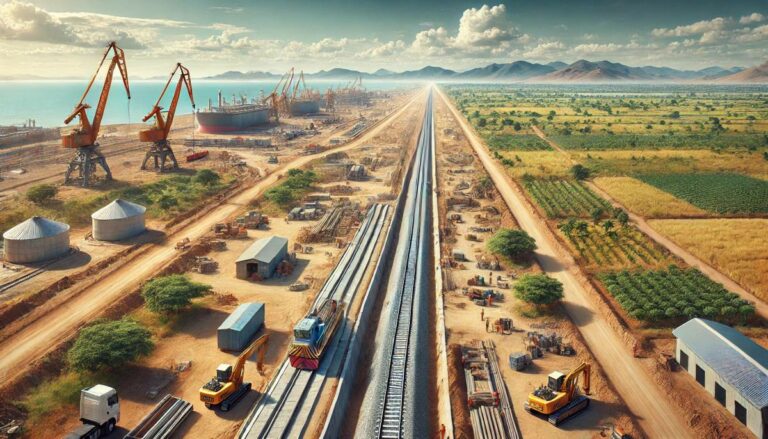
Angola’s infrastructure strategy is built around national integration, export logistics and diversification away from overdependence on oil. Current priorities include modernising ports, railways, roads and airports, expanding electricity generation and transmission, improving water supply, and using transport corridors, especially Lobito, to connect domestic production zones with regional and global markets.
The state is also trying to crowd in more private capital through the 2019 PPP law, updated procurement rules and sector reforms, particularly in power and water. In practice, infrastructure delivery still depends heavily on sovereign financing, export credit, multilateral support and state-owned enterprises, but the policy direction is clearly toward more blended and concession-based models.
Transport Priorities
Transport is central to Angola’s development model. The country has an extensive but uneven road system, with rehabilitation still needed across large stretches, while rail revival has focused on the three historic corridors linking the coast to inland markets. The Benguela Railway is the standout asset because it underpins the Lobito Corridor and gives Angola a strategic role in mineral and freight flows from the Copperbelt to the Atlantic.
On the maritime side, Luanda and Lobito are the key logistics hubs, supported by Namibe and Cabinda. In aviation, the new Dr António Agostinho Neto International Airport is intended to replace capacity constraints at Luanda’s older gateway and strengthen cargo and passenger connectivity. The government’s long-range transport programme explicitly targets better sub-regional connections and more efficient movement of goods across all provinces.
Investment Focus
Angola’s construction sector is still closely tied to public investment cycles, oil revenue and state-led infrastructure programmes. The strongest activity tends to sit in transport, power, water, public buildings, industrial facilities and urban expansion around Luanda and key provincial centres. Official reporting has linked recent construction growth to higher government capital spending rather than to a broad-based private real estate boom.
The medium-term outlook depends on how successfully Angola converts corridor development, energy reform and mining diversification into bankable projects. International contractors and foreign suppliers continue to play an outsized role, particularly in airport, power, transport and industrial schemes, because projects often rely on EPC models, export credit and external finance.
Infrastructure Investment & Finance
Finance text here...
Latest News from Highways.Today