3D Printing Big Ideas into Reality
Additive Engineering Solutions did not begin as a conventional start up story. There was no grand business plan sketched on a whiteboard or investor pitch rehearsed in a coffee shop. Instead, the idea emerged organically from a research environment where experimentation mattered more than scale. Based in Ohio, the company has since become one of the most influential names in large format polymer 3D printing, but its origins trace back to a moment of curiosity at a national laboratory.
The spark was lit at the Manufacturing Demonstration Facility at Oak Ridge National Laboratory. The MDF exists to explore what is possible in advanced manufacturing, not to operate as a production shop. That distinction would later become critical. In 2014, the MDF partnered with Cincinnati Incorporated and others to 3D print a car live on the show floor at the International Manufacturing Technology Show. Amid the noise and spectacle, one engineer stood watching more intently than most.
From Caterpillar To Concept
Austin Schmidt was working at Caterpillar at the time. What caught his attention was not the novelty of a printed car, but the underlying capability of large scale polymer printing. It hinted at a way to rethink tooling, fixtures, and early stage validation for heavy equipment. Soon after, Schmidt and his colleagues travelled to the MDF to test the idea by printing a full scale mock up of a bulldozer frame.
The result weighed around 2,000 pounds and proved immediately valuable for assembly verification. It allowed engineers to assess fit, access, and ergonomics without committing to costly metal fabrication. Encouraged by the outcome, Schmidt wanted to continue working with the MDF on additional prints. That was when reality set in.
He recalled the response clearly: “I like to say, ‘Oak Ridge National Laboratory’s MDF will print one part for anyone, but two parts for no one,’” Schmidt said. “At the time I thought, ‘If they’re turning away a big company like Caterpillar, who else are they turning away?’”
Spotting The Gap In The Market
That limitation was not a failure of the MDF. It was a function of its mission. The facility exists to solve manufacturing problems through research, not to become a commercial service provider. Schmidt soon discovered that Cincinnati Incorporated was similarly focused on building machines, not running them for customers.
The realisation exposed a clear gap in the market. There was cutting edge technology available, proven at scale, yet no company dedicated to offering large format polymer printing as a repeatable service. Schmidt shared the idea with his friend Andrew Bader, who brought complementary experience through his family’s metalworking business. Both had already experimented with small scale 3D printing ventures. The leap to large format suddenly felt logical.
Thus Additive Engineering Solutions, known as AES, was born.
Investing In Big Area Additive Manufacturing
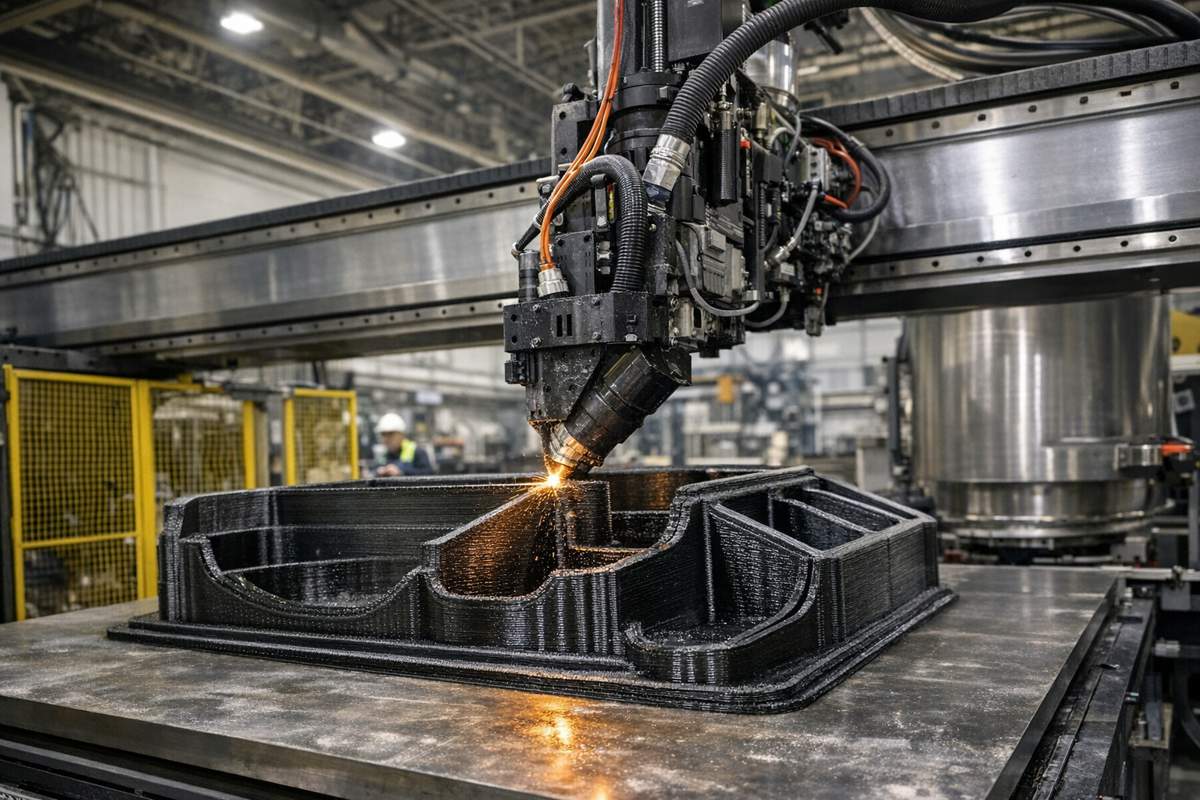
The first hurdle was capital. Large area additive manufacturing requires machines of exceptional scale. The team needed a BAAM printer, a system so large it could comfortably fit a small dinner party inside its build envelope. Developed through collaboration between ORNL and Cincinnati Incorporated, the BAAM platform was adapted from industrial laser cutting systems by replacing the laser head with a polymer extruder.
Polymer 3D printing relies on a simple but unforgiving principle. Molten plastic is extruded through a nozzle, deposited layer by layer to form a part. In BAAM systems, the build table moves vertically as the part grows, enabling prints measured in metres rather than millimetres. Every motion is governed by specialised control software.
That software, known as Slicer, was developed by researchers at ORNL. Alex Roschli, the laboratory’s lead software engineer for the programme, explained the process succinctly: “The Slicer software program takes an object, ‘slices’ it into layers, then fits toolpaths to each layer,” he said. “The toolpaths determine the motions of the 3D printer and where the material is extruded.”
Learning The Language Of Machines
For AES, acquiring the printer was only the beginning. The greater challenge lay in mastering and adapting the Slicer instructions to control the BAAM system reliably. Large format printing leaves little room for error. Geometry, temperature, speed, and material behaviour all interact at scale.
Schmidt and Bader leaned heavily on their relationship with ORNL, maintaining close contact for software guidance and troubleshooting. That collaboration became a long term partnership rather than a one off consultation. Bader noted: “We probably have talked to ORNL at least on a monthly basis for almost 10 years.”
This ongoing dialogue allowed AES not only to refine its own processes, but also to influence the evolution of the software itself by proposing new features based on real world production experience.
The Goldilocks Challenge Of Polymer Printing
Among the most persistent technical hurdles is what the team describes as a Goldilocks problem. In large format polymer printing, temperature control must be just right. Too hot, and layers slump or distort. Too cold, and the bond between layers weakens.
Schmidt explained the risk plainly: “The printing can’t be too hot or cold, or we end up scrapping the whole job,” he said. “Something that took 24 hours to print, you could lose the whole thing at hour 22.”
The issue is compounded by scale. As parts grow larger, the time between successive passes over the same area increases. Lower layers can cool excessively before the nozzle returns, preventing proper fusion. Yet excessive heat creates its own failures. Managing this balance defines the upper limits of part size and complexity.
Rethinking Toolpaths And Angles
One solution emerged through experimentation with nozzle orientation. By tilting the nozzle to a 45 degree angle, AES found that toolpaths could be shortened. This reduced cycle times between layers and helped maintain more consistent thermal conditions.
Bader described the benefit: “Switching over to 45 degrees, your tool paths for each layer can be shortened, so you have more room to work with that Goldilocks effect.”
The approach also unlocked new geometries. Bowl shaped forms and other complex surfaces became feasible where traditional vertical deposition would have failed. However, innovation rarely arrives without consequences.
Software Complexity At Scale
Changing the deposition angle introduced a new set of challenges. Roschli highlighted one of the most immediate risks: “One of the problems is that by changing the angle, now your machine could run into the print bed,” he said. Geometry calculations, collision avoidance, and path planning all became more complex.
Developing new software instructions to manage angled deposition proved far more difficult than expected. Each adjustment rippled through the system, requiring careful validation before it could be deployed in production. The work reinforced the importance of close cooperation between machine operators and software developers.
Becoming A Global BAAM Leader
While solving these technical problems, AES steadily expanded its market presence. Today, the company operates four of the fifteen BAAM systems ever built. As Bader put it: “Our company now has four out of the 15 BAAMs ever made. We’ve become a world leader in large area polymer additive manufacturing.”
With Cincinnati Incorporated no longer producing BAAM machines, AES has also become a critical support resource for other organisations operating the technology. That role extends beyond printing parts to advising on maintenance, upgrades, and process optimisation.
Expanding Capacity And Industry Reach
The company’s growth is not confined to technical capability. AES recently broke ground on new factory space, expanding its physical footprint to meet rising demand. Its client base now spans aerospace, defence, and construction, sectors where large, lightweight, and rapidly produced components offer tangible advantages.
Applications range from tooling and moulds to jigs, fixtures, and prototype structures. In construction, large format polymer printing is increasingly explored for formwork, architectural elements, and custom components that would be uneconomical to machine traditionally.
The Role Of The Manufacturing Demonstration Facility
Schmidt credits the MDF with more than technical support. He emphasised the broader ecosystem that enabled AES to succeed: “It wasn’t just that they showed us how to use the machine, they pulled together the whole ecosystem needed to make it successful.”
The MDF functions as a matchmaking platform as much as a research centre. Its extensive network of industry partners creates opportunities for collaboration that extend well beyond a single project. Each connection opens the door to new markets and ideas.
A Growing Yet Focused Market
Large scale polymer additive manufacturing remains a niche, but one that is gaining momentum. Bader reflected on the timing: “Large scale polymer is still pretty niche, so it’s not a massive market, but it’s growing every year. Within the last couple years, we’re really hitting our stride. And that’s because the market itself is finally catching up.”
Advances in materials science, simulation, and digital design are accelerating adoption. As industries seek faster development cycles and greater design freedom, technologies once seen as experimental are moving into mainstream production planning.
National Collaboration And Technology Transfer
The MDF is supported by the Department of Energy’s Advanced Materials and Manufacturing Technologies Office and operates as a nationwide consortium. Its mission is to innovate, inspire, and catalyse transformation across US manufacturing. The facility also serves as the model for the national laboratory system’s C4 Partnering Model.
C4 aims to increase cross sector collaboration and reduce the time it takes for new technologies to reach the market. By connecting laboratories, industry, and regional ecosystems, the model strengthens commercialisation pathways and regional manufacturing resilience.
Research At The Core Of Industrial Progress
Oak Ridge National Laboratory is managed by UT Battelle for the Department of Energy’s Office of Science. As the largest supporter of basic research in the physical sciences in the United States, the Office of Science underpins advances that address some of the most pressing challenges facing industry and society.
For Additive Engineering Solutions, this environment provided the foundation for a business that bridges research and real world production. By translating laboratory scale innovation into industrial capability, the company exemplifies how collaboration can turn an idea into a global manufacturing force.