Sharper Insights for Critical Minerals with Data-Driven Mining
GeologicAI has taken a decisive step to strengthen its position in the global critical minerals sector with the acquisition of Lumo Analytics, a specialist in Laser-Induced Breakdown Spectroscopy technology. The move brings together advanced sensing hardware, deep geoscience expertise, and decision-focused analytics at a moment when the mining industry is under mounting pressure to deliver minerals faster, cleaner, and with less risk.
Across exploration and resource development, decision-makers are grappling with more complex ore bodies, tighter regulatory scrutiny, and growing demand for minerals essential to electrification, renewable energy, and advanced manufacturing. Against that backdrop, the integration of Lumo Analytics into GeologicAI’s platform signals a clear intent to compress timelines between discovery and production by improving data quality directly at the source.
High-Resolution Decision Engineering Comes Into Focus
At the core of GeologicAI’s strategy is what the company calls High-Resolution Decision Engineering. Rather than relying on fragmented datasets gathered at different stages of the mining lifecycle, the approach focuses on capturing dense, high-quality geological data early and continuously, then translating it into practical insights through advanced modelling and analytics.
The acquisition builds on GeologicAI’s track record of scanning more than two million metres of drill core worldwide. By adding LIBS capability to its existing sensor suite, the company now offers a more complete picture of mineralogy, particularly for elements that have traditionally been difficult to measure quickly and cost-effectively.
Completing the Integrated Sensor Suite
For years, the mining industry has depended on laboratory-based assays to provide definitive geochemical results. While accurate, those methods are time-consuming and expensive, often creating bottlenecks in exploration and resource evaluation. On-site sensing technologies have begun to close that gap, but limitations have remained, especially when it comes to light elements and rare earth elements.
The addition of Lumo Analytics’ compact LIBS scanner addresses that gap head-on. By integrating LIBS with GeologicAI’s existing Resource Knowledge Systems, the company now offers a unified, on-site sensor suite capable of delivering richer datasets across a broader range of elements. This integration allows geologists and engineers to make informed decisions earlier, reducing uncertainty and rework further down the line.
Responding to a Critical Minerals Crunch
The timing of the acquisition is no accident. Global demand for lithium, copper, nickel, cobalt, and rare earth elements continues to accelerate, driven by electric vehicles, grid-scale energy storage, wind turbines, and digital infrastructure. At the same time, new discoveries are harder to find and often more geologically complex.
Grant Sanden, Chief Executive Officer of GeologicAI, framed the challenge in direct terms, stating: “The mining industry currently faces a ‘critical minerals crisis’, requiring faster and more accurate data to bring resources to market.” He added: “To address this, we are driving a strategy of bringing together enhanced data at the source, industry-specific domain expertise, and advanced, purpose-built analytics. This acquisition represents a key step forward in our mission.”
Why LIBS Matters on the Ground
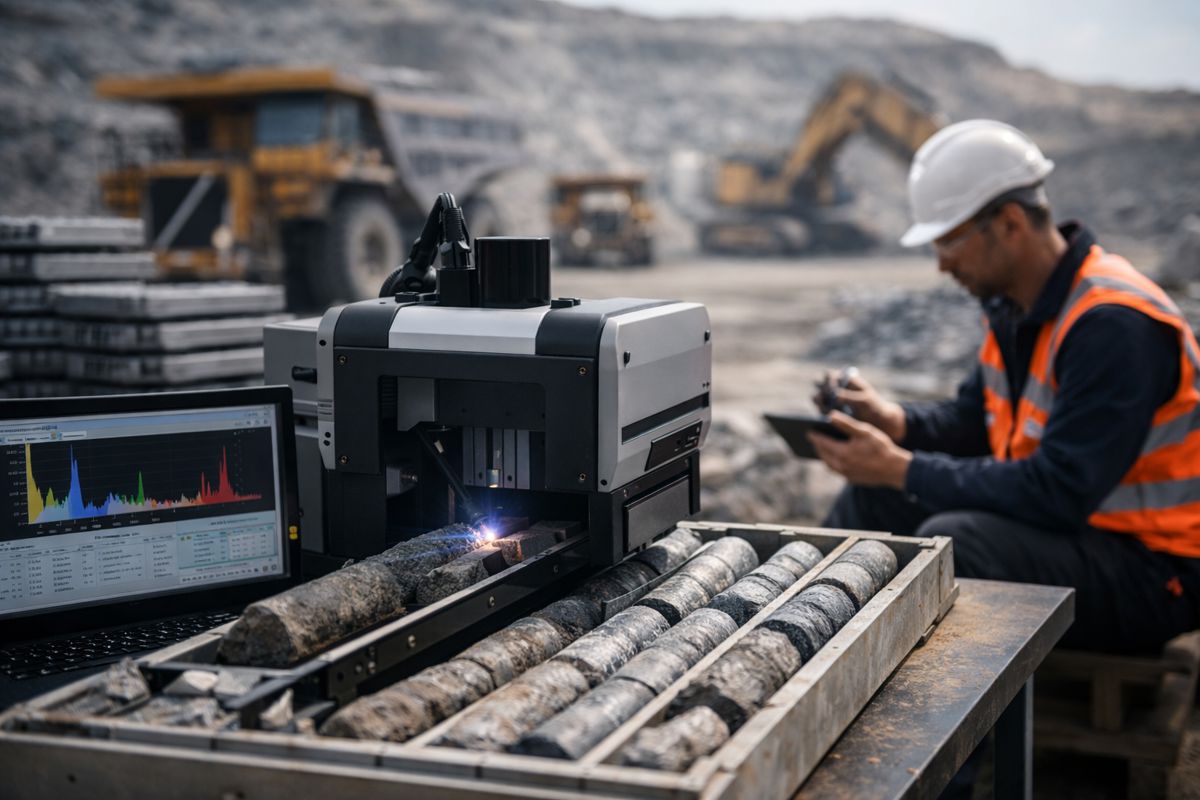
Laser-Induced Breakdown Spectroscopy has been discussed in mining circles for years, but recent advances in miniaturisation, durability, and data processing have pushed it from the laboratory into the field. The technology works by firing a high-energy laser pulse at a rock surface, creating a micro-plasma. As the plasma cools, it emits light unique to the elements present, producing an immediate chemical fingerprint.
For mining teams, the implications are significant. LIBS delivers rapid, non-contact, non-destructive measurements that can be carried out directly on drill core or rock faces. This capability is particularly valuable for detecting light elements and rare earth elements that conventional sensors often struggle to capture reliably in real time.
Technical Synergy and Proven Expertise
The fit between the two companies is not merely strategic but deeply technical. GeologicAI’s engineering leadership includes long-standing LIBS expertise, creating a natural alignment with Lumo Analytics’ hardware development. Steve Buckley, Senior Vice President of Engineering at GeologicAI and a veteran of more than 25 years in the field, highlighted this alignment, noting: “Lumo Analytics has built the most compact and efficient LIBS scanner available in the market. Battle-tested in the field, it provides unparalleled insight at speed.” He continued: “We are excited for both their team and technology to join our drive for High-Resolution Decision Engineering in the critical minerals industry.”
This combination of mature hardware and established domain knowledge reduces integration risk and accelerates the delivery of value to customers. Rather than experimenting with unproven tools, mining companies gain access to technology that has already been tested under real-world conditions.
Extending Reach Across the Resource Lifecycle
By folding LIBS into its platform, GeologicAI expands the relevance of its solutions beyond early-stage exploration. High-resolution elemental data supports a wide range of applications, including resource estimation, grade control, metallurgical planning, and even processing optimisation.
Detailed mineral mapping can help operators identify variability within ore bodies that might otherwise be missed, enabling more selective mining and better recovery rates. Over time, this level of insight can translate into lower operating costs, reduced waste, and improved environmental outcomes.
A Shared Vision From Lumo Analytics
For Lumo Analytics, the acquisition represents an opportunity to scale its technology and reach a broader segment of the global mining industry. Antti Kotanen, co-founder and Chief Executive Officer of Lumo Analytics, emphasised the growing role of LIBS in modern operations, stating: “Capable of rapid, non-contact, non-destructive measurements, LIBS is taking off in the mining industry as a means of measuring light elements and rare-earth elements, allowing assessment of crucial deposits and providing detailed mineralogy.” He added: “We are very proud of what we have built and excited, by joining with GeologicAI, to extend the reach and impact of our technology to the whole industry.”
The statement reflects a broader industry trend toward partnerships and consolidation, as specialised technology providers seek platforms capable of delivering global scale and long-term support.
Industry Backing From Major Players
The acquisition has also drawn support from within the mining sector itself. As major producers reassess how they evaluate and develop resources, access to real-time, high-resolution data is increasingly seen as a competitive advantage.
Pekka Santasalo, Head of Growth and Ventures at Rio Tinto, underscored this point, commenting: “As demand for critical minerals continues to grow, access to high-resolution, real-time geological data is becoming essential to improving decision quality and reducing risk.” He continued: “The combination of GeologicAI’s multi-sensor platform with Lumo Analytics’ LIBS technology represents an important step forward in how the industry can better understand complex ore bodies and make more informed resource decisions.”
Such endorsement signals confidence not only in the technology itself but in its ability to integrate into existing workflows at scale.
Continuity for Customers and Ongoing Innovation
Both companies have been clear that existing customers will see no disruption as a result of the transaction. GeologicAI has confirmed the continued supply and support of all Lumo Analytics offerings, alongside ongoing investment in further LIBS innovation.
This assurance is critical in an industry where technology adoption often hinges on long-term reliability and vendor stability. By committing to continuity, GeologicAI positions itself as a partner rather than a short-term supplier, reinforcing trust among clients ranging from global majors to select junior miners.
Strengthening the Case for Data-Led Mining
Taken together, the acquisition highlights a broader shift within the mining industry toward data-led decision-making. As ore bodies become more complex and margins more sensitive, the ability to extract actionable insight from geological data is no longer optional.
GeologicAI’s expanded platform reflects an understanding that technology alone is not enough. Value is created when accurate data, captured at the right time, is paired with domain expertise and analytics designed for real-world decisions. In that sense, the integration of LIBS is less about adding another sensor and more about closing the loop between measurement and action.
Faster Insights at the Source
With LIBS now part of its integrated sensor suite, GeologicAI is positioned to play a central role in how the critical minerals industry navigates its next phase of growth. Faster insights at the source can shorten development timelines, reduce uncertainty, and support more responsible resource extraction.
As governments and industries alike place greater emphasis on secure, transparent supply chains for critical minerals, technologies that improve understanding of the subsurface will continue to attract attention and investment. In acquiring Lumo Analytics, GeologicAI has signalled that it intends to remain at the forefront of that evolution.