EBRD Investment Securing Water and Agriculture in Morocco
Water has always shaped Morocco’s agricultural heartlands, but in recent decades the balance has tilted dangerously. Declining rainfall, rising temperatures and relentless pressure on groundwater have left entire regions exposed. Against that backdrop, the third and final phase of the Saïss Water Conservation Programme stands out as a decisive intervention, not just for irrigation, but for long term water security and rural stability.
Backed by a sovereign loan of up to €150 million from the European Bank for Reconstruction and Development, alongside grants from international partners, this phase focuses on building a modern water distribution network to irrigate 20,000 hectares across the Saïss plain in the Fès Meknès region. Once complete, the programme will reach around 5,000 farms and support the livelihoods of an estimated 1.8 million people. The scale alone places it among Morocco’s most significant climate resilience investments to date.
Completing a Flagship Programme
The Saïss Water Conservation Programme has been years in the making. Initial financing phases in 2017 and 2020 laid the foundations for a large scale shift away from unsustainable groundwater abstraction. This final tranche brings total programme costs to €252 million, closing the loop on a multi phase effort supported previously by the European Union and the Green Climate Fund.
What distinguishes this programme is its clear end goal. Rather than incremental fixes, it aims to fundamentally rebalance water use in one of Morocco’s most productive yet water stressed agricultural basins. By replacing groundwater pumping with a reliable surface water supply, the programme tackles both immediate irrigation needs and the long term preservation of the Saïss aquifer.
Financing Structure and International Support
At the core of the latest financing package is the EBRD’s sovereign loan of up to €150 million. This is complemented by a €5 million investment grant from the Bank itself, underscoring the project’s strategic importance. In addition, a €500,000 technical assistance grant will support implementation, system design and operational capacity.
International cooperation plays a central role. The United Kingdom has contributed a US$ 7.5 million grant, equivalent to roughly €6.5 million, through the High Impact Partnership for Climate Action multi donor fund. This mechanism channels climate focused finance into projects that deliver measurable adaptation and mitigation outcomes, particularly in water stressed regions.
Such blended finance structures are increasingly seen as essential for large scale climate infrastructure. By combining concessional funding with sovereign lending, the programme reduces fiscal pressure while accelerating delivery of urgently needed assets.
From Dam to Field
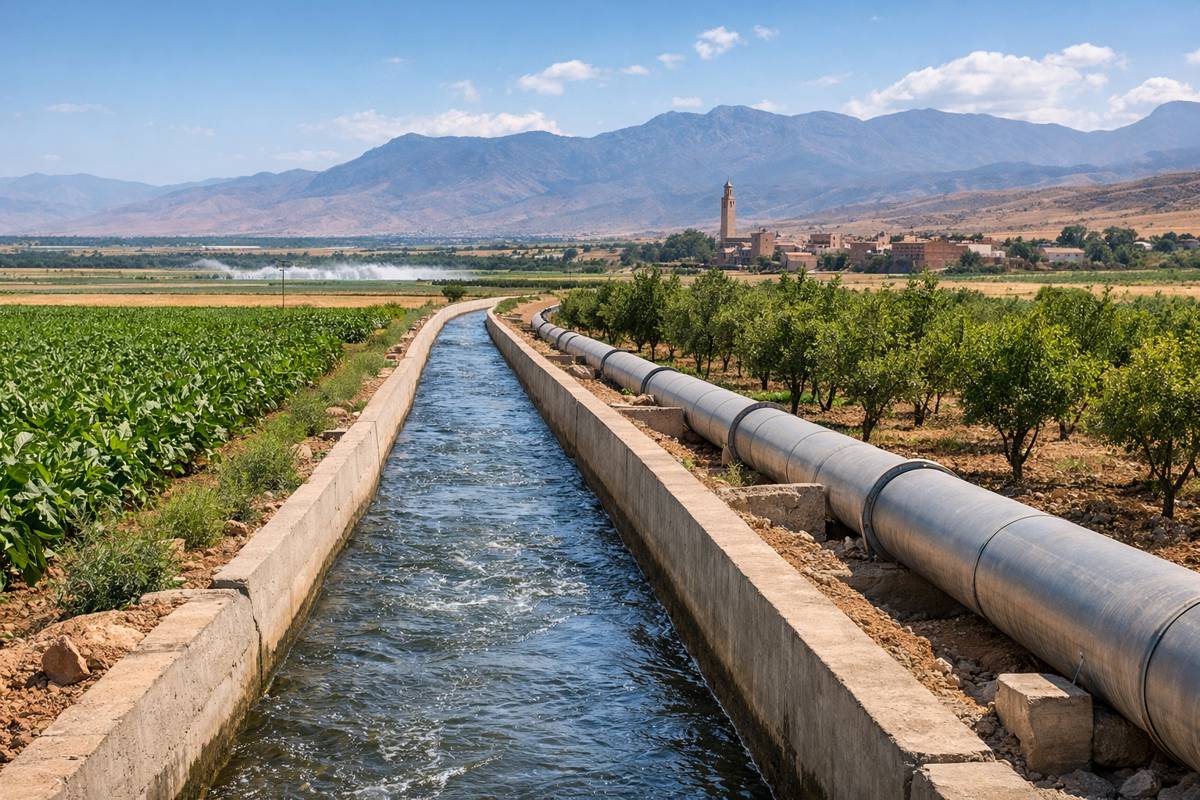
Technically, the programme hinges on transferring between 90 and 120 million cubic metres of water each year from the M’Dez dam to the Saïss plain. This surface water will be conveyed through a newly constructed distribution network designed for efficiency, reliability and long term operation.
Once operational, the system will replace thousands of individual groundwater wells currently drawing down the aquifer. That shift is critical. Decades of over abstraction have lowered water tables, increased pumping costs and threatened the viability of farming across the region. Surface water irrigation offers a far more resilient alternative, especially as climate variability intensifies.
Climate Change and Water Scarcity
Morocco’s water challenge is not theoretical. The country has experienced recurring droughts, shrinking reservoirs and declining groundwater reserves. Climate projections suggest these pressures will only intensify, particularly in inland agricultural regions such as Saïss.
By enabling climate resilient irrigation, the programme directly addresses these risks. Surface water allocation can be managed more flexibly than groundwater, allowing authorities to adapt to seasonal variability and longer term climate trends. At the same time, reducing pressure on the aquifer creates a buffer for future generations.
Agricultural Resilience and Food Security
Agriculture remains a cornerstone of Morocco’s economy and social fabric. In regions like Fès Meknès, farming supports entire communities, from smallholders to agri processing businesses. Water insecurity threatens not only crop yields but also employment, income stability and food supply chains.
The Saïss programme strengthens agricultural resilience by providing farmers with predictable access to irrigation water. This reliability enables better crop planning, improved productivity and greater willingness to invest in modern farming techniques. Over time, these gains ripple outward, supporting rural development and national food security.
Digital Management and Operational Efficiency
Beyond pipes and pumping stations, the project incorporates modern digital management tools. A SCADA based system will enable remote monitoring and control of the irrigation network, optimising water distribution and reducing losses.
Such systems are increasingly vital in large scale water infrastructure. Real time data allows operators to detect leaks, balance demand and respond quickly to operational issues. In water scarce environments, every cubic metre saved matters.
Inclusion, Skills and Local Capacity
Infrastructure alone does not guarantee success. Recognising this, the programme includes technical cooperation initiatives focused on skills development and inclusion. Young people and women in the Fès Meknès region will receive targeted training in sustainable water management, enhancing employability and local expertise.
This emphasis reflects a broader shift in development finance. Projects are now expected to deliver social value alongside physical assets, building human capital that outlasts construction timelines. In the Saïss region, that means creating a new generation of professionals capable of managing complex water systems.
Political Commitment and Partnership
The financing agreement was signed in Rabat by senior representatives of Morocco and the EBRD, signalling strong political backing. For the Moroccan government, the programme aligns with a national vision centred on water security, agricultural resilience and climate adaptation.
Minister Delegate for the Budget Fouzi Lekjaa highlighted the strength of the partnership, stating: “The quality of our partnership with the EBRD is based on a solid relationship focused on delivering concrete results. The financing agreement that has just been signed is part of a clear national vision and reaffirms the government’s commitment to strengthening the kingdom’s water security and ensuring the resilience of Moroccan agriculture in the face of the increased effects of climate change. The EBRD plays a key role in the development of sustainable infrastructure in the kingdom by promoting green and inclusive investments. The Bank also supports the dynamism of the private sector through direct financing for enterprises, as well as by providing financing lines to partner banks.”
From the Bank’s perspective, continuity matters. Greg Guyett, First Vice President of the EBRD, emphasised long term engagement: “We are pleased to finance the final phase of the Saïss Water Conservation Programme, building on the success of the first two phases of this strategic investment. This long term engagement reflects the strength of our partnership with Morocco and our shared goal to advance sustainable, climate resilient water management. As the programme nears completion, the EBRD will continue supporting the country’s priorities to modernise water infrastructure, promote efficient use of resources and improve rural livelihoods.”
Morocco and the EBRD
Since launching operations in Morocco in 2012, the EBRD has invested nearly €5.9 billion across 125 projects. These span renewable energy, transport, water, municipal services and private sector development. The Saïss programme sits firmly within this broader portfolio, exemplifying the Bank’s approach to climate aligned infrastructure.
For Morocco, such partnerships provide more than capital. They bring technical expertise, international best practice and access to global climate finance networks. In an era of tightening public budgets and escalating climate risks, that combination is increasingly valuable.
A Model for Water Stressed Regions
As the Saïss Water Conservation Programme reaches its final phase, its implications extend beyond the Fès Meknès region. Many agricultural basins across North Africa and the Mediterranean face similar challenges of over exploited aquifers and climate stress.
By demonstrating how surface water transfers, digital management and inclusive capacity building can work together, the programme offers a replicable model. It shows that with the right financing structures and political commitment, large scale water adaptation is not only possible, but practical.
Rather than a stopgap response, the Saïss initiative represents a structural shift in how water is valued and managed. For Morocco, it is a step towards safeguarding agriculture, stabilising rural communities and navigating an increasingly uncertain climate future.