Shengle International Airport Anchors Inner Mongolia on the Air Silk Road
Shengle International Airport is no longer a future promise sketched onto planning documents. With the successful on site verification and calibration test flight completed at Hohhot Shengle International Airport in November, Inner Mongolia’s first 4F class airport has formally crossed the threshold from construction to operational readiness. For China’s northern frontier, this milestone carries weight well beyond aviation. It signals the emergence of Hohhot as a pivotal hub on the evolving Air Silk Road and reinforces the city’s long standing role as a bridge between regions, cultures, and economies.
The smooth landing of the calibration aircraft marked the final technical validation of complex navigation, communications, and operational systems. In civil aviation terms, it confirmed that Shengle International Airport meets the stringent requirements needed to handle the world’s largest and most advanced commercial aircraft. In strategic terms, it confirmed something more symbolic. Hohhot is once again positioning itself as a place where routes converge and exchange happens, this time not by camel caravan or tea road, but by wide body aircraft and international air cargo.
A 4F Class Airport with National and International Significance
Shengle International Airport holds the distinction of being Inner Mongolia’s first 4F class civil aviation airport, the highest classification within China’s aviation system. This designation allows the airport to accommodate aircraft such as the Airbus A380 and Boeing 747, placing it firmly within the top tier of global airport infrastructure. The classification is not merely technical. It reflects long term ambition and a clear strategic purpose.
The airport is designed to operate as a regional aviation hub, a primary alternate landing airport within the Beijing Tianjin Hebei airport cluster, and a Class I international aviation port. It also plays a defined role within China’s Belt and Road Initiative, acting as a northern transport node that connects domestic routes with international corridors stretching into Mongolia, Russia, and onward to Europe. For policymakers and investors alike, this combination of capacity, location, and designation positions Shengle as infrastructure with national relevance rather than purely regional importance.
A Geography Shaped by Movement and Exchange
Hohhot’s emergence as a transport hub is not a modern invention. Geography has always dictated its importance. Sitting at the meeting point of the Central Plains, the grasslands, and the desert, the region has served for centuries as a gateway between agrarian China and the nomadic north. This role is deeply embedded in Chinese history and continues to inform contemporary development strategies.
During the Northern Wei Dynasty, Shengle served as a capital city controlling vital passages between regions, enabling commerce and mobility across otherwise challenging terrain. In the Tang Dynasty, trade routes extended northwards from Baidouchuan through today’s Inner Mongolia into Mongolia and Russia. By the Qing Dynasty, Guisui City had become a key node on the Grassland Silk Road. Perhaps most evocatively, from the late seventeenth to early twentieth centuries, the Tea Road stretched some 13,000 kilometres from Wuyi Mountain in Fujian, passing through Hohhot before reaching Mongolia and Russia. These routes turned the city into a place of encounter, where merchants, ideas, and cultures mixed.
Modern infrastructure development under the Belt and Road Initiative echoes this historical function. The difference lies in scale, speed, and technology. Where caravans once took months, aircraft now make the journey in hours. Shengle International Airport is intended to be the contemporary expression of that same connective instinct.
Architecture Rooted in Grassland Culture
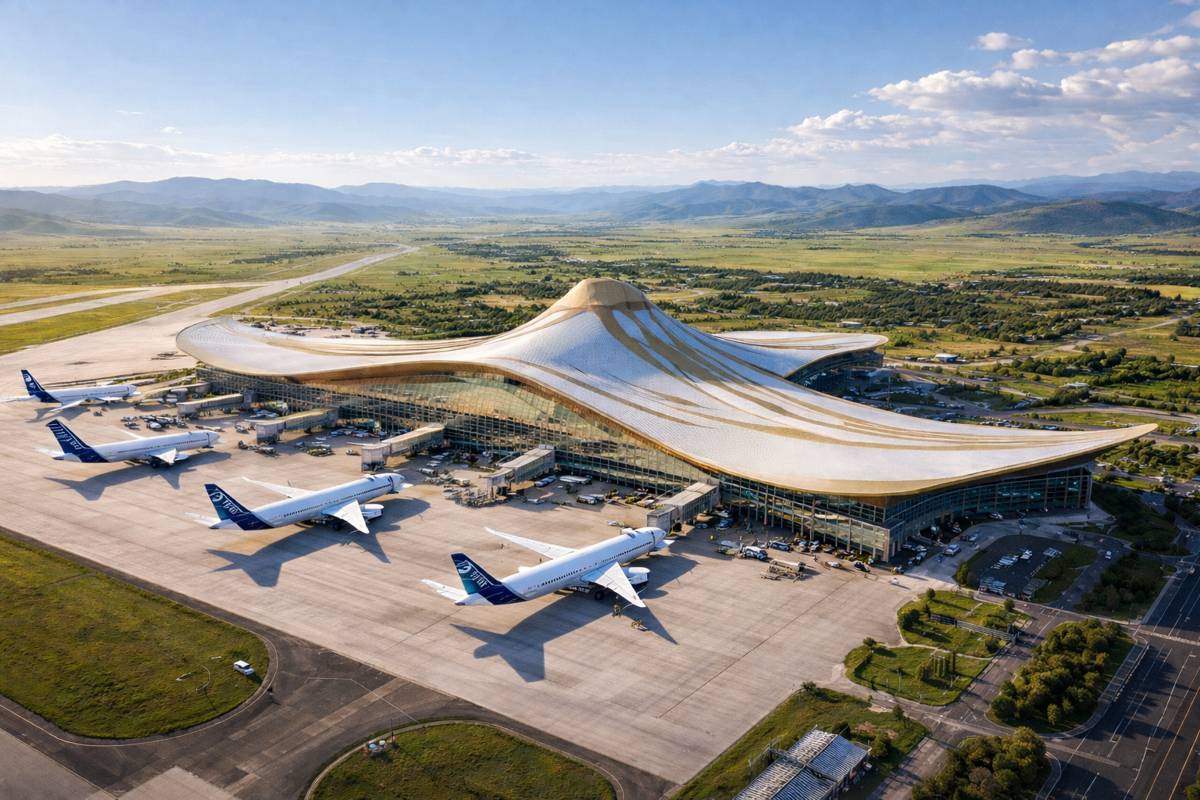
Seen from above, Shengle International Airport’s terminal is immediately distinctive. Its form resembles a carefully crafted saddle, a deliberate reference to the horse riding heritage that has shaped life on the grasslands for generations. This is not architectural novelty for its own sake. It reflects an effort to embed local identity into a piece of globally facing infrastructure.
The terminal’s main façade is defined by a 600 metre long eave inspired by the flowing khata scarf, a traditional symbol of respect and welcome. The gesture is both cultural and functional, creating a strong visual identity while offering shelter and scale appropriate to a major international gateway. Inside, skylights formed using spindle columns, cables, and inflatable membranes evoke the structure of a traditional Mongolian yurt. Natural light filters through the roof, opening views toward the sky and reinforcing a sense of openness and place.
For international passengers, these design choices communicate something important. Shengle International Airport is not an anonymous transit point. It is a gateway that tells a story about where travellers have arrived and what the region values.
More Than an Airport, a Platform for Global Integration
Beyond its architectural character, Shengle International Airport has been planned as a functional platform for integration into global aviation and logistics networks. Hohhot’s position on the Belt and Road land corridor and its role as the northern gateway of the China Mongolia Russia economic corridor give the airport strategic relevance for both passenger travel and freight movement.
The airport supports the city’s ambition to move further up the value chain, attracting logistics, trade, tourism, and advanced services. Air connectivity is increasingly linked to economic competitiveness, particularly for inland regions. Direct access to international routes reduces friction for exporters, attracts foreign investment, and supports the movement of high value and time sensitive goods.
In this context, Shengle International Airport is infrastructure designed not only to move people, but to accelerate economic integration across borders.
Capacity Planning for the Long Term
Shengle International Airport has been designed with clear long term growth targets. By 2030, the airport aims to handle an annual passenger throughput of 28 million, process 320,000 tonnes of cargo and mail, and support approximately 244,000 aircraft movements. These figures reflect expectations of steady regional growth combined with increased international connectivity.
Looking further ahead, the planning horizon extends to 2050. By that point, annual passenger numbers are projected to reach 65 million, with cargo and mail volumes rising to 800,000 tonnes and aircraft movements exceeding 511,000. Such capacity projections indicate confidence in sustained demand and position the airport as a long term asset within China’s national aviation system.
For infrastructure investors and planners, this staged capacity development demonstrates a measured approach. Expansion is aligned with anticipated demand rather than speculative overbuild, a balance that has become increasingly important in large scale transport infrastructure projects.
Digital Connectivity as Core Infrastructure
Modern airports are no longer judged solely on runways and terminals. Digital connectivity has become a core part of the passenger experience and operational efficiency. At Shengle International Airport, communication infrastructure has been treated as essential rather than optional.
Civil communication facilities were completed alongside the main construction works, and a seamless access strategy has been implemented in advance of opening. All three major Chinese telecom operators share a jointly built network, ensuring uninterrupted connectivity from arrival through boarding and departure. For international travellers and business passengers, this level of digital reliability supports productivity, navigation, and comfort.
Such investment reflects broader trends in aviation, where smart airports integrate communications, data, and automation to improve resilience and service quality. Shengle International Airport is aligning itself with these global best practices from the outset.
Building New Air Corridors Across Regions
Route development will determine how fully Shengle International Airport realises its strategic potential. Looking toward 2025, Hohhot Airport plans to strengthen partnerships with Xi’an and Qingdao airports, creating new transfer opportunities that extend its reach well beyond Inner Mongolia.
Through Qingdao Airport, Hohhot will gain improved access to routes serving Japan and South Korea. Via Xi’an Airport, connections will extend across Northwest China, Central Asia, and Southeast Asia. These partnerships will enable transfer services that link Hohhot to a wider network of domestic and international destinations without relying solely on direct flights.
In parallel, the airport will capitalise on Hohhot’s geographic proximity to Russia and Mongolia. Transfer services are planned that route passengers from Xi’an or Qingdao through Hohhot onward to regional cities as well as destinations in Russia and Mongolia. These emerging air bridges are expected to support economic exchange, tourism, and cultural communication across northern Eurasia.
A Northern Gateway with Global Reach
As dawn breaks over the grasslands, Shengle International Airport presents a striking image of modern infrastructure set within an ancient landscape. It is a young airport, but one shaped by centuries of movement, trade, and connection. From its 4F class runways to its culturally grounded architecture and digitally enabled operations, the airport reflects a deliberate effort to align heritage with future facing ambition.
For Hohhot, Shengle International Airport is more than a new point of departure and arrival. It is a statement of intent. By strengthening links between China, Mongolia, Russia, and Europe, the airport reinforces the city’s historical role as a crossroads while equipping it for contemporary global engagement. As operations commence and routes expand, the Air Silk Road passing through Hohhot is set to gain renewed relevance, carrying people, goods, and ideas across the northern frontier once more.