Major Stations, Rail and Systems Contract Opens for Toronto Subway Expansion
Infrastructure Ontario and Metrolinx have taken a decisive step forward in delivering one of the Greater Toronto Area’s most strategically important transit investments.
With the release of a Request for Qualifications for the Stations, Rail and Systems package of the Yonge North Subway Extension, the project has entered a stage that places industry capability, delivery experience and collaborative strength firmly in the spotlight.
Issued via the MERX procurement platform, the RFQ invites qualified consortia to signal their interest and demonstrate their credentials for a contract that will ultimately define the operational heart of the extension. This milestone follows earlier progress on advance tunnelling works and confirms that the project is now transitioning from preparatory activity into full system delivery.
The deadline for RFQ submissions is 23 January 2026, setting a clear and immovable timetable for contractors, designers and systems specialists preparing to engage with one of Canada’s most closely watched public transport procurements.
Why the Yonge North Subway Extension Matters
Extending Line 1 north beyond Finch Station has long been viewed as a missing link in Toronto and York Region’s transit network. Population growth along the Yonge Street corridor has consistently outpaced the capacity of existing bus and road infrastructure, creating congestion that affects commuters, businesses and freight movement alike.
The Yonge North Subway Extension addresses this imbalance by delivering approximately eight kilometres of new rapid transit, providing a seamless subway connection into Richmond Hill. In doing so, it supports broader policy objectives centred on sustainable mobility, economic competitiveness and reduced dependence on private vehicles.
Beyond transport efficiency, the extension is also a catalyst for urban development. Transit oriented communities planned around the new stations are expected to unlock residential density, commercial investment and long term employment opportunities, reinforcing the economic rationale behind the project.
Scope and Scale of the Stations, Rail and Systems Contract
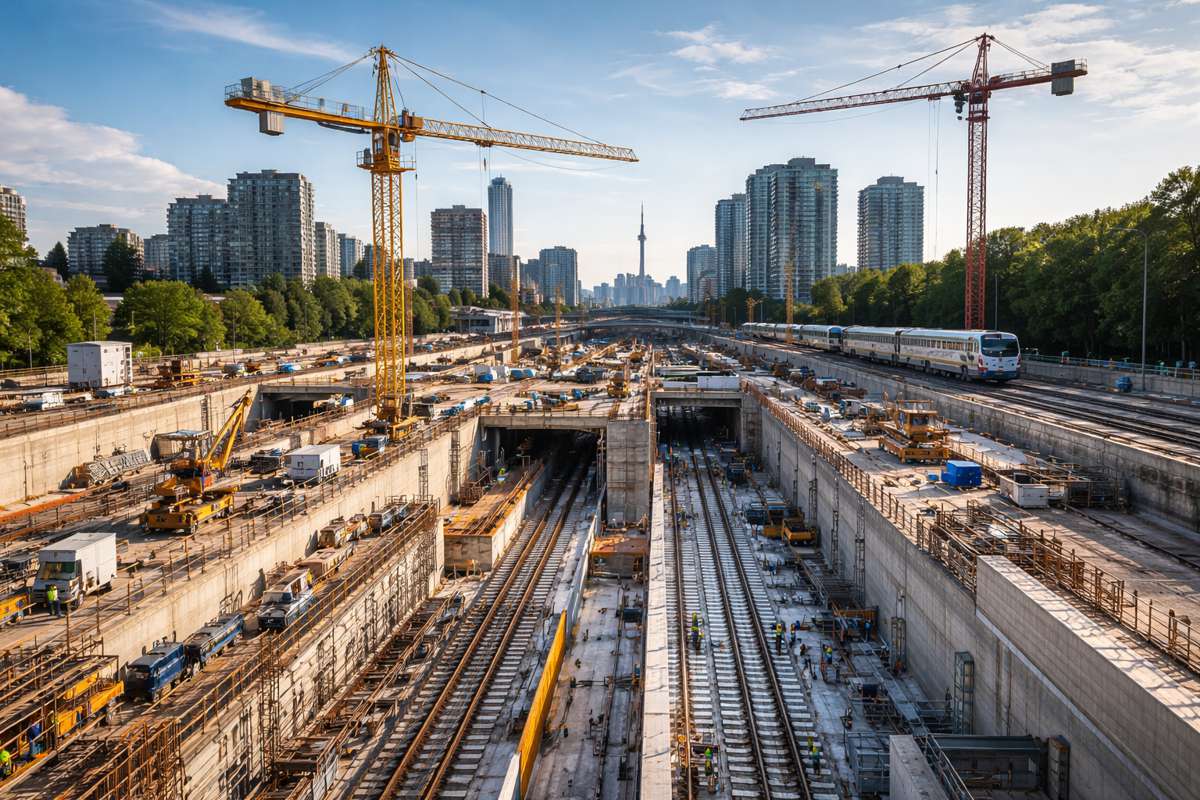
The Stations, Rail and Systems package represents one of the most complex and integrated elements of the Yonge North Subway Extension. Unlike advance tunnelling works, which focus largely on underground excavation, this contract encompasses the infrastructure passengers will ultimately see and use.
The RFQ outlines a broad scope of responsibilities, including:
- Delivery of five new subway stations and associated bus terminals
- Construction of a new train storage facility north of the existing Finch terminus
- Installation of trackwork, power supply, signalling and communications systems
- Provision of emergency exit buildings, traction power substations and tunnel cross passages
- Modifications and tie ins at Finch Station to integrate the extension with the existing Line 1 network
- Testing, commissioning and full systems integration
Collectively, these elements demand not only civil engineering expertise but also deep experience in rail systems integration, safety certification and operational readiness. The successful proponent will be responsible for ensuring that the extension functions as a seamless continuation of Toronto’s busiest subway line.
Progressive Alliance Model Shapes Industry Engagement
A defining feature of the Yonge North Subway Extension is its use of a progressive alliance contracting model. Rather than pursuing a traditional design build approach, Infrastructure Ontario and Metrolinx have opted for a framework that prioritises collaboration, transparency and shared accountability.
Under this model, public sector partners and private sector participants work together from an early stage to develop design solutions, manage risk and align incentives. Commercial arrangements are structured to reward collective performance rather than individual contractual positioning.
For industry bidders, this changes the nature of competition. Technical capability remains essential, but equal weight is placed on behavioural attributes, collaborative track records and the ability to work constructively within an integrated delivery team. The RFQ phase is therefore as much about organisational culture as it is about engineering credentials.
Timeline, Market Response and the January 2026 Deadline
With the RFQ now open, prospective teams are operating against a compressed but clearly defined procurement timetable. Submissions must be completed and lodged by 23 January 2026, after which Infrastructure Ontario and Metrolinx will evaluate responses and identify a shortlist of qualified proponents.
Those shortlisted will be invited to participate in a subsequent Request for Proposals phase, during which detailed technical solutions, commercial structures and delivery strategies will be assessed. This competitive dialogue is expected to refine scope, confirm risk allocation and establish target cost frameworks consistent with the alliance model.
For the construction and rail systems market, the RFQ has already generated strong interest. The scale of the contract, combined with its prominence within Ontario’s wider transit expansion programme, positions it as a flagship opportunity for firms seeking long term involvement in Canadian infrastructure delivery.
Integration with Advance Works and Existing Networks
The Stations, Rail and Systems contract does not exist in isolation. It builds directly on advance tunnelling works that are already underway, requiring close coordination between delivery teams to maintain programme alignment and safety assurance.
Equally important is integration with the existing Line 1 subway. Modifications at Finch Station and careful management of operational interfaces will be critical to minimising disruption to passengers while enabling a reliable transition to expanded service once the extension opens.
This requirement places additional emphasis on systems engineering discipline, staged commissioning strategies and rigorous testing regimes. Experience with live rail environments will be a key differentiator among bidders as the procurement process progresses.
Part of a Broader Transit Investment Programme
The Yonge North Subway Extension sits within a broader wave of transit investment reshaping the Greater Toronto Area. Alongside projects such as the Ontario Line and other subway extensions, it reflects a long term commitment to expanding rapid transit capacity in step with population growth.
From a policy perspective, these investments are designed to deliver multiple returns. Improved mobility supports labour markets and productivity, while reduced road congestion contributes to emissions reduction and public health objectives. For investors and contractors, the programme offers a sustained pipeline of work across civil construction, systems delivery and asset management.
As the RFQ deadline approaches, attention will remain firmly focused on how industry responds to the challenge. The outcome of this procurement will not only determine who delivers the next phase of the Yonge North Subway Extension, but also set benchmarks for collaborative infrastructure delivery in Canada.