Bobcat is Rewriting the Rules of Compact Equipment at CES
The construction sector rarely changes direction overnight. Progress tends to arrive in measured steps, shaped by hard lessons learned on real jobsites. Yet every so often, a moment comes along that signals a genuine shift in thinking. At CES 2026, Doosan Bobcat Inc. offered precisely that. Not with a single headline-grabbing gadget, but with a carefully connected portfolio of technologies designed to make compact equipment simpler, safer and more productive to operate.
Rather than chasing novelty for its own sake, Bobcat’s latest developments focus on people. Operators, technicians and fleet owners sit squarely at the centre of the strategy. Artificial intelligence, autonomy, electrification and connectivity are not presented as abstract concepts, but as practical tools woven into machines that already form the backbone of construction, utilities, agriculture and landscaping work worldwide.
Scott Park, CEO and Vice Chairman of Doosan Bobcat, framed the approach with characteristic clarity: “For nearly 70 years, Bobcat has led the compact equipment industry by solving real problems for real people. Today, as workforce needs change and jobsites become more complex, we’re responding with intelligent systems that empower people to accomplish more, faster and smarter. These innovations aren’t concepts for the distant future; they’re advancements that are shaping how work gets done right now.”
That emphasis on immediacy matters. Labour shortages, skills gaps and rising safety expectations are no longer looming challenges. They are daily realities. Bobcat’s CES 2026 showcase reflects an understanding that technology must lower barriers, not raise them.
Bobcat Jobsite Companion and the Evolution of the Operator Interface
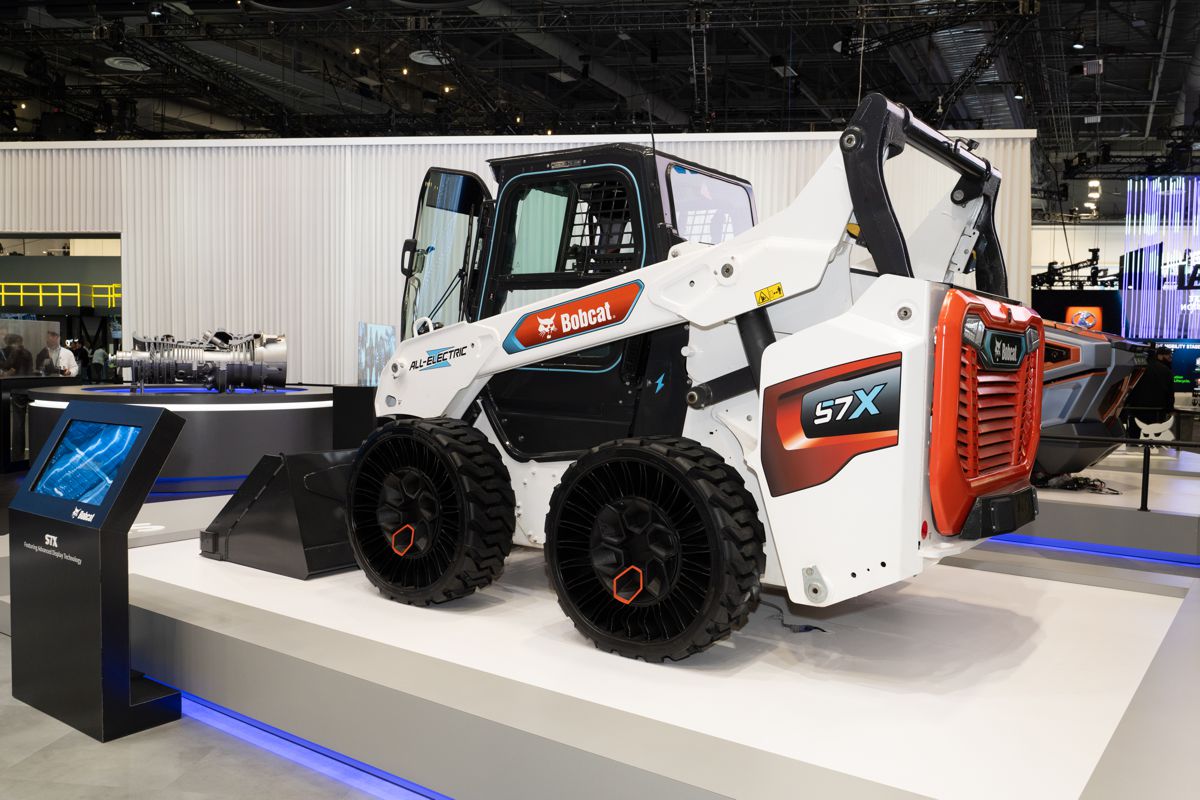
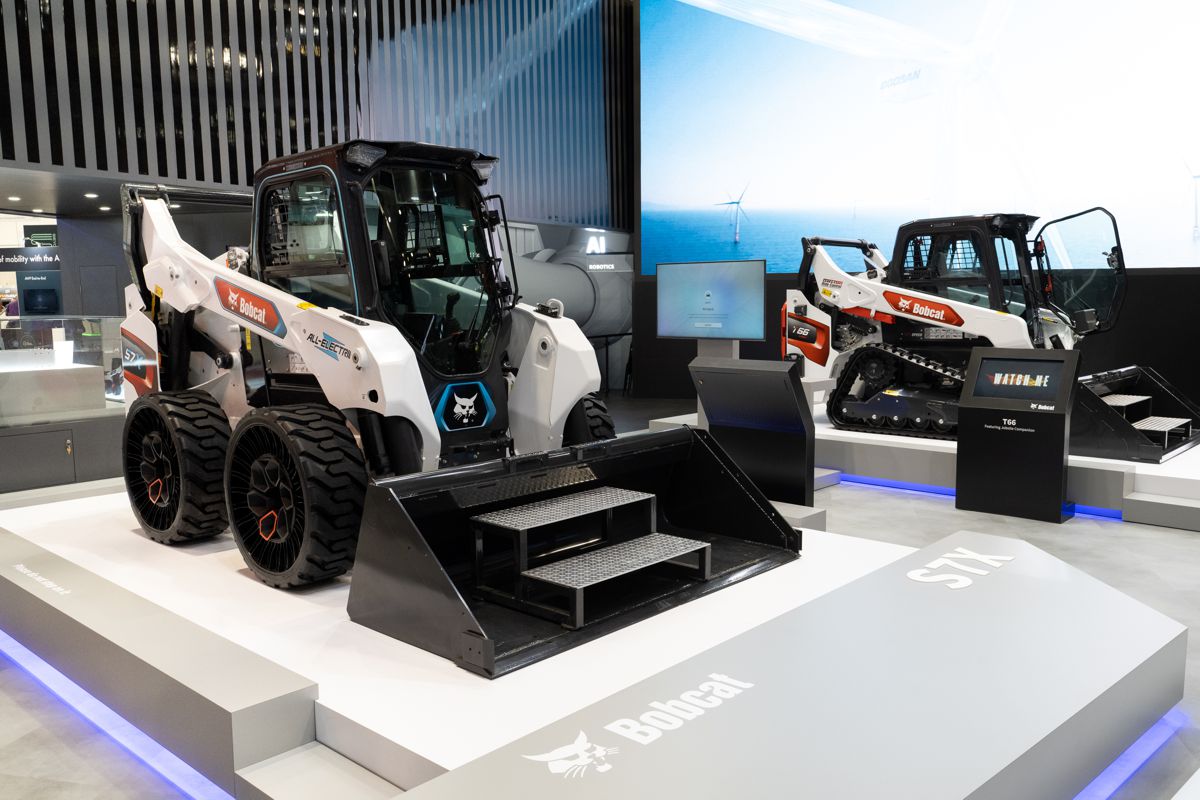
At the heart of the announcement sits Bobcat Jobsite Companion, described as the first AI-enabled feature developed specifically for compact construction equipment. This prototype marks the most significant change in the machine operator interface in nearly twenty years, not because it adds complexity, but because it removes it.
Jobsite Companion allows operators to interact with the machine through natural voice commands or simple prompts displayed in the cab. Instead of navigating menus or memorising settings, an operator can ask the machine for guidance, request an adjustment, or automate routine functions while keeping both hands on the controls. More than fifty machine functions can be automated or optimised in this way.
What sets the system apart is where its intelligence lives. Powered by Bobcat’s proprietary AI large language model, Jobsite Companion runs entirely onboard the machine. There is no dependency on cloud connectivity, a crucial consideration for remote or connectivity-limited sites. Real-time responsiveness is preserved whether the machine is working in an urban redevelopment zone or far from reliable network coverage.
Joel Honeyman, Vice President of Global Innovation at Doosan Bobcat, highlighted the human impact of the technology: “Jobsite Companion lowers the barrier to entry for new operators while helping experienced professionals work faster and more precisely. It’s not just smarter technology; it’s a smarter experience that puts expert-level guidance directly in the cab.”
In practical terms, this means less time spent training on interfaces and more time focused on the task at hand. For an industry grappling with an ageing workforce and fewer new entrants, that shift could prove decisive.
Service.AI and the Fight Against Downtime
If Jobsite Companion focuses on productivity in the cab, Service.AI addresses one of the most persistent frustrations beyond it: downtime. Equipment that is waiting for diagnosis or repair is equipment that is not earning.
For contractors weighing technology upgrades against capital budgets, the market for used Bobcats for sale remains an important part of the ownership equation, especially when lower acquisition costs can be paired with stronger uptime, diagnostics and support.
Service.AI is an AI-powered service and support platform designed for dealers and technicians. The system provides instant access to repair manuals, warranty information and Bobcat’s extensive archive of historical service cases. More importantly, it offers real-time diagnostic guidance, effectively placing the knowledge of a master technician at the technician’s fingertips.
By simplifying complex diagnostics into step-by-step processes, Service.AI accelerates repair timelines and reduces the risk of misdiagnosis. In an era where skilled technicians are in short supply across global markets, this approach helps to stretch existing expertise further without compromising quality.
The broader implication is a more resilient service ecosystem. Faster repairs mean higher machine availability, lower operating costs for fleet owners and stronger dealer relationships built on reliability rather than reaction.
Collision Warning and Avoidance Built for Compact Equipment
Safety innovation in construction often focuses on large machines and major projects, yet many of the industry’s most serious incidents occur around compact equipment operating in tight, congested environments. Bobcat’s prototype Collision Warning and Avoidance System addresses that reality directly.
Designed specifically for the compact equipment sector, the system uses advanced imaging radar to track the position, direction and speed of surrounding objects in real time. When a potential hazard is detected, the machine alerts the operator and can automatically slow or stop to help prevent a collision.
Crucially, the system has been developed to enhance awareness without overwhelming the operator. Early customer testing has already identified the technology as a differentiator when selecting equipment, suggesting that safety features are increasingly influencing purchasing decisions alongside performance and price.
As regulatory scrutiny around site safety continues to intensify, proactive systems like this may soon shift from optional innovation to expected standard.
Advanced Display Technology and Seeing the Jobsite Differently
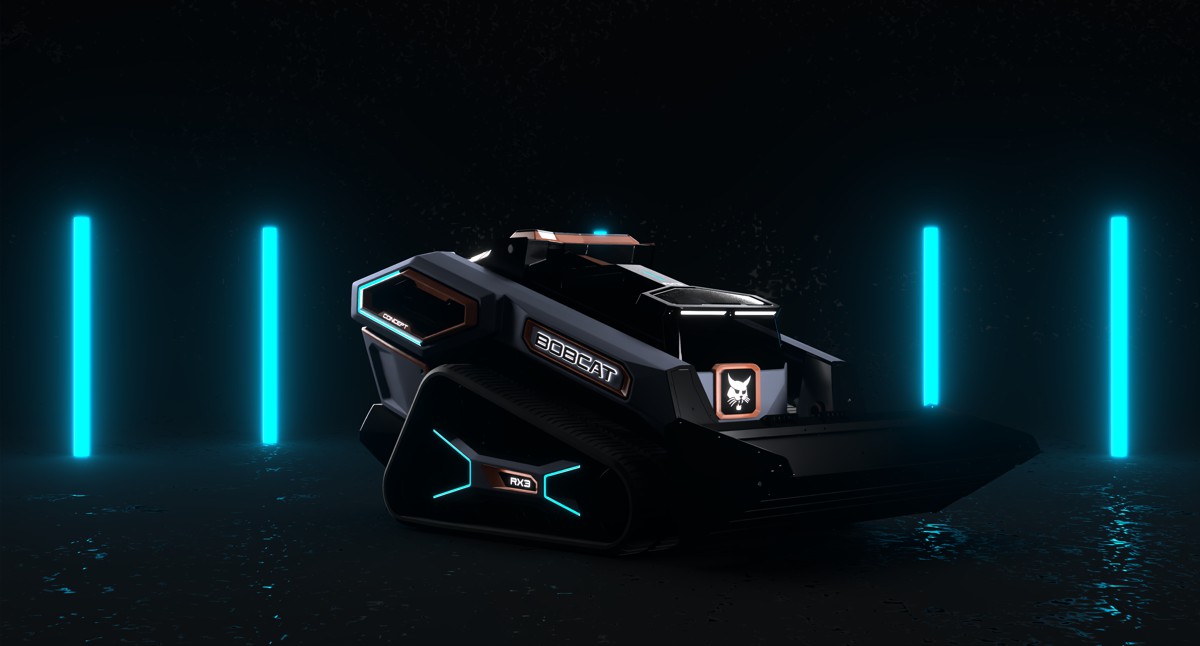
Bobcat’s Advanced Display Technology concept rethinks how information is delivered to operators. Rather than adding another screen, the system integrates a MicroLED, transparent, auto-tint, touch-enabled display directly into the cab door or machine window.
Operational data is overlaid onto the operator’s natural field of view, allowing machine insights and jobsite awareness to coexist. The display concept supports a range of functions, including:
- 360-degree camera views
- Collision warning and avoidance alerts
- Jobsite feature visualisation
- Real-time machine performance data
- Visual asset tracking and monitoring
Honeyman captured the philosophy succinctly: “It’s not just a screen. It’s a smarter window into the work, delivering clarity, control and confidence.”
The approach aligns with broader human-machine interface trends seen across transport, aviation and industrial automation, where situational awareness is prioritised over raw data volume.
RogueX3 and the Shape of Future Machines
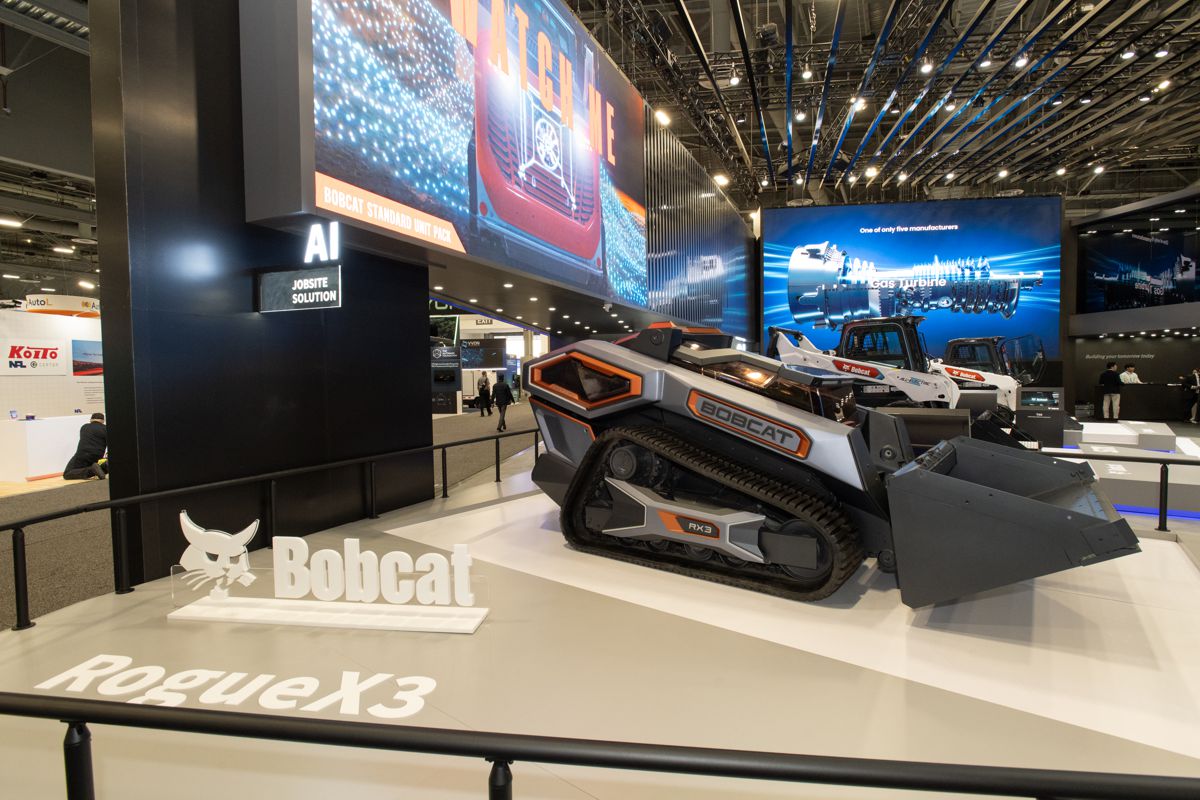
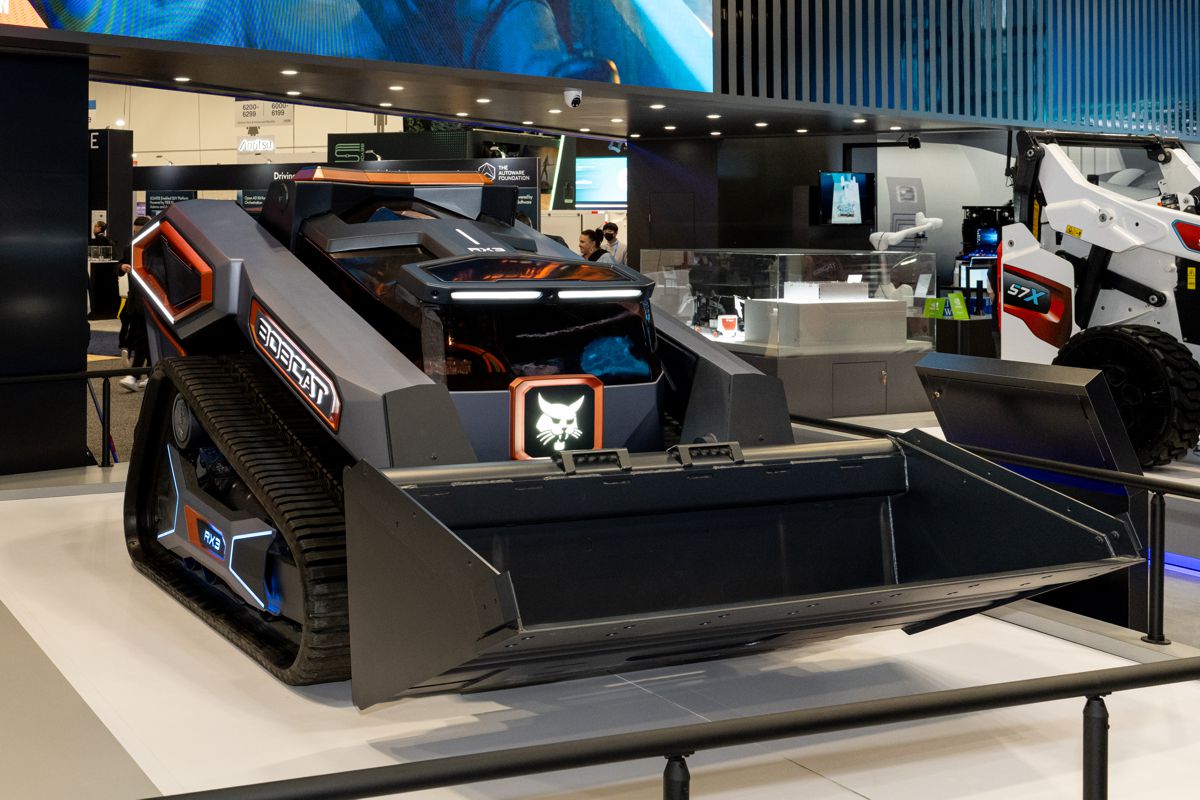
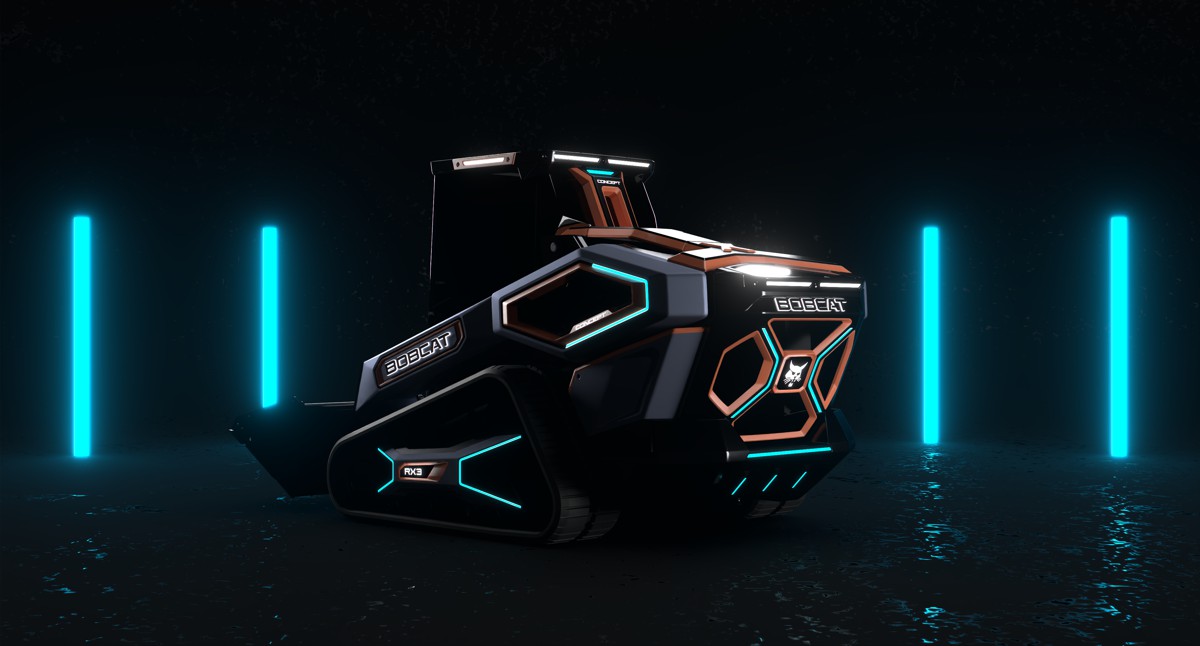
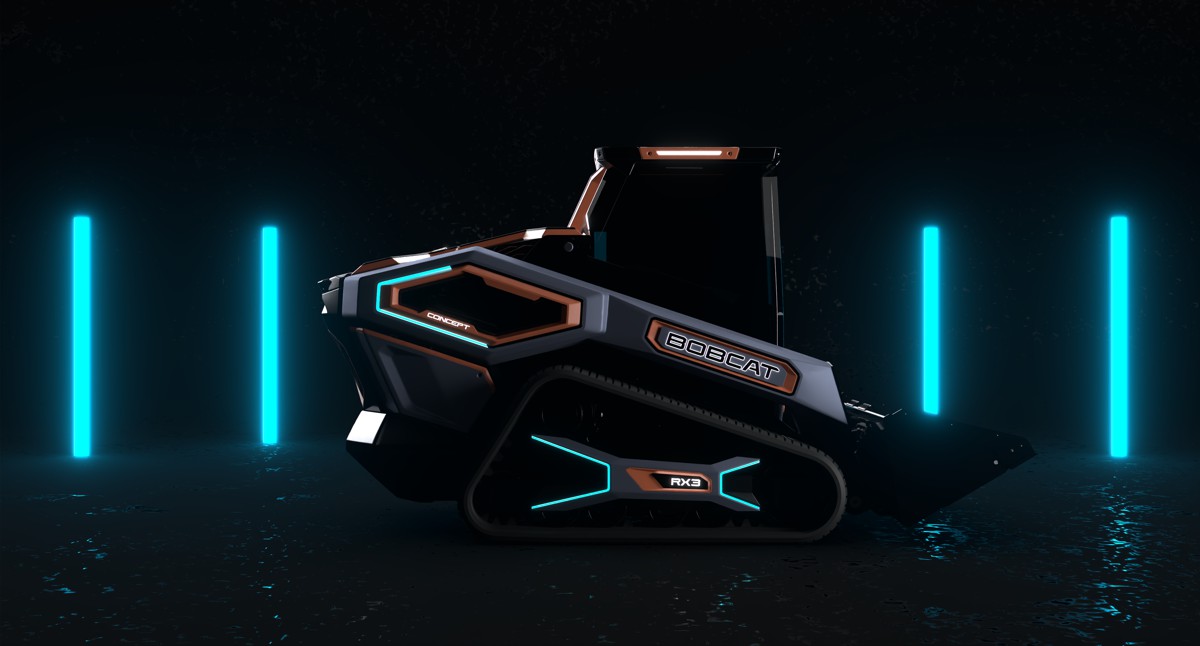
Perhaps the most visually striking element of Bobcat’s CES presence was RogueX3, the company’s most advanced concept machine to date. Fully electric and autonomous, RogueX3 builds on earlier RogueX platforms while pushing modularity to new extremes.
The CES version operates without a cab and can function remotely or autonomously, but the underlying design is intentionally flexible. Interchangeable components allow configurations with or without a cab, on wheels or tracks, with varied lift arms and layouts. Looking ahead, the platform could support electric, diesel, hybrid or hydrogen powertrains.
This modular philosophy reflects a future where machines are no longer fixed-purpose assets. Instead, they become adaptable platforms that evolve with job requirements, regulatory pressures and energy availability. Multiple pending patents linked to RogueX3 suggest that many of these ideas will influence Bobcat’s production machines in the years ahead.
Bobcat Standard Unit Pack and the Practical Path to Electrification
Electrification only succeeds when power solutions fit the realities of the jobsite. Bobcat’s answer is the Bobcat Standard Unit Pack, or BSUP, a modular, fast-charging battery system engineered for harsh working environments.
BSUP units are designed to be stackable and compact, fitting within the tight space constraints of loaders, excavators and forklifts. They are built to withstand dust, debris and impact, and can be scaled across Bobcat’s equipment range. Notably, the system is also intended to be available to other OEMs.
By standardising battery modules, Bobcat reduces complexity for fleet owners managing mixed equipment types. Cleaner, quieter operation becomes more accessible without requiring bespoke power solutions for every machine.
An Integrated Vision Taking Shape
Viewed individually, each of these technologies addresses a specific challenge. Taken together, they form a coherent system aimed at redefining how compact equipment is operated, serviced and powered.
Park summarised the intent clearly: “We’re not just imagining the future, we’re engineering it. By combining AI, autonomy, electrification and connectivity, Bobcat is creating technology that empowers people, simplifies work and sets a new standard for the industry.”
While the products and systems showcased at CES 2026 remain prototypes or concept models, several are already advancing towards commercialisation. Their significance lies not only in what they do today, but in the direction they signal for an industry under pressure to do more with less, without compromising safety or reliability.