Faraday Future Sets Course for FX Super One and Robotics Growth at CES
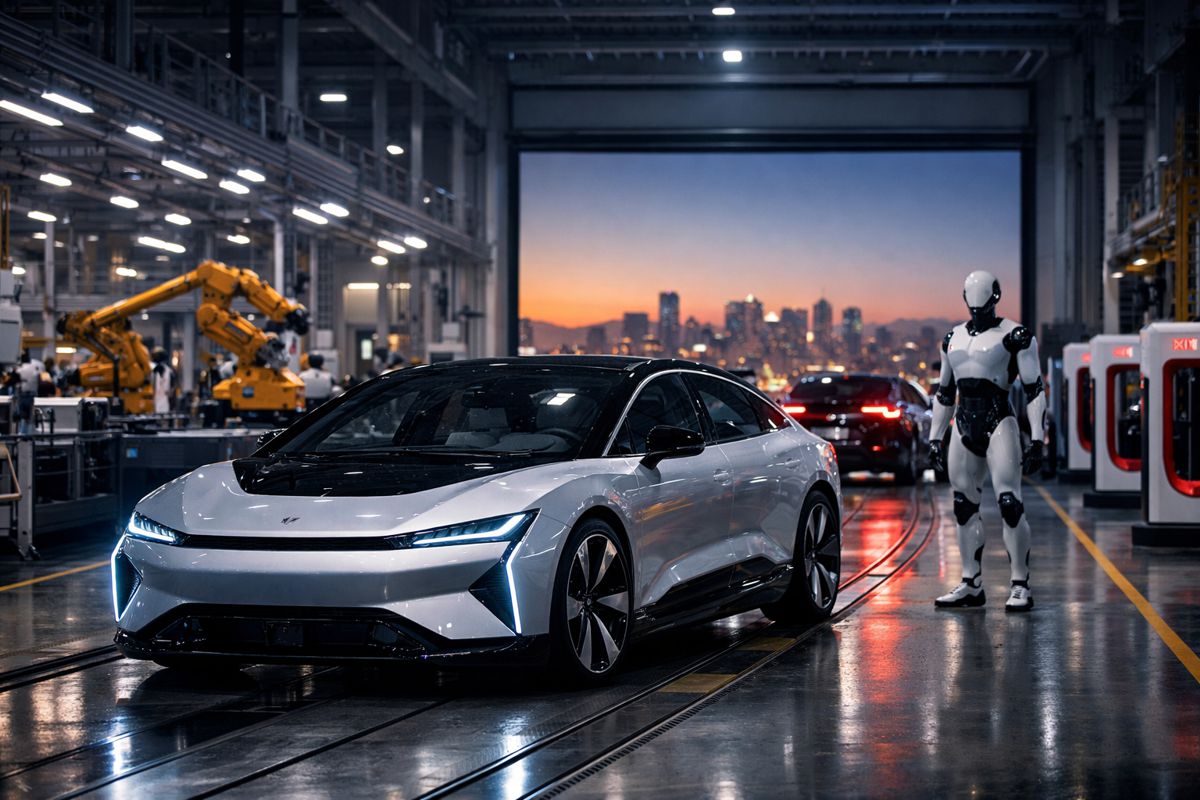
Faraday Future Intelligent Electric Inc. entered 2026 with a clear message to investors, partners, and the wider mobility sector. The California-based company is no longer speaking only about vehicle launches or factory readiness. Instead, it is laying out a broader industrial vision that links intelligent electric vehicles with embodied artificial intelligence robotics, supported by a structured delivery roadmap and a disciplined five-year execution plan.
Unveiled during the company’s first-ever Stockholders’ Day in Las Vegas, held alongside the Consumer Electronics Show, the update positioned Faraday Future as a business seeking credibility through measurable milestones rather than speculation. At the centre of this outlook sits the FX Super One, supported by an emerging FX brand portfolio and an ambitious move into AI-driven robotics.
A Structured Delivery Plan for FX Super One
Faraday Future has adopted a three-stage delivery structure for the FX Super One in the United States, a model designed to balance production learning, risk management, and financial discipline. Rather than pursuing an aggressive full-scale launch from day one, the company is sequencing deliveries to validate operations and contribution margins before entering the wider consumer market.
The first phase of deliveries is expected to begin in the second quarter of this year. This initial stage focuses primarily on FX Par partners, with deliveries capped at 50 units. These early vehicles are intended to support partner engagement, real-world validation, and operational feedback, all while maintaining tight control over volumes.
Phase two is scheduled for the third quarter and expands deliveries to industry leaders and B2B partners, with volumes capped at 200 units. During this period, Faraday Future is targeting a production ramp-up alongside its first positive contribution margin. This stage represents a critical transition, where operational efficiency and cost discipline begin to matter as much as engineering readiness.
The third phase marks the shift to full-scale deliveries, expected in the fourth quarter of this year or the first quarter of next year. At this point, the FX Super One will enter its broader U.S. market rollout, supported by expanded after-sales operations and a more mature supply chain. The company has stated that this phase is designed to sustain positive contribution margins rather than chase volume at any cost.
Launch Timing and Infrastructure Readiness
The final U.S. launch of the FX Super One is planned for the second quarter of this year. Importantly, Faraday Future is aligning this launch with the establishment of its after-sales and charging service infrastructure. This includes the rollout of underlying systems, operational frameworks, and service readiness that are often underestimated in early-stage EV programmes.
A key element of this infrastructure strategy is access to Tesla’s Supercharger Network across North America, Japan, and South Korea. By securing compatibility with an established charging ecosystem, Faraday Future is addressing one of the most persistent concerns among EV buyers: reliable and widespread charging access. This move reduces dependency on proprietary infrastructure while enhancing customer confidence from day one.
Regulatory Progress and Certification Milestones
Regulatory and compliance certifications for the FX Super One are progressing largely on schedule. Faraday Future has reported that key component certifications are nearing completion, creating a solid foundation for full vehicle homologation.
Vehicle-level certifications, including EPA, CARB, and FMVSS compliance, are expected to be completed by the third quarter of this year. These milestones are essential not only for U.S. market entry but also for building credibility with international regulators and partners as the FX brand considers expansion into additional regions.
Scaling the FX Super One Beyond Launch
Looking beyond the initial delivery phases, Faraday Future has outlined sales projections for the FX Super One that extend through the end of the decade. From 2027 onwards, the model line-up is expected to include both battery electric vehicle variants and HEREV models, which combine electric propulsion with a hybrid extended-range configuration.
Projected volumes indicate a steady but ambitious ramp-up:
- Approximately 4,900 units in 2027
- Around 18,000 units in 2028
- Roughly 38,000 units in 2029
- Up to 55,000 units in 2030
These figures reflect a strategy that prioritises controlled scaling rather than sudden volume spikes. The approach aligns with Faraday Future’s broader objective of building a sustainable manufacturing and financial model rather than relying on speculative growth.
Five-Year Business Plan and Production Targets
At the heart of Faraday Future’s long-term outlook is a cumulative five-year production and sales target of 400,000 to 500,000 vehicles. This volume is expected to be driven primarily by the FX Super One, a planned FX 4 model, and additional FX-branded vehicles currently under consideration.
The company’s baseline plan outlines production and sales of approximately 250 units in 2026, scaling to around 5,000 units in 2027 and more than 22,000 units in 2028. A sharper increase is anticipated thereafter, with roughly 130,000 units projected for 2029 and approximately 250,000 units in 2030. These targets are aligned closely with model introductions, factory readiness, and supplier capacity.
Key markets identified within this plan include the United States and the Middle East, where FX Super One deliveries have already begun. Other high-value markets are under evaluation, reflecting a cautious but opportunistic approach to global expansion.
Financial Discipline and Path to Profitability
Faraday Future has set clear financial objectives alongside its production targets. The company aims to achieve positive operating cash flow within approximately three years, supported by a target gross margin of around 20 percent.
The path to these goals is underpinned by what the company describes as strong market demand and tangible operational progress. Significant steps have already been taken across supplier engagement, homologation activities, and manufacturing readiness at the Hanford facility. Engineering validation, initial crash testing, battery safety certification, and software compliance are all advancing through a combination of in-house expertise and independent third-party validation.
Over the next twelve months, disciplined execution and timely vehicle delivery remain the primary focus. Flexibility has been built into the plan to allow adjustments in response to market conditions or supply chain challenges, an approach designed to mitigate risk while maintaining momentum.
Embodied AI Robotics Enters the Strategy
Beyond vehicles, Faraday Future has expanded its Global EAI Industry Bridge Strategy to include Embodied AI Robotics. This move signals a broader ambition to position the company at the intersection of mobility, artificial intelligence, and robotics.
AI is now entering a phase of large-scale deployment and commercialisation, with embodied AI emerging as one of the most significant industrial trends of this cycle. Faraday Future believes this convergence offers profound long-term value, not only for the company but for the wider technology and mobility ecosystem.
The stated objective is to become one of the first U.S. companies to deliver humanoid robot products to market with a positive contribution margin. By leveraging expertise developed through intelligent electric vehicles, Faraday Future aims to transfer learnings in software, sensors, and systems integration into a new product category.
A Dual-Track Growth Model
The combination of EAI vehicles and EAI robotics forms what Faraday Future describes as a dual-track growth model. Rather than treating robotics as a speculative side project, the company is positioning it as a parallel business line capable of contributing meaningfully to revenue and long-term valuation.
Private previews of the first planned robotics products were hosted during the Stockholders’ Day event, offering a glimpse into how this strategy may translate into tangible products. While detailed specifications have not yet been disclosed, the emphasis has been placed on commercial viability rather than experimental showcases.
NADA Show Launch and Partner Ecosystem
Faraday Future plans to hold the U.S. launch and begin sales of its first embodied AI robotics products on February 4 at the National Automobile Dealers Association Show in Las Vegas. The event will coincide with the FX Partner Summit, bringing together dealers and partners from both the automotive and technology sectors.
This summit is designed to expand the FX Par network, enabling partners to participate not only in vehicle sales and co-creation but also in the early rollout of AI robotics products. By integrating partners across both business lines, Faraday Future is attempting to build a collaborative ecosystem rather than a traditional top-down distribution model.
Leadership Perspective and Long-Term Vision
Faraday Future’s leadership team has framed this outlook as a turning point for the company. Speaking to stockholders, Global Co-CEO Matthias Aydt emphasised transparency and engagement as central to the company’s strategy: “First and foremost, I want to thank all of our stockholders both in attendance and who joined the livestream online for taking the time to hear these comprehensive updates on the Company’s future from myself and other members of our leadership team. We’ve said it before, but I want to say it again today; this event and all of our forward-facing communications to our stockholders reflects Faraday Future’s commitment to transparency, stockholder engagement, and long-term value creation as the Company accelerates toward its mission of revolutionizing the intelligent electric vehicle space.”
Founder and Global Co-CEO YT Jia struck a more symbolic note when addressing the year ahead: “The year 2026 is the Year of the Horse, and I hope that it will also be the year for FF to gallop full speed ahead and ride to victory. We will work extremely diligently and fight tooth and nail for the successful production, delivery, and ramp-up of FX Super One as we mark a new era of EAI vehicles and EAI robotics.”
Building Credibility Through Execution
Founded in 2014, Faraday Future set out to disrupt the automotive industry with a user-centric and technology-first approach. Its flagship FF 91 established a foundation in luxury and performance, while the FX strategy is intended to translate advanced technology into more accessible price segments.
As 2026 unfolds, the company’s credibility will be shaped less by ambition and more by execution. The staged rollout of the FX Super One, combined with a measured expansion into embodied AI robotics, suggests a business attempting to balance innovation with financial realism. Whether this approach delivers on its promises will become clearer as vehicles reach customers and robotics products move from preview to production.