Solid State Batteries Move Onsite as ProLogium Targets Construction at CES
Solid-state batteries have long promised a step change in safety, performance, and reliability, yet large-scale industrial adoption has remained elusive. That picture is now beginning to change. ProLogium Technology has announced a strategic collaboration with Kyushu Electric Power Co., Inc. and Nakayama Iron Works, Ltd., bringing solid-state battery technology decisively into the world of heavy and compact construction machinery.
The partnership will debut its first tangible results at CES 2026, where the three companies will jointly unveil a 24V solid-state battery module alongside two zero-emission construction machines, the MSD700 and the NE100HBJ. More than a technology demonstration, the collaboration establishes a vertically integrated ecosystem that spans battery cell development, module engineering, and real-world industrial deployment. In doing so, it positions solid-state batteries not as a future concept, but as a practical and scalable solution for demanding construction environments.
Why Industrial Energy Needs a Rethink
Across construction, mining, and industrial equipment sectors, pressure is mounting from multiple directions. Regulators are tightening emissions standards, urban job sites are becoming more constrained, and operators are demanding safer, quieter, and more efficient machines. At the same time, the limitations of conventional lithium-ion batteries are becoming increasingly visible, particularly around thermal runaway risks, charging times, and durability under vibration-heavy conditions.
In this context, solid-state batteries offer a compelling alternative. By removing flammable liquid electrolytes and rethinking internal battery architecture, they promise enhanced safety and stability. Yet industrial users require more than theoretical advantages. They need proof that new energy systems can withstand harsh operating conditions, integrate into existing equipment platforms, and deliver tangible productivity gains. This collaboration is designed to answer exactly those concerns.
ProLogium’s Safety-First Solid-State Architecture
At the centre of the project is ProLogium’s next-generation lithium ceramic solid-state battery technology. The company’s approach is built around a Super-fluidized All Inorganic Solid State Electrolyte, combined with an Active Safety Mechanism that activates under high temperature and high voltage conditions. Together, these features are intended to stabilise both cathode and anode materials and interrupt thermal chain reactions before they escalate.
Vincent Yang, Founder and CEO of ProLogium, explained the significance of this design philosophy: “ProLogium’s next-generation solid-state lithium ceramic battery features a unique Super-fluidized All Inorganic Solid State Electrolyte, combining a non-flammable all-inorganic electrolyte with an Active Safety Mechanism that is released under high temperature and high voltage to stabilise the active materials of both the cathode and anode. This enables the battery to truly interrupt thermal chain reactions and achieve the ultimate goal of eliminating thermal runaway.”
By addressing safety at the cell level, ProLogium aims to remove one of the most persistent barriers to battery electrification in heavy machinery. The focus is not only on preventing combustion, but on delivering predictable, stable performance across a wide operating envelope.
Vertical Integration as a Competitive Advantage
What sets this partnership apart is the depth of integration between the three companies. Rather than treating batteries as an off-the-shelf component, the alliance has been structured to optimise performance from the cell through to the finished machine.
ProLogium supplies the solid-state lithium ceramic cells. Kyushu Electric Power applies its extensive expertise in energy systems and battery monitoring and control to design the 24V solid-state battery module. Nakayama Iron Works then integrates the module into its construction machinery platforms, ensuring compatibility with real-world duty cycles and operating conditions. Supporting partners, including module manufacturer Seiko Electric and global sales agent Sojitz Kyushu Corporation, complete the value chain.
This vertically integrated model allows quality, safety, and cost considerations to be addressed holistically. It also accelerates the path from research and development to commercial deployment, a critical factor as the construction industry looks to decarbonise without compromising productivity.
Energy Expertise from the Grid to the Job Site
Kyushu Electric Power’s role extends beyond module assembly. The company brings decades of experience in energy technology, system monitoring, and battery control, all of which are essential for industrial electrification.
Koji Kurayama, Manager of the Next-Generation Storage Battery System Project at Kyushu Electric Power, highlighted the broader ambition of the collaboration: “We are excited to leverage our expertise in energy technology and battery monitoring to contribute to the development of next-generation solid-state battery solutions. This collaboration represents a significant step toward realising a sustainable and carbon-neutral future.”
By applying grid-level thinking to mobile energy systems, Kyushu Electric Power helps ensure that the battery modules are not only powerful, but also intelligently managed, maximising lifespan and operational reliability.
Construction Machinery Built for a Zero-Emission Era
Nakayama Iron Works brings the technology to life on the job site. Known for its specialist construction and material processing equipment, the company is integrating the solid-state battery module into two very different machines, each addressing a distinct market need.
Hiroshi Nakayama, President of Nakayama Iron Works, underscored the strategic importance of the move: “By integrating next-generation solid-state battery technology and collaborating with industry leaders, we are committed to delivering advanced solutions that address the evolving needs of our customers and contribute to a sustainable future.”
The result is not a concept vehicle, but working machinery designed to operate in environments where emissions, noise, and safety constraints are increasingly decisive factors.
Inside the 24V Solid-State Battery Module
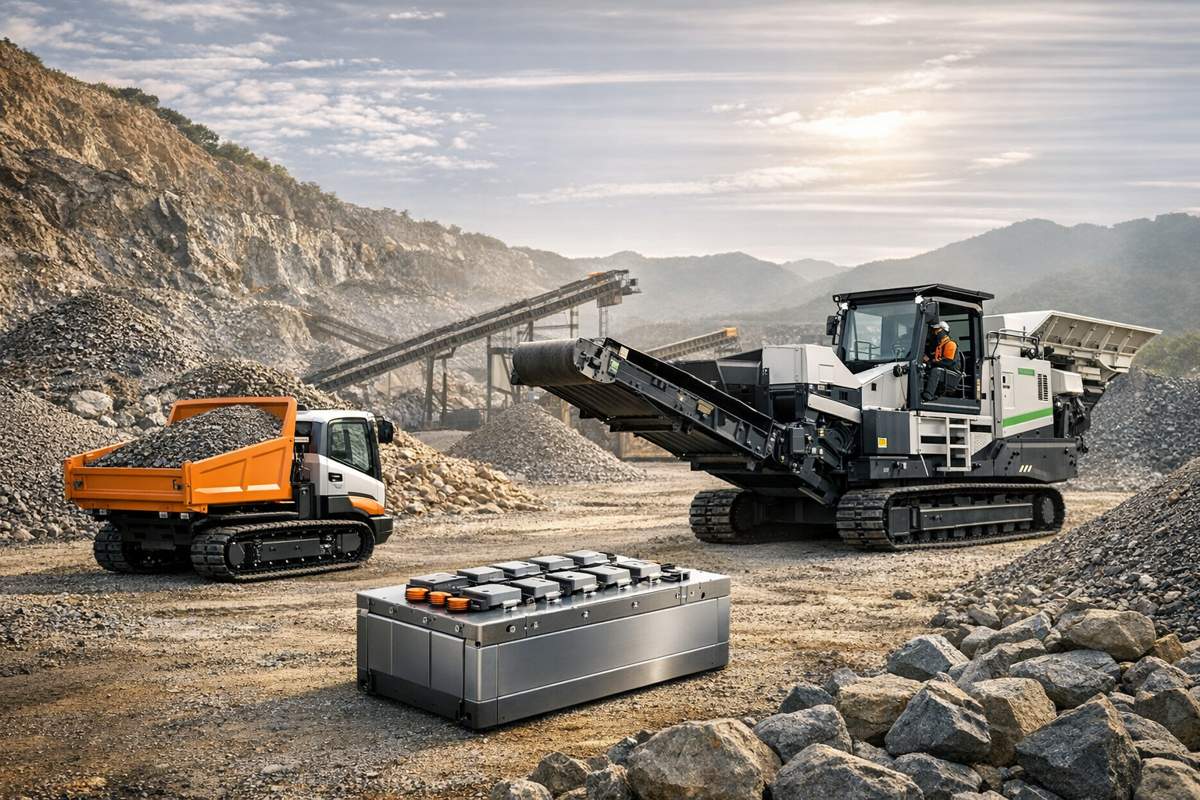
The 24V DC battery module being showcased at CES 2026 incorporates seven ProLogium SN-10 solid-state cells. Despite its compact form factor, the module delivers a capacity of up to 111.3Ah and an energy capacity of up to 2,671Wh. Designed for industrial conditions, it offers high vibration resistance and supports an operating voltage range from 29.4V down to 17.5V.
Flexibility is another key attribute. Through configurable series and parallel arrangements, the module can be adapted to deliver higher voltage, higher current, or larger capacity depending on application requirements. Compared with conventional lithium-ion solutions, the solid-state module promises not only improved safety, but also faster charging and longer operating times.
Measurable Productivity Gains on Site
For contractors and operators, performance improvements matter most when they translate into real productivity gains. The projected figures for the two machines illustrate the potential impact.
For the MSD700, overall operating time across all functions is expected to increase from around two hours to approximately 3.7 hours. Charging time, meanwhile, is projected to fall to around 0.45 hours, or roughly 27 minutes. That combination significantly reduces downtime and increases effective utilisation.
The NE100HBJ shows even more dramatic gains. In travel duty, operating time is expected to increase from eight hours to ten hours. In crushing duty, runtime could extend from four hours to as much as ten hours. Charging time is projected to drop to approximately 0.24 hours, or around 14 minutes. Together, these improvements make a compelling case for solid-state batteries in high-throughput material processing applications.
MSD700 Compact Design for Constrained Environments
The MSD700 is a compact, battery-driven construction machine designed for narrow and challenging environments where larger equipment or manual labour struggle to operate efficiently. Its compact vehicle design allows it to access confined spaces while maintaining functional capability.
With zero tailpipe emissions, the MSD700 can operate safely indoors, underground, or in low-temperature environments without concerns about exhaust gases. This makes it particularly suitable for urban construction, refurbishment projects, and industrial facilities where ventilation is limited and emissions regulations are strict.
NE100HBJ Crushing Without Compromise
The NE100HBJ, part of the DENDOMAN series, is a battery-driven crusher capable of processing between 15 and 50 tonnes of rock or concrete per hour. Traditionally, this class of equipment has relied heavily on diesel power due to energy demands and duty cycles.
By pairing solid-state batteries with efficient electric drive systems, the NE100HBJ achieves zero emissions without sacrificing throughput. The extended runtime and rapid charging capability enabled by ProLogium’s battery technology significantly enhance its practicality for demolition, recycling, and quarrying applications.
Beyond Construction, a Broader Industrial Implication
While the immediate focus is on construction machinery, the implications of this collaboration extend far wider. Industrial sectors ranging from logistics and ports to mining and infrastructure maintenance are all grappling with similar challenges around safety, emissions, and energy efficiency.
Conventional lithium batteries, with their liquid electrolytes and separator-based designs, remain vulnerable to thermal runaway and combustion. Even some sulphide-based solid-state batteries still carry inherent risks. ProLogium’s all-inorganic electrolyte architecture and integrated safety mechanisms represent a different approach, one aimed at fundamentally eliminating these hazards rather than mitigating them after the fact.
Scaling Up for Global Deployment
Technology alone is not enough. Industrial electrification depends on the ability to scale production reliably and cost-effectively. ProLogium’s gigawatt-hour-scale superfactory manufacturing capability plays a crucial role here, enabling mass production of solid-state batteries while optimising costs.
This manufacturing scale allows the company to support diverse global partners and applications, from compact machinery to larger industrial platforms. Combined with the vertically integrated partnership model demonstrated in this project, it provides a credible pathway for solid-state batteries to move from niche deployments to mainstream industrial adoption.
Setting a New Reference Point for Smart Construction
The collaboration between ProLogium, Kyushu Electric Power, and Nakayama Iron Works marks a meaningful milestone in the evolution of construction machinery. By bringing solid-state battery technology into working machines and demonstrating measurable gains in safety, runtime, and charging performance, the partnership sets a new reference point for what zero-emission construction equipment can achieve.
As the industry continues its transition towards cleaner, smarter, and more resilient infrastructure, this project stands as a clear signal that solid-state batteries are ready to play a central role. Not as a distant promise, but as a practical energy solution shaping the next generation of industrial machinery.