Rethinking Pickup Truck Storage for the Infrastructure Economy
The global construction and infrastructure ecosystem is quietly changing its relationship with the humble pickup truck. Once seen primarily as a means of transport, the truck is now increasingly treated as a mobile asset, a rolling extension of the jobsite that must deliver productivity, security and resilience in equal measure.
For contractors, maintenance crews, utilities, logistics operators and infrastructure inspectors, the way tools and equipment are stored is no longer a secondary concern. It has become a frontline operational issue, tied directly to efficiency, downtime, safety and loss prevention.
Against that backdrop, the launch of a fully redesigned truck bed tool box by DECKED carries significance well beyond the aftermarket accessories category. While tool boxes have existed for decades with only incremental changes, this release signals a more fundamental rethink of what truck-based storage must deliver for modern, professional users operating in demanding environments.
Why Truck Storage Matters to Infrastructure Productivity
In construction, infrastructure maintenance and transport operations, lost time is rarely recovered. Crews that arrive on site without the right tools, or spend critical minutes searching for equipment buried under loose gear, pay for it in productivity and safety. Theft adds another layer of cost, not only through replacement expenses but also through disrupted schedules and insurance claims.
Industry research consistently shows that tool loss and disorganisation contribute to avoidable inefficiencies on jobsites, particularly for mobile crews responsible for highways, utilities, rail corridors and industrial facilities. As work becomes more decentralised and assets more distributed, secure and structured vehicle storage has emerged as a quiet but essential enabler of reliable operations.
The challenge is that many traditional metal tool boxes were never designed for this reality. Welded aluminium or steel units dent, corrode, leak and often prioritise basic containment over true system integration. For professionals who rely on their vehicles daily, these limitations have become increasingly difficult to ignore.
A Category Long Overdue for Disruption
The truck bed tool box market has remained largely stagnant for years, dominated by variations on the same metal designs. While power tools, digital workflows and connected equipment have evolved rapidly, storage solutions have lagged behind, offering little innovation beyond lock upgrades or minor layout tweaks.
This gap has become more visible as trucks themselves have grown more sophisticated. Modern pickups now serve as platforms for power generation, digital connectivity and modular work setups. Storage systems that fail to match this evolution risk becoming bottlenecks rather than assets.
It is into this context that DECKED introduces a ground-up redesign rather than a cosmetic refresh. By questioning long-standing assumptions about materials, construction and usability, the company positions its new Tool Box as a response to structural shortcomings in the category rather than a simple product extension.
Material Science Meets Real-World Abuse
At the core of the new Tool Box is a decisive move away from welded metal construction. Instead, DECKED has adopted compression-moulded, fibre-reinforced Sheet Moulding Compound. This material, widely used in demanding industrial and automotive applications, delivers strength characteristics comparable to steel while maintaining the weight profile closer to aluminium.
The practical implications are significant. Unlike metal boxes, the structure does not dent under impact, does not rust when exposed to moisture or road salts, and does not rely on welded seams that can become failure points over time. For infrastructure professionals operating across variable climates, from wet coastal highways to arid desert corridors, material resilience directly affects lifecycle costs.
Just as importantly, the material choice enables tighter tolerances and more consistent weather sealing. Tools and sensitive equipment remain protected not only from theft attempts but also from dust ingress, heavy rain and prolonged exposure to the elements, conditions that frequently undermine traditional designs.
Security as an Operational Requirement, Not a Feature
Tool theft remains a persistent problem across construction and infrastructure sectors, particularly for vehicles left unattended overnight or parked at remote sites. While locks are often marketed as security solutions, the reality is that box construction and lid integrity matter just as much as the locking mechanism itself.
DECKED’s approach treats security as a system-level requirement. The reinforced structure, weather-tight sealing and integrated locking design are intended to resist forced entry attempts without compromising everyday usability. This matters for operators who cannot afford to trade access speed for protection, especially when tools are needed repeatedly throughout the day.
By designing the Tool Box to withstand extreme abuse without losing functionality, the company aligns security with durability, reducing the likelihood that damage itself becomes a point of vulnerability over time.
From Storage Container to Organised System
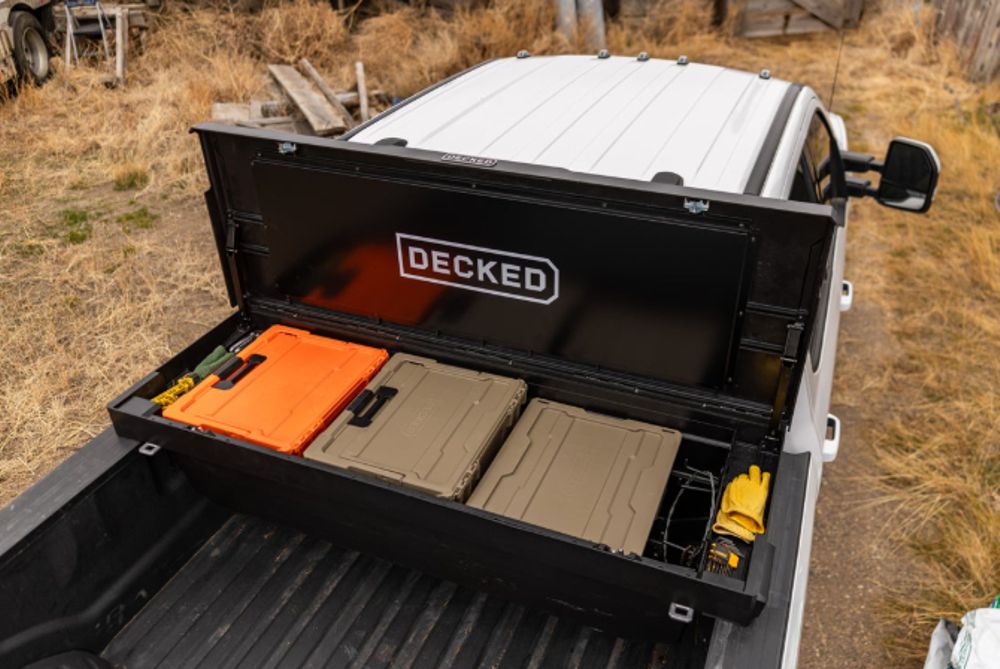
One of the most notable shifts in the new Tool Box is its emphasis on purpose-built organisation. Rather than an empty cavity that relies on users to impose order, the interior is designed to support modular cases, trays and hooks as part of a wider ecosystem.
Built-in accessory rails accommodate DECKED’s own D-Co cases as well as Milwaukee Packout cases, reflecting the reality that professionals already invest heavily in modular tool platforms. This compatibility reduces friction and avoids forcing users into closed systems that limit flexibility.
For infrastructure crews managing diverse equipment, from surveying instruments to electrical tools and safety gear, this structured approach supports faster access, clearer inventory control and reduced handling time. Over the life of a vehicle, those incremental efficiencies add up.
Usability Engineered for the Jobsite
Ease of access is often overlooked in discussions about durability and security, yet it plays a decisive role in day-to-day productivity. The industry-first, one-touch auto-open lid, supported by patent-pending gas struts, addresses a familiar frustration for tradespeople working with full hands or in confined spaces.
The lid design is intended to open smoothly and remain out of the way, reducing strain and awkward movements that contribute to fatigue or minor injuries. For crews working long shifts or operating in adverse conditions, small ergonomic improvements can have outsized effects on comfort and efficiency.
This focus on practical usability reinforces the idea that the Tool Box is not just designed to survive harsh environments, but to actively support the people working within them.
Designed for Longevity in a Circular Economy
Infrastructure assets are increasingly evaluated through the lens of lifecycle value rather than upfront cost alone. Vehicle-mounted equipment is no exception. Products that fail prematurely or cannot adapt to new vehicles contribute to unnecessary waste and replacement expense.
DECKED positions the Tool Box as a long-term asset, designed to move from truck to truck over decades of use. This approach aligns with broader industry efforts to reduce material waste and extend the useful life of equipment wherever possible.
By combining durable materials with a transferable form factor, the Tool Box supports more sustainable procurement practices without relying on sustainability claims or marketing language. Longevity, in this case, becomes a practical environmental benefit rather than a headline.
Integration Within a Broader Storage Ecosystem
The Tool Box does not exist in isolation. It is designed to integrate with DECKED’s wider range of truck bed storage solutions, including its Drawer System and CargoGlide, as well as compatible modular cases. For operators managing fleets rather than individual vehicles, this ecosystem approach offers consistency across different truck configurations.
Such integration supports standardisation, making it easier to train crews, manage inventories and plan vehicle fit-outs at scale. In infrastructure and transport organisations where vehicles are often reassigned or shared, this consistency can simplify operations and reduce downtime.
Compatibility with established third-party systems also reflects an understanding that professional users value interoperability over exclusivity.
Manufacturing and the Importance of Domestic Production
Manufactured in the United States, with facilities in Ohio and Utah, the Tool Box reflects a broader trend toward reshoring and domestic production in industrial supply chains. For infrastructure buyers, local manufacturing can translate into more reliable supply, clearer quality control and stronger aftersales support.
In an era marked by global supply chain disruptions, these factors carry tangible commercial relevance. Products that can be sourced and supported reliably reduce procurement risk, particularly for public sector contracts and critical infrastructure operators.
A Signal of Where Vehicle-Based Work Is Heading
While the Tool Box itself is a tangible product, its broader significance lies in what it represents. As construction, infrastructure and transport operations become more mobile, digitised and performance-driven, even seemingly peripheral components like storage systems are being re-evaluated.
The move away from legacy materials, the emphasis on system integration and the focus on long-term value all point to a maturing understanding of the pickup truck as a professional platform rather than a simple utility vehicle.
For investors, policymakers and industry leaders, such developments underscore the importance of incremental innovation in overlooked areas. Productivity gains do not always come from headline technologies alone. Sometimes, they emerge from rethinking the fundamentals.