Egypt’s Obelisk Solar Project Secures US$150m EIB Financing
Egypt’s energy transition has moved beyond ambition and into execution, with the Obelisk solar photovoltaic project in Qena Governorate emerging as one of the most consequential clean power developments on the African continent. Backed by US$150 million in financing from the European Investment Bank (EIB Global) and supported by a wider coalition of European and multilateral partners, Obelisk is not simply another renewables announcement. It is a signal that bankable, grid-scale clean infrastructure in North Africa is now being delivered at a pace and scale that can materially reshape national energy security.
This matters because Egypt sits at the crossroads of regional electricity demand growth, energy affordability pressures, and rising climate risk. Electricity demand continues to expand alongside industrial development, urban growth, and infrastructure investment. At the same time, global fuel price volatility and supply-side constraints have reminded policymakers across the region that relying heavily on imported or price-sensitive fuels carries real economic and political risk. Large-scale solar is no longer viewed as an environmental add-on. It is increasingly treated as a resilience measure and a strategic asset.
The early completion and inauguration of the first phase of Obelisk also illustrates a shift in the way major clean energy projects are being delivered. Financing, risk-sharing, and technical capacity are being bundled through partnerships rather than carried by a single institution or developer. For construction and infrastructure stakeholders, that model is becoming just as important as the megawatts themselves, because it creates a repeatable blueprint for future megaprojects in solar, wind, grid modernisation and storage.
A 1 GW-Scale Solar and Storage Build with Regional Significance
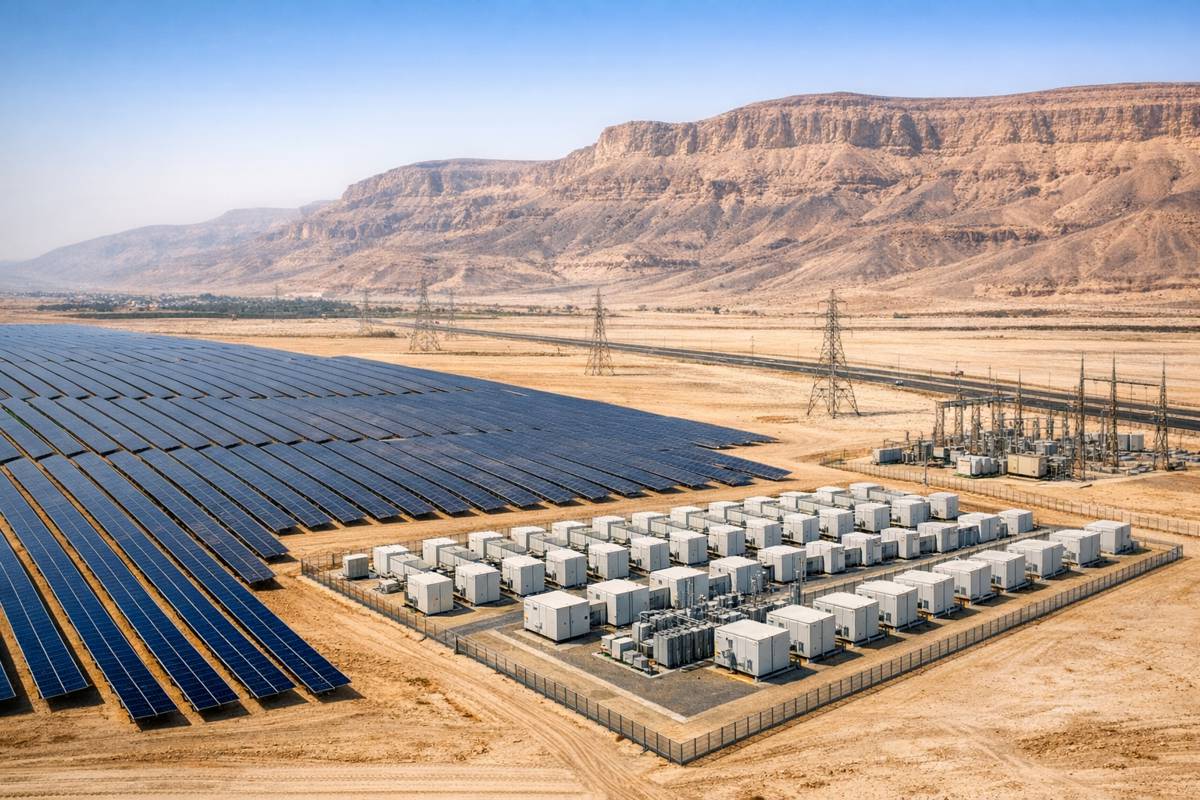
At full development, the Obelisk project combines a 1.1 GWp solar photovoltaic plant with a 100 MW / 200 MWh battery energy storage system (BESS), developed by Scatec. The project has been described as the biggest hybrid solar PV project in Africa, a distinction that carries weight given the growing number of utility-scale programmes in South Africa, Morocco, and across the Sahel. The size of the plant places it firmly in the category of infrastructure that can shift grid dynamics rather than merely contribute incremental capacity.
The inclusion of battery storage is the part that should make infrastructure planners sit up. Solar generation is valuable, but it is also variable. Batteries allow generation to be smoothed and dispatched more strategically, helping operators respond to peak demand periods and reducing curtailment when solar output exceeds immediate grid needs. In practical terms, storage turns a solar farm from a daytime resource into something closer to a predictable component of system planning. For fast-growing economies, that predictability has economic value.
Obelisk’s output will be sold to the Egyptian Electricity Transmission Company under a long-term power purchase agreement, reinforcing the trend toward contractual structures that make capital-intensive clean energy projects financeable. Long-term PPAs reduce revenue uncertainty, which is precisely what debt providers need in order to price risk sensibly over long tenors. It also provides the grid operator with a planned supply profile rather than a speculative one, supporting more coherent network planning and investment sequencing.
From a construction delivery perspective, projects of this magnitude bring their own set of complexities. Utility-scale solar requires extensive ground preparation, logistics planning, substation integration, and transmission connection works, often in remote or harsh environments. When batteries are added, the engineering scope expands further to include dedicated storage infrastructure, safety systems, thermal management, power electronics, and grid compliance requirements. The result is a clean energy asset that looks increasingly like a conventional piece of strategic infrastructure, rather than a simple renewable generation site.
Why Battery-Backed Solar is Becoming the New Normal
For years, battery storage was treated as the “next phase” for solar-heavy grids. That language is already aging. In emerging markets especially, the question is no longer whether storage will be deployed, but how quickly it can be funded and integrated without creating additional burden on already stretched utilities and regulators. The Obelisk model suggests that storage is moving into the baseline expectations for utility-scale solar, at least for projects aiming to play a system-level role.
A 100 MW / 200 MWh battery configuration is designed for meaningful operational flexibility. It does not turn solar into a 24-hour power station, but it allows energy shifting and grid support at the times that matter most. Those windows often include late afternoon and evening peaks, when solar production drops and demand rises. Batteries can also support stabilisation services, depending on grid rules and control systems, making renewables more cooperative within a legacy network built around dispatchable generation.
This has direct implications for infrastructure investors and policymakers. It means renewable expansion can reduce the need for peaking fossil fuel plants, lower the stress on existing generation fleets, and potentially reduce fuel import exposure. In countries facing currency pressure or balance-of-payments concerns, reducing fuel imports can be about economic sovereignty as much as it is about decarbonisation.
For contractors and EPC stakeholders, hybrid solar plus storage is also a growing market segment requiring new combinations of skillsets. It blends high-volume civil works with a sharp increase in electrical and digital controls complexity. That creates opportunities for specialist subcontractors, technology integrators, and O&M providers who understand grid code compliance, asset monitoring, and performance optimisation.
Financing the Energy Transition Through Blended Partnerships
The EIB’s US$150 million financing package is significant on its own, but the broader financing structure is arguably the real story. Obelisk is being co-financed with the African Development Bank, while also involving the European Bank for Reconstruction and Development (EBRD) and British International Investment (BII). Additional support is being provided via grants, concessional financing, and an EU NDICI guarantee as part of a Team Europe approach.
This style of financing reflects a wider shift in global infrastructure development. Rather than relying on a single lender, large clean energy projects are increasingly structured through layered capital stacks designed to reduce risk, improve affordability, and accelerate delivery timelines. Guarantees and concessional elements can make projects viable in markets where sovereign risk perceptions or macroeconomic uncertainty might otherwise raise borrowing costs beyond feasibility.
The EIB framed the project as an example of how European financing can accelerate Egypt’s clean energy ambitions while strengthening energy security and economic resilience. EIB Vice-President Gelsomina Vigliotti said: “This landmark project demonstrates how strategic European financing can accelerate Egypt’s clean energy ambitions while strengthening energy security and economic resilience. By supporting the Obelisk solar project, the EIB is investing in large-scale renewable infrastructure that delivers affordable, sustainable power, supports decarbonisation, and reinforces our partnership with Egypt under the European Union’s Global Gateway and the EU-Egypt Strategic Partnership.”
For infrastructure investors, the message is clear enough: this is a priority corridor for development finance. Egypt’s energy projects are not being treated as isolated transactions but as part of a wider strategic relationship, connecting European energy security priorities with regional development goals. That alignment can unlock faster approvals, stronger political backing, and broader risk-sharing frameworks, all of which reduce friction in delivery.
From Scatec’s perspective, the partnership also underlines the value of experienced developers in scaling projects across emerging markets. Scatec CEO Terje Pilskog stated: “Scatec is very pleased to welcome the European Investment Bank as a partner in the Obelisk project. Their support is instrumental in driving forward this landmark initiative, and we are proud to be working together to strengthen Egypt’s renewable energy future.”
From Policy Targets to Physical Infrastructure
Egypt has set a target of 42% renewable energy in electricity generation by 2030, and Obelisk directly supports that trajectory. Targets alone, however, do not move electrons. Projects do. The importance of Obelisk lies in the way it translates national commitments into grid-connected infrastructure with long-term commercial structure and international financing support.
EIB Global Director General Andrew McDowell positioned the project as a proof point for what aligned ambition and finance can achieve. He said: “The inauguration of Obelisk’s first phase shows what can be achieved when strong national ambition is matched with reliable long-term financing and effective partnerships. By supporting Egypt’s first large-scale solar project with battery storage, the EIB is helping to translate climate commitments into concrete infrastructure that delivers clean electricity, builds local capacity and accelerates the energy transition. This project reflects our role as a trusted partner working alongside Egypt and international financiers to scale up renewable energy where it matters most.”
The reference to “capacity” matters here. Large renewable projects can generate local workforce and supply chain development when procurement strategies align with skills transfer and long-term operations requirements. While the source material does not provide job numbers or localisation percentages, the scale of Obelisk strongly suggests meaningful opportunities across civil works, electrical installation, safety systems, grid connection works, and later operations and maintenance.
In practical delivery terms, early completion of the first phase implies the project is tracking well against its schedule and mobilisation plan. In a sector where delays can be caused by supply chain disruptions, grid connection constraints, or permitting complexities, early milestone delivery tends to reflect strong project management, effective stakeholder coordination, and robust financing execution.
Europe’s Strategic Interest in Egypt’s Clean Power Expansion
Obelisk is also framed as supporting EU priorities, including REPowerEU and the EU-Egypt Partnership Priorities, as well as reflecting the EIB’s climate and development commitments in the Southern Neighbourhood. That combination of priorities is not accidental. Since the energy shocks of recent years, Europe has become more strategic about securing energy stability while advancing decarbonisation. Supporting clean generation and grid resilience in neighbouring regions is now part of a broader approach to stability and long-term economic alignment.
The EU Ambassador to Egypt, Angelina Eichhorst, described Obelisk as a model for partnership-driven development, stating: “The European Union stands with Egypt as the country accelerates its green transition. The Obelisk photovoltaic solar project is a shining example of how our Egyptian partners deliver clean, reliable energy, create skilled jobs, and advance climate action with the EU as a strong partner. By supporting large-scale renewable infrastructure, we are investing in a more resilient and sustainable future for all people living in Egypt”
For the construction and infrastructure ecosystem, these kinds of statements are not merely ceremonial. They are signals to markets and developers that strategic alignment exists at senior political levels. That lowers uncertainty, encourages long-term investment planning, and can support faster pipeline development across related sectors such as transmission upgrades, interconnectors, industrial electrification, and low-carbon transport infrastructure.
The inauguration event itself reflected that strategic importance, attended by senior Egyptian leadership including Prime Minister H.E. Dr. Mostafa Madbouly, along with ministers spanning transport, industrial development, planning, electricity, and renewable energy, as well as the Governor of Qena. Large infrastructure projects rarely attract that breadth of representation unless they are seen as materially aligned with national development objectives.
What Obelisk Means for Contractors, Investors, and Policymakers
For contractors and supply chain firms across the region, Obelisk strengthens the business case for scaling capabilities in utility-scale renewables and grid integration. Solar PV is no longer a niche build category. It is entering the mainstream of national infrastructure programmes, often paired with storage and digital controls. Companies that can deliver safely, quickly, and in compliance with grid and environmental standards are likely to find growing opportunity across Africa and the Middle East.
For investors and project finance stakeholders, the deal illustrates how blended finance and multilateral participation can accelerate delivery while reducing risk exposure. It also demonstrates that Egypt’s renewable programme can attract credible international capital at meaningful scale, especially when PPAs and strategic partnerships are structured in ways that lenders recognise.
For policymakers, the Obelisk model shows that policy targets become more credible when linked to deliverable projects with clear procurement structures and reliable financing. It also highlights that batteries are increasingly part of modern grid planning, not an optional extra. As more renewables come online, system operators will need flexibility assets like storage, demand response, and grid upgrades to maintain reliability.
Taken together, Obelisk isn’t simply a solar project. It is a marker of the region’s accelerating shift toward a clean power system that still prioritises resilience and affordability. In that sense, it fits the direction of travel for global infrastructure as a whole: more electrification, more decentralised generation, and more emphasis on flexibility and security.