WEMAG Secures €220m to Accelerate Grid Upgrades in Northern Germany
Germany’s energy transition has never been short on ambition, but it’s the infrastructure underneath it all that decides whether progress will be smooth or painful. That’s why a new €220 million financing agreement between the European Investment Bank (EIB) and WEMAG deserves attention well beyond the borders of West Mecklenburg. Signed in the presence of Minister-President Manuela Schwesig, EIB Vice-President Nicola Beer, and the WEMAG Board of Directors, the deal is designed to accelerate a programme of power grid investments planned over the next four years.
At face value, it’s a loan to a regional grid operator in northern Germany. In reality, it’s a case study in what Europe now needs more of: practical funding that turns renewable generation growth into reliable electricity delivery, even in rural areas where grid reinforcement can be slower, costlier, and more politically invisible. The EIB says the financing will cover more than one-third of WEMAG’s planned grid investments over the next four years, strengthening the foundations for households, businesses and industry to access renewable power at predictable, competitive prices.
This matters because the energy transition doesn’t fail in parliaments. It fails in substations, in congested feeders, and at the end of long distribution lines where modern loads are rising faster than cables were ever designed to handle. What’s unfolding in West Mecklenburg is a condensed version of the wider European grid challenge: balancing fast-growing decentralised renewables with a system built for centralised generation and one-way power flows.
Grid Expansion Becomes the Bottleneck of the Energy Transition
Across Europe, the expansion of renewable energy is colliding with a simple engineering truth: the electricity grid has limits. West Mecklenburg is seeing growing demand for grid upgrades driven by photovoltaics, including large solar parks and rooftop systems, alongside the rise of electromobility. These shifts change how electricity moves through the network, creating new power flows that require stronger infrastructure and smarter operation.
It’s not just about plugging in more generation. It’s about ensuring that the grid can accept it safely and efficiently. When rooftop solar expands rapidly, local networks can experience voltage issues, reverse power flows, and thermal constraints. Meanwhile, more heat pumps and EV charging can push peaks higher, especially during winter evenings when domestic demand is already strong.
WEMAG’s investment plan is therefore aimed at a broader outcome than simply “adding capacity.” The stated goal is to make power supply more secure and ensure stable operation over the long term for households, businesses and industry, while preparing the region for new energy-efficient technologies. That combination is key, because resilience and flexibility now sit alongside decarbonisation as the defining priorities of grid development.
From Solar Roofs to EV Chargers, the Demand Curve is Shifting Locally
One of the most important details in the agreement is where the investment impact is expected to land: not just on high-voltage corridors, but close to where people live and work. WEMAG’s planned investments are intended to support more rooftop photovoltaic systems, heat pumps, and EV charging stations.
That puts distribution networks under the spotlight. For decades, energy infrastructure planning was shaped by predictable consumption patterns and controllable central generation. Now the electricity system is increasingly “interactive”, with thousands of smaller producers and flexible loads reshaping what demand even means. The power grid is becoming a platform, not just a pipeline.
For investors and policymakers, the message is simple: the clean energy transition is entering a phase where wires, transformers and digital control systems are just as decisive as wind turbines and solar panels. You can’t electrify transport, heating, or industry without reinforcing the networks that connect them.
Why the EIB Is Putting Its Weight Behind Regional Grid Operators
The EIB is positioning itself not merely as a lender, but as a catalyst for infrastructure readiness. In West Mecklenburg, the bank frames the loan as a direct contribution to ensuring reliable renewable electricity supply at predictable prices, supporting both energy security and regional economic development.
WEMAG CFO Caspar Baumgart underlined the scale and complexity of the work ahead, highlighting the importance of long-term partnership financing rather than short-term fixes: “The EIB’s support will give us the financial power to equip West Mecklenburg’s electricity grid for the future. Expanding our grids is challenging, and requires strong partners. With the EIB by our side, we are securing investments that are equally crucial for climate protection, economic development and security of supply,”
There’s also a strategic signal here for other municipal and regional utilities across Europe. The narrative often suggests that major transformation is driven by national champions and vast energy conglomerates. This agreement argues something different: rural and regional grid operators can deliver meaningful infrastructure upgrades when they have access to affordable capital and clear investment frameworks.
Grid Digitalisation Moves From “Nice to Have” to Operational Necessity
While grid expansion tends to bring to mind physical construction, the announcement makes it equally clear that modernisation is also digital. WEMAG is cited as an example of a rural municipal energy service provider and grid operator that can plan and implement extensive expansion and digitalisation when EU-level financing is available.
That matters for construction and infrastructure professionals, because grid works increasingly sit at the intersection of civil engineering, electrical engineering and digital integration. New connections, reinforcements, and substation upgrades now come with added layers: monitoring systems, automated control, and smarter management of local generation and demand.
In practice, digital upgrades can help grid operators identify constraints earlier, coordinate maintenance more effectively, and accelerate fault response times. They can also support more dynamic network operation, which becomes essential when renewables introduce variability and when customers become both producers and consumers.
Political Backing Adds Momentum to Regional Energy Infrastructure
Energy infrastructure is rarely a purely technical matter. It’s also political, because reliability, affordability and local development are tied directly to public trust. Minister-President Manuela Schwesig framed the project as a collaboration between EU support and regional expertise: “With the EIB and WEMAG, EU support comes together with regional know-how. Together, we are setting the course to ensure that our electricity grid remains safe, resilient and high-performing into the future. I wish the project every success.”
That emphasis on resilience is telling. It reflects a broader European shift where energy security is no longer treated as a background condition. It has become a strategic priority, shaped by external supply risks and the internal demand for electrification and decarbonisation.
For industry stakeholders, this kind of regional leadership can also remove friction from project delivery. Political support doesn’t build substations on its own, but it can smooth planning processes, accelerate coordination, and help justify investment that might otherwise be difficult to explain in purely short-term financial terms.
The WEMAG Battery Storage Site Symbolises a Decade of Grid Innovation
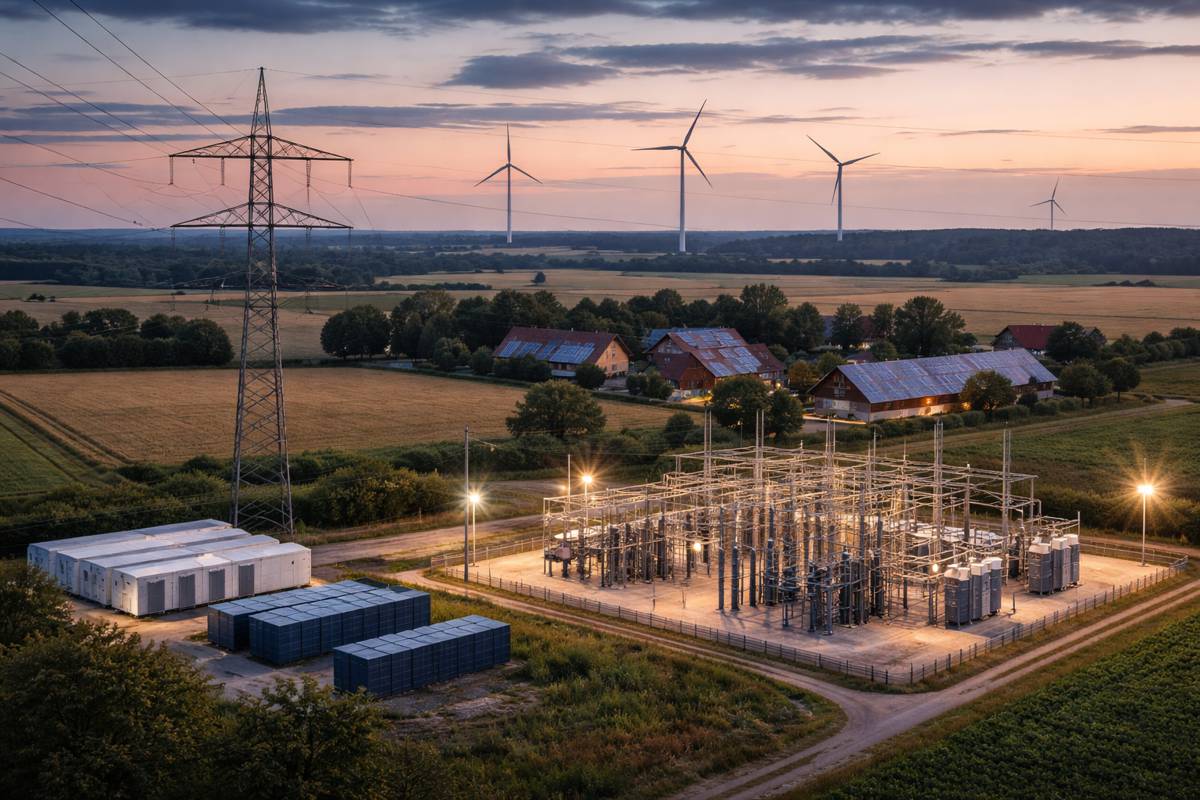
The agreement was signed at a location that carries its own symbolism: WEMAG’s battery storage facility, commissioned in 2014 and described as Europe’s largest commercial battery storage system at the time. It was built to demonstrate how energy storage could balance fluctuations in renewable generation and support grid stability.
Today, the facility is described as a 16 MW / 20 MWh lithium-ion system, supporting additional services such as black start capability and reactive power. In other words, it’s not just a “battery” in the casual sense. It’s part of the toolkit for modern grid stability, helping manage voltage, system recovery, and reliability under high shares of wind and solar.
This is exactly the kind of infrastructure theme that resonates with the wider construction and industrial technology ecosystem: energy transition delivery isn’t only about new generation assets. It’s about the integration layer that keeps the system stable when everything becomes more decentralised and dynamic.
The Bigger Investment Horizon: €1.2bn by 2033
While the EIB loan supports the next four years, WEMAG’s longer-term spending ambition is larger. WEMAG Netz GmbH plans to invest €1.2 billion in grid infrastructure in Mecklenburg-Vorpommern by 2033. That’s the kind of timeline that signals structural change rather than incremental maintenance.
For the wider market, this is where the opportunity becomes tangible. Grid investment translates into procurement cycles, contractor demand, equipment supply, digital integration work, and extended asset management obligations. It also creates knock-on effects: if a region can connect more renewables and support electrified industry, it becomes more attractive for investment and job creation.
EIB Vice-President Nicola Beer explicitly linked grid investment to community-level transformation and industrial development: “With this loan, we are reinforcing not just cables and power lines, but also homes and businesses in West Mecklenburg. A stable, high-performing grid is necessary in order for there to be safe, affordable and renewable electricity in the future – for families, trade professionals and industry alike. The EIB supports investments in power grids and energy across Germany, to make sure that the energy sector’s transformation reaches local communities. That businesses can come in, electrify their production, and create new jobs. That economic development does not fail due to a lack of infrastructure.”
Europe’s Grid Push Is Backed by Wider Financing Commitments
This loan sits within a broader EIB push to fund Europe’s energy transition at scale. The bank states that between 2023 and 2027, it will provide €45 billion to finance renewable energy projects, support REPowerEU targets, and reduce dependence on Russian fossil fuel imports.
The EU’s policy direction reinforces this momentum. The European Commission notes that the revised Renewable Energy Directive increased the binding EU renewables target for 2030 to 42.5%, with an ambition to reach 45%. Targets of that scale don’t just require generation build-out. They require the grid to become stronger, more flexible, and more digitally manageable.
EIB officials have also highlighted grid financing as part of the institution’s broader role in energy security and climate-friendly power supply across Germany. The WEMAG agreement is therefore one piece of a much larger structural effort: rebuilding energy infrastructure so decarbonisation doesn’t come at the cost of reliability.
A Template for Rural Regions Trying to Keep Pace With Electrification
There’s a tendency to talk about energy transition winners as big cities and industrial hubs. Yet some of the most complex integration challenges appear in rural regions where renewable generation grows quickly but grid capacity upgrades can lag. West Mecklenburg represents that tension, and WEMAG’s financing deal offers a pragmatic path forward.
It also provides a reality check for anyone expecting electrification to happen “automatically”. EV uptake, rooftop solar, and heat pump adoption don’t just stack neatly on top of an old grid. They change the rules of system planning. If the grid doesn’t keep pace, the result is constraints, curtailment, frustration, and slower progress.
WEMAG Chief Technical Officer Thomas Murche summed up the scale of the task and the long-term responsibility of regional utilities: “As a regional energy supplier, we are responsible for ensuring stable, future-proof grids. This loan will enable important infrastructure measures in rural areas that will serve our customers and the whole region in the long term. We will strengthen and expand our electricity grid to meet the needs of the energy transition,”
For the global construction and infrastructure ecosystem, the lesson is clear. The next phase of decarbonisation will be led by unglamorous but critical projects: network reinforcement, substation upgrades, smart grid controls, storage integration, and everything it takes to ensure that clean electricity isn’t just generated, but delivered reliably to people and business.