Kyrgyz Republic Modernising Ageing Power Infrastructure with EBRD Support
Keeping the lights on sounds like a simple promise, until a country’s power network starts showing its age. Across much of the world, electricity grids are becoming the quiet bottleneck of economic growth: they sit between new generation capacity and end users, yet too often they’re asked to carry heavier loads, over longer distances, with equipment that’s decades past its prime.
That tension is particularly visible in the Kyrgyz Republic, where abundant hydropower has long underpinned national energy supply, but ageing transmission and distribution infrastructure has struggled to keep pace with modern expectations. Now, a new financing package from the European Bank for Reconstruction and Development (EBRD) aims to shift the country’s grid from survival mode into something more fit for purpose. The bank is extending a €61.7 million sovereign loan to support critical upgrades, with additional grant and technical cooperation funding designed to turn the investment into construction-ready, deliverable infrastructure.
It’s not a headline-grabbing megaproject by global standards, but it doesn’t need to be. In grid modernisation, the returns often come from unglamorous details: fewer technical losses, better voltage stability, reduced outage risks, and a network that can integrate renewables without wobbling every time demand spikes.
Why Grid Modernisation Has Become an Infrastructure Priority
Power transmission is having a moment, and not by choice. Across Europe, Central Asia, and beyond, policy makers are pushing for cleaner generation, more electrified industry, and greater energy security. Yet the grid is what determines whether those ambitions translate into real-world reliability.
In countries with legacy infrastructure, the problem usually isn’t a lack of generation potential. It’s the inability to move electricity efficiently and predictably where it’s needed. Technical losses, congested lines, ageing substations, and limited monitoring systems can drain value from every kilowatt-hour produced. For nations trying to balance affordability with decarbonisation, those losses aren’t just an engineering issue; they’re an economic leak.
For the Kyrgyz Republic, the stakes are higher still. The national electricity sector is hydro-rich, but decades of underinvestment have left the transmission backbone under strain. The result is a system that, despite its clean generation profile, faces operational fragility and reduced efficiency. That’s the type of mismatch that keeps infrastructure planners awake at night: plenty of low-carbon power upstream, but a grid that struggles to deliver it cleanly and consistently downstream.
The EBRD Financing Package and What It Unlocks
The EBRD’s package brings together a €61.7 million sovereign loan, alongside an investment grant of up to €3 million and €3 million in technical cooperation (TC) funds. The structure matters. In grid upgrades, funding isn’t just about buying equipment. It’s also about ensuring projects are procured properly, built to spec, and delivered with the kind of oversight that protects reliability for decades.
According to the announcement, the TC funds will support project procurement and construction supervision, a practical but essential step. In many emerging infrastructure markets, project outcomes live or die on those processes. Procurement standards, contractor selection, and supervision aren’t just paperwork; they’re the difference between a substation that works as designed and one that becomes an expensive maintenance headache.
From an investor’s perspective, this kind of blended financing is also a signal. It suggests the upgrades are being approached as a long-term system improvement, not a patchwork response to the next seasonal demand crunch. For the construction and infrastructure supply chain, it points to near-term opportunities in high-voltage civil works, electrical installation, protection systems, and commissioning expertise.
A 500 kV Link Designed to Strengthen the North-East Network
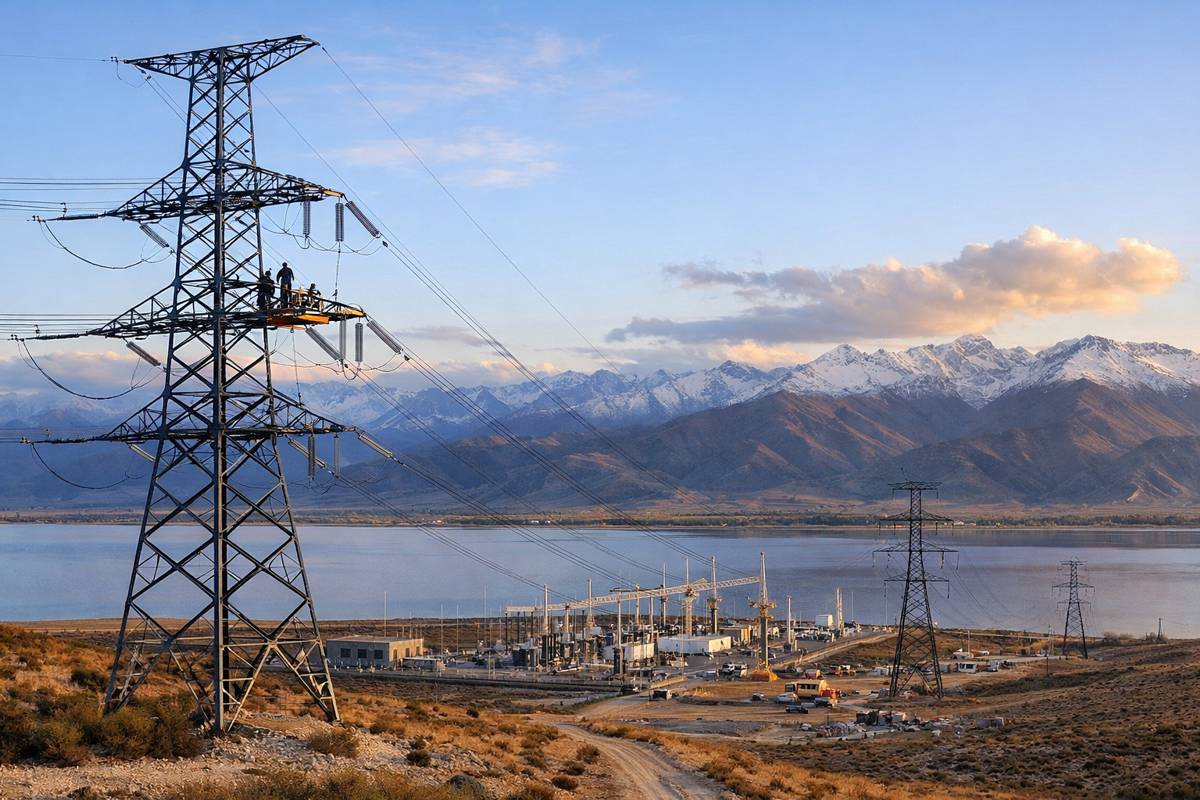
At the heart of the programme is a significant transmission build: the construction of a new 53 km, 500 kV transmission line between Kemin and Balykchy, near Issyk-Kul in the north-east of the country. Alongside it, the plan includes a new 500 kV substation in Balykchy.
That 500 kV level is a clue to the project’s role. High-voltage transmission is typically used for moving large amounts of power efficiently over longer distances, reducing losses compared with lower voltage options. In practical terms, the new link is designed to improve backbone capacity, strengthen grid stability, and support a more robust flow of electricity where it’s most valuable.
It’s also the kind of infrastructure that becomes a platform for additional investment. Once a high-voltage corridor and substation are in place, the network can often integrate future generation, support industrial loads, and improve interconnection potential without repeatedly returning to the drawing board. Put bluntly, it’s expensive work, but it’s the sort of expensive work that can stop countries haemorrhaging value through inefficiency.
The Ageing Substation Reality and a Loss Rate That’s Too High to Ignore
Behind the financing lies a stark infrastructure reality. In the Kyrgyz Republic, around 90 per cent of substations are more than 25 years old. That statistic alone paints a picture: equipment installed in the late 1990s or earlier now being asked to perform in a very different energy landscape, under modern reliability expectations and higher operational stress.
Older substations don’t just mean more breakdowns. They can limit monitoring and automation, increase safety risks for operators, and constrain the grid’s ability to manage variable loads. In the wider global push toward smarter infrastructure, substation age often becomes a proxy for digital readiness too, because retrofitting protection, communications, and control systems onto ageing assets is rarely straightforward.
The system’s efficiency gap is reflected in current losses. The announcement notes that technical and commercial losses across the transmission and distribution network stand at nearly 14.6 per cent, described as well above international standards. Losses at that level represent an ongoing drain on national energy economics, because electricity is being generated, transmitted, and paid for in resources, but never reaching end users in full.
In many markets, loss reduction is one of the most cost-effective “new energy” strategies available. Instead of building new generation capacity, you reclaim power already produced. For hydro-heavy systems, that means the environmental profile improves too, because wasted electricity still carries embedded impacts from infrastructure operations and maintenance, even if the generation itself is low-carbon.
What the Upgrade Means in Energy and Carbon Terms
Grid modernisation projects can be frustratingly difficult to explain in simple numbers, because their value is often systemic: stability, resilience, fewer outages, lower maintenance costs, and better capacity utilisation. Here, though, the announcement provides concrete projections.
The upgrade is expected to reduce electricity losses by 34 GWh annually, while cutting greenhouse gas emissions by 3,323 tonnes of CO2e each year. Those are meaningful savings, not just symbolic improvements. In the language of infrastructure delivery, it’s proof that the project isn’t merely replacing ageing kit for the sake of it, but driving measurable operational change.
There’s also a wider point worth making. Loss reduction is, in a sense, the cleanest “generation” you can procure. It doesn’t require new dams, new turbines, or new land use. It’s achieved through better infrastructure performance, improved electrical parameters, and modernised components that reduce waste in the system.
For construction professionals, these outcomes translate into a growing pipeline of grid work globally: upgrades, expansions, digital monitoring systems, and new substation builds. For policy makers, it’s a reminder that decarbonisation targets can’t be met without the networks that move energy. For investors, it signals where capital is heading: towards enabling infrastructure, not just generation assets.
From Domestic Reliability to Regional Green Energy Trade
Beyond the immediate domestic benefits, the project is also framed as part of the Kyrgyz Republic’s future role in regional energy markets. With better grid stability and increased interconnection capacity, the country aims to position itself as a regional exporter of green energy, using surplus clean hydropower to supply neighbouring nations.
That matters more than it might seem at first glance. Regional energy trade can help smooth demand fluctuations, improve economic returns on generation assets, and support neighbouring countries trying to reduce dependence on higher-carbon sources. It can also strengthen geopolitical resilience by diversifying supply pathways.
Of course, exporting electricity isn’t simply about producing surplus power. It requires a stable transmission system that can manage flows reliably and meet operational requirements. The Kemin–Balykchy line and the new 500 kV substation are therefore not just national assets; they’re part of the kind of infrastructure that enables cross-border power trade to become routine rather than occasional.
In the broader context of energy transition, that’s exactly where the conversation is going: not isolated national grids, but interconnected systems capable of moving clean power across regions. The Kyrgyz Republic’s hydropower advantage could become more commercially valuable with the right transmission backbone underneath it.
What This Means for Contractors, Technology Suppliers, and the Wider Supply Chain
For the infrastructure and industrial technology sectors, the project is a reminder that grid modernisation is now one of the most persistent investment themes worldwide. High-voltage transmission lines and substations are complex assets, pulling together civil construction, electrical engineering, specialist manufacturing, and digital monitoring.
Projects like this typically require work across foundations and access roads, tower erection, conductor stringing, transformer and switchgear installation, protection and control systems, and commissioning. The inclusion of procurement support and construction supervision funding suggests the delivery approach will focus heavily on proper technical standards and execution quality.
It also highlights how grid investment is increasingly tied to renewable integration. Even when the renewable source is stable, as hydropower largely is, the network still needs modern capability to reduce losses and handle demand dynamics. And with more countries pursuing electrification of transport, heating, and industry, the pressure on transmission and distribution infrastructure is only going one way.
For technology providers, the opportunity extends beyond hardware. Modern substations and high-voltage networks increasingly rely on improved monitoring and control methods, and while the announcement doesn’t detail digital features, the overall direction of travel in the sector is clear: smarter, more observable grids designed to reduce outages and improve operational decision-making.
EBRD’s Long-Term Investment Footprint in the Kyrgyz Republic
The financing also sits within a broader EBRD relationship with the Kyrgyz Republic. Since 1992, the bank has invested almost €1.15 billion across 280 projects, with a focus largely on sustainable infrastructure and the private sector.
That track record provides context for why this grid investment matters. Multilateral development banks typically don’t fund isolated upgrades in a vacuum. They tend to build pipelines, support reform frameworks, and apply structured procurement and delivery standards that can influence broader market practices.
From the perspective of national infrastructure planning, this kind of partnership can accelerate the shift from reactive maintenance toward strategic asset management. For the construction and engineering ecosystem, it can bring more predictable investment patterns, encouraging local capability development while also attracting international suppliers and expertise.
A Practical Step Towards a More Efficient, Export-Ready Power Network
There’s no single silver bullet for power sector reform, but modernising transmission infrastructure is one of the most practical steps a country can take to improve reliability, cut waste, and prepare for growth. For the Kyrgyz Republic, where hydropower provides a strong foundation, the limiting factor increasingly lies in what happens after generation: the ability to transmit power efficiently and securely through a network built for today’s demands.
The EBRD-backed upgrades, including the 53 km 500 kV line between Kemin and Balykchy and the new 500 kV substation in Balykchy, address that challenge at the backbone level. Combined with grant support and technical cooperation funding, the package is designed not just to build new infrastructure, but to deliver it with the rigour required for long-term performance.
In an energy transition increasingly defined by the strength of grids rather than the novelty of generation, these are the projects that quietly reshape national capability. Less wastage, fewer losses, better stability, and the potential to export clean power are not flashy outcomes, but they’re the ones that make modern economies run.