Rome Metro Line C Gains Momentum With €776m Northern Extension Contract
Rome’s long-running Metro Line C programme has taken another decisive step forward, with Webuild and partner Vianini Lavori, operating as part of the Metro C Consortium, awarded a €776 million (US$902 million) contract to design and build the T1 section in the city’s northern quadrant. The new scope will link Clodio/Mazzini and Farnesina, extending a line that has gradually evolved from a transport upgrade into one of Europe’s most complex urban underground construction challenges.
For the global construction and infrastructure ecosystem, this contract is far more than a headline budget figure. Metro C is a case study in how modern cities are trying to solve 21st-century mobility problems while digging through 2,000 years of history. It combines heavy civil engineering, strict risk management, delicate archaeology, and the need to keep a busy capital moving above ground while tunnelling progresses below it. In other words, it’s exactly the kind of “mega-project reality” that contractors, investors, and policymakers need to watch closely.
At a time when European cities are accelerating investments into lower-carbon public transport, Rome’s Metro C remains a vivid reminder that the hard part isn’t selling the idea, it’s delivering the infrastructure in the real world. The T1 award signals intent to keep the programme moving with continuity, at a moment when fragmentation and stop-start funding can quickly turn urban tunnelling into a decades-long headache.
Why T1 Matters for Rome’s Transport Network and for Industry
Metro Line C is designed to eventually run 29 kilometres with 31 stations, stretching from Monte Compatri/Pantano in the east to Farnesina in the north. To date, 24 stations have been completed between Monte Compatri/Pantano and Colosseo/Fori Imperiali in the historic centre. That progress has already pushed the line into areas of exceptional engineering and cultural sensitivity, and the northern push towards Farnesina intensifies that complexity.
The new T1 section matters because it reinforces momentum at the point where metro expansions often stall. While early phases of new lines are typically constructed in less constrained corridors, the later stages are where risk multiplies: deeper alignments, tighter working footprints, and higher interface complexity with utilities, buildings, road networks, and heritage assets. Rome is now firmly in that stage.
From an infrastructure investment standpoint, the significance is commercial as well as civic. A contract of this scale reflects sustained demand for large-scale urban rail delivery capacity across Europe, even in challenging environments. It also underlines how procurement is shifting toward consortium models that can manage whole-system delivery, combining design capability, mechanised excavation expertise, and experience in high-risk underground works.
The Archaeological Dimension That Changes Everything Underground
Few metro programmes in the world carry the same archaeological burden as Rome’s Metro C. The project’s recent expansion included the public inauguration in December of two new stations: Colosseo/Fori Imperiali and Porta Metronia. These stations extended the line by 3 kilometres and introduced a connection to Line B, strengthening network integration in the city’s core.
However, the engineering story sits side-by-side with a cultural one. During the construction of this stretch of Metro C, more than 625,000 cubic metres of archaeological material were carefully excavated along the section stretching from Monte Compatri/Pantano to Clodio/Mazzini. That is not just a statistic, it’s a measure of how metro delivery in heritage-dense cities becomes a hybrid effort involving archaeologists, planners, engineers, and construction teams working in step.
For contractors and project owners, archaeology isn’t a “soft” issue. It influences programme certainty, cost exposure, design decisions, and even equipment selection. Excavation can’t simply proceed at maximum speed if discoveries require documentation, preservation, or redesign. That has consequences for risk allocation, contract structures, contingency planning, and the management of stakeholder expectations.
The opening of what have been described as “archaeo-stations” demonstrates how infrastructure can be forced to serve more than one purpose. Stations are no longer just transport nodes. In cities like Rome, they can become curated public spaces that reveal historic layers, creating a form of civic infrastructure that sits somewhere between mobility asset and cultural institution.
Keeping Tunnel Boring Moving to Avoid Fragmented Delivery
One of the defining risks in major underground programmes is disruption to the tunnelling sequence. Tunnel boring machines and the logistics chains that support them are designed for continuity. Stop-start works can lead to cost escalation, delays, remobilisation challenges, and reduced efficiency, especially when multiple interfaces and phases need to align.
The Metro C Consortium will manage both the design and construction of Section T1, developed in coordination with Section T2. The award of T1 is intended to allow mechanised excavation to continue seamlessly from Farnesina to Piazza Venezia, preventing fragmentation of the works.
That’s significant for the industry because it’s a tacit admission of what experienced project teams already know: sequencing is everything. In dense urban environments, the logistical chain behind a TBM is often as complicated as the machine itself. Spoil removal, segment supply, ventilation, power, and safety systems must operate as a production line. If the chain breaks, productivity suffers quickly.
By prioritising continuity, the project signals an approach that is closer to “industrialised tunnelling” than traditional city-centre construction. It’s a practical strategy designed to preserve learning curves, reduce repeated mobilisation costs, and keep specialist labour and equipment utilisation high.
Section T2 and the High-Stakes Challenge of Crossing Beneath the Tiber
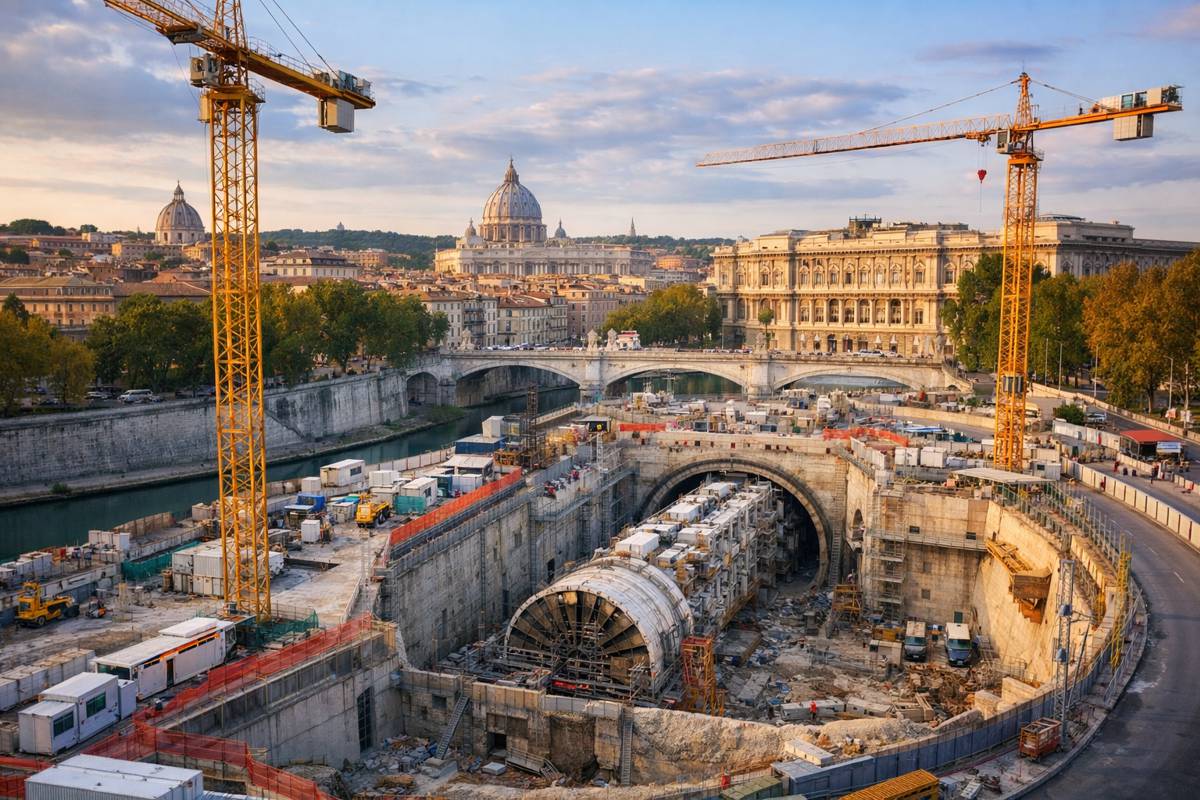
While T1 has now been awarded, Section T2 is in the executive design phase and will feature Line C’s first crossing beneath the Tiber River. River crossings add another tier of engineering challenge to urban metro systems, particularly in older cities with complex ground conditions and extensive buried infrastructure.
A river crossing brings heightened attention to groundwater management, settlement risk, monitoring regimes, and tunnel lining integrity. It also increases the scrutiny of design assurance processes and emergency planning. Even if the tunnelling itself is technically achievable, the risk management overhead can be substantial, and the confidence of regulators and stakeholders becomes critical.
For policymakers and investors, the Tiber crossing also acts as a litmus test. Delivering it successfully demonstrates that Metro C can still progress through the most technically constrained areas, supporting the long-term business case of the entire line. If it becomes delayed or contested, it risks dragging the wider programme into another cycle of disruption.
That’s why the coordinated delivery of T1 and T2 matters. In large metro projects, sections cannot be treated as isolated civil works packages. Their interfaces decide performance, both in cost and schedule. When the alignment, station boxes, and tunnelling sequences are closely linked, coordination is not a nice-to-have, it’s the entire job.
Venezia Station and Rome’s Second Major Phase of Works
While attention is shifting north, construction at Venezia station is advancing as part of the project’s second major phase. This is strategically important because Venezia sits at the heart of Rome’s historical and transport geography, where construction constraints and public sensitivity are at their highest.
Large station caverns in historic city centres demand carefully staged excavation, long-term monitoring, and complex ground support. They often involve deep shafts and limited surface access, all while keeping traffic and pedestrian routes functioning above ground. It’s the kind of work that tests a contractor’s ability to blend technical competence with public-facing discipline.
Venezia also plays into a bigger reality about urban rail megaprojects: stations, not tunnels, frequently dictate project timelines. Tunnel bores can progress rapidly once established, but station construction involves bigger footprints, more interfaces, and deeper integration with systems, architecture, and public realm requirements.
As Metro C matures, the programme is increasingly defined by those high-impact nodes, where engineering, heritage, and city operations collide. Progress at Venezia is therefore a meaningful signal that the project’s most difficult elements are not just being planned, but actively being executed.
Global Metro Construction Trends and What Metro C Represents
Rome’s Metro C is part of a broader global shift back toward metro investment as cities confront congestion, air quality pressures, and carbon reduction targets. Across Europe, new metro lines and extensions are being positioned as long-term economic infrastructure, not simply transport upgrades.
While each city has its own drivers, there are common themes: moving people efficiently, supporting housing growth, reducing dependence on private vehicles, and creating more resilient urban systems. Metro expansion is also increasingly tied to “liveability economics”, where transport access is linked to productivity, investment attraction, and regional competitiveness.
What makes Metro C particularly relevant to the construction sector is its intensity. It’s not a straightforward tunnel project. It is a layered job with archaeological constraints, station complexity, and highly sensitive ground conditions. That combination mirrors what other historic cities face, from Athens to Istanbul, from Paris to Madrid.
As a result, the techniques, governance approaches, and delivery strategies tested in Rome can influence future programmes elsewhere. Whether it’s excavation sequencing, monitoring regimes, or the integration of archaeology into construction planning, Metro C continues to provide lessons that extend beyond Italy.
Webuild’s Metro Track Record and the International Project Pipeline
For Webuild, the T1 contract strengthens what the Group describes as a global track record exceeding 890 kilometres of metro lines built. That scale matters because major metro projects increasingly demand contractors with a proven ability to deliver across multiple regulatory regimes, geotechnical contexts, and procurement frameworks.
The company is currently leading projects including Lines 15 and 16 of the Grand Paris Express in France, Lines 2 and 4 in Lima, Peru, and the Sydney Metro in Australia. In Italy, after completing Milan’s M4, Webuild is also working in Naples on the finalisation of the Capodichino Station.
From a market perspective, that portfolio underlines a wider trend: a relatively small group of international contractors have emerged as dominant players in high-complexity metro delivery. The barriers to entry are steep. Tunnelling expertise, safety governance, specialist equipment, and systems integration capability are not easily scaled overnight.
This matters to governments and investors because it shapes procurement competition. When only a handful of consortia can realistically bid for the biggest projects, the industry must pay careful attention to capacity, resilience, and supply chain risk. Contractors with deep global pipelines can bring knowledge and resources, but they also face workforce constraints and competing priorities across regions.
Urban Mobility, Sustainability, and the Quiet Shift in City-Building Priorities
Metro expansion is often discussed in political terms, but at ground level it is about changing how cities operate. Rome’s Metro C is intended to strengthen sustainable urban mobility, improving connectivity and capacity while supporting a shift away from car dependency in a city that has long struggled with surface congestion.
This transition isn’t just a climate issue. It’s also an economic one. Efficient transport networks support labour mobility, tourism movement, and service access. For a capital city, reliability matters. When public transport is slow or fragmented, productivity costs mount quietly across the economy, showing up as lost time, reduced activity, and constrained development potential.
The other reality, of course, is that sustainable infrastructure must still be buildable. Rome’s Metro C shows what happens when sustainability goals meet construction constraints. It’s a reminder that decarbonisation strategies must be backed by delivery capability, resilient procurement, and long-term planning discipline.
By awarding T1, Rome is signalling that it intends to keep pushing forward, even through the complicated part of the line. For the industry, the project stands as an evolving benchmark for what it takes to deliver modern mobility beneath one of the world’s most historic cities.
A Metro Project That Blends Modern Engineering With Ancient Rome
Metro C is no ordinary transport expansion, and that’s precisely why it matters. It’s a programme shaped by engineering difficulty, cultural responsibility, and the practical need to deliver infrastructure without tearing a city apart.
With Section T1 now awarded, the line’s northern advance is beginning to take clearer shape, supported by the continuity of mechanised excavation and coordination with future works including the first crossing beneath the Tiber. Meanwhile, progress at Venezia station and the successful opening of Colosseo/Fori Imperiali and Porta Metronia show that the project can deliver through Rome’s most sensitive zones.
For construction professionals, Metro C remains a living project laboratory. For investors and policymakers, it’s a signal of how capital cities are investing in long-life assets to remain competitive, connected, and cleaner to move around. And for Rome itself, it’s a reminder that building the future sometimes means carefully excavating the past, one metre at a time.