US-59 Diboll Bypass Delivers Bridges, Barriers and Better Traffic Flows for Texas
Sacyr’s completion of the US-59 highway project in Diboll, Texas, is the sort of infrastructure milestone that doesn’t always make national headlines, yet it quietly changes how a region works. With an investment valued at $146 million (€125 million), the newly delivered 13.2-kilometre bypass forms part of the future Interstate 69 corridor, one of the most strategically significant mobility routes under development in the United States.
For construction professionals and policymakers, projects like this matter because they sit at the crossroads of three priorities that rarely align neatly: safety, productivity and long-term freight resilience. A bypass is rarely just a new strip of pavement. It is a redesign of traffic behaviour, a reset of local access patterns, and, in many cases, a deliberate move away from congestion-prone, conflict-heavy urban routes towards safer, higher-capacity highway movement.
In practical terms, the US-59 improvement supports smoother regional logistics while cutting the stop-start disruption that previously shaped the Diboll section of the route. For investors and the supply chain community, it represents the kind of “invisible upgrade” that can reduce costs over time through reliability rather than speed alone. And for local communities, the effect is immediate: fewer heavy vehicles moving through town streets, fewer conflict points, and a safer environment that isn’t dominated by passing traffic.
A Bypass Built for Safety, Flow and Regional Access
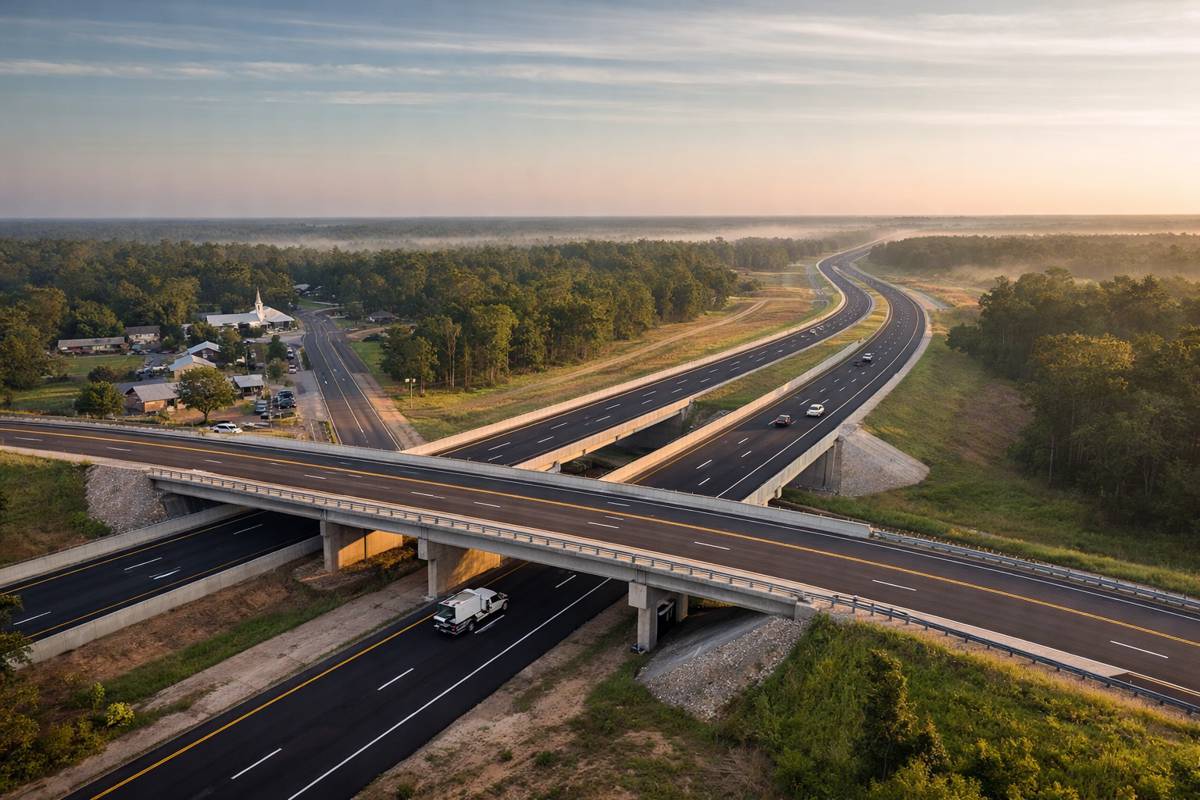
The defining feature of the new US-59 section is straightforward: it bypasses Diboll entirely. That shift matters because it reduces direct interaction between local traffic and through traffic, which is where many crash risks and delay patterns often emerge. Rather than forcing drivers and freight operators through a series of interruptions, the new alignment removes level crossings and traffic lights, replacing them with uninterrupted highway travel.
It’s a change that reads as “simple” on paper, but it is typically transformative on the ground. Fewer crossings and fewer signals generally means fewer sudden braking events, fewer risky turning movements, and fewer rear-end collisions caused by abrupt queues. It’s also one of those upgrades that makes travel times more predictable, which is exactly what freight corridors need to run efficiently.
The bypass also demonstrates how modern road design increasingly prioritises separation of movement types. Local journeys and regional commuting patterns benefit when long-distance vehicles aren’t forced into the same conflict zones as school runs, retail traffic and local services. That’s not just about convenience either. It’s about reducing exposure and building a network that works the way it’s supposed to, even as populations grow and traffic volumes rise.
The Bigger Picture Behind Interstate 69
The reference to Interstate 69 is not window dressing. This corridor is widely viewed as a long-term backbone for trade and mobility, connecting regions through multiple states and supporting freight movement at scale. Texas plays an outsized role in that story, given its economic weight, freight volumes, and position as a gateway state for continental trade.
When a project is designed as part of an interstate corridor, the decisions are rarely short term. Pavement choices, bridge layouts, barrier installations and junction design are all expected to serve for decades. That has knock-on effects for contractors and material suppliers, because high-spec road delivery requires a different approach to design coordination, construction sequencing and quality control.
In that sense, the Diboll upgrade isn’t just an isolated “finish line moment.” It’s one piece of a wider connectivity puzzle, and each completed segment reduces network friction. Over time, that has real economic consequences, particularly for industries that rely on consistent transport performance: construction supply chains, agriculture, manufacturing and heavy equipment logistics, to name only a few.
Heavy Civil Construction by the Numbers
Major highway improvements are often judged by their most visible outcomes, but the real scale is usually hidden in the detail. In Diboll, the works included the construction of 28 bridges, which immediately signals the complexity of the delivery. Bridges typically represent some of the highest-risk, highest-effort components in road building, requiring careful staging, structural coordination and rigorous inspection regimes.
In addition to bridgeworks, the project also included the installation of 12,000 metres of concrete barrier. Barriers are more than passive roadside furniture. They are safety infrastructure, separating opposing flows and reducing the severity of run-off-road incidents and cross-median crashes. For high-volume corridors, that separation can be a defining safety feature, especially where speed differentials exist between passenger vehicles and heavy trucks.
Pavement quantities also point to the industrial scale of the build. More than 172,000 tonnes of asphalt pavement were laid as part of the works, underlining the project’s material intensity. For asphalt production, transport and laying operations, that volume indicates a supply chain operation as much as a construction site. Timing, temperature management, logistics coordination and compaction quality all become critical performance factors at this scale.
Why This Kind of Project Matters to the Construction Sector
From an industry standpoint, the Diboll highway completion reinforces how highway modernisation continues to drive heavy civil work across the United States. Even when new “mega projects” dominate headlines, it’s the steady pipeline of corridor upgrades, bypasses and capacity improvements that keeps contractors busy and supply chains moving.
The project also reflects the ongoing preference for interventions that deliver multiple benefits at once: safety improvements, reduced travel time, and better traffic flow. That combination is what tends to unlock long-term value. Cutting delays alone is rarely enough. The better benchmark is whether a corridor becomes more dependable and safer, especially under peak demand conditions and during incident recovery.
For the construction market, bypass schemes also provide lessons in stakeholder coordination. They affect local communities, land use, access routes, and sometimes long-standing travel habits. Delivering them successfully often requires balancing public expectations, technical constraints and environmental considerations, all while meeting programme targets and controlling costs.
Strengthening Sacyr’s Position in the US Infrastructure Market
The Diboll project is also notable as part of Sacyr’s growing delivery record in the United States. With this completion, the company has now delivered 10 road projects in the country: two in Texas and eight in Florida. In a market as competitive as US infrastructure, that’s not an incidental footprint. It signals sustained operational capability and an ability to deliver repeatedly across different state environments.
Sacyr reports that its total executed investment in the United States now exceeds $1.2 billion (€1.03 billion). For a contractor operating internationally, that level of delivery represents more than project revenue. It represents embedded market credibility, regional experience and the kind of track record that helps secure future procurement wins.
What’s particularly important from a commercial perspective is that the Diboll bypass marks the second project Sacyr has completed for the Texas Department of Transportation (TxDOT). Repeat delivery for a public client is often the clearest indicator of trust, performance and compliance. In practice, agencies tend to lean towards contractors with proven experience navigating state-specific standards, approval structures and delivery expectations.
Texas and Florida as Strategic Proving Grounds
Texas and Florida aren’t just random map pins for roadbuilding. They are two of the most active, high-demand environments for infrastructure delivery in the United States, driven by population growth, freight demand, tourism, and climate-related resilience pressures. Contractors who can deliver at pace in those regions tend to develop strong competence in large-scale traffic management, accelerated delivery demands and complex interface conditions.
In Florida, road delivery often comes with particular challenges linked to drainage requirements, flood risk, and storm resilience, which influence everything from embankments to pavement design. Texas, meanwhile, brings its own scale pressures, long-distance freight routes and fast-moving regional growth patterns. The ability to deliver across both states suggests a contractor that can adapt, which is increasingly valuable as infrastructure owners demand smarter, faster, more predictable outcomes.
For technology providers and investors tracking market trends, repeated highway delivery also implies stable demand for associated sectors: asphalt production, bridge components, barrier systems, construction logistics, surveying, inspection, and digital construction controls. It all connects. Roadbuilding may be the headline, but it pulls an entire ecosystem along behind it.
Infrastructure Upgrades That Deliver Immediate Community Value
Although corridor significance tends to dominate the strategic narrative, bypass delivery can also reshape daily life in smaller communities. Removing heavy through-traffic from a city environment changes noise patterns, reduces congestion pressure on local junctions, and improves the overall safety feel of streets.
In Diboll’s case, eliminating level crossings and traffic lights from the main route supports smoother movement and fewer conflict points. That means fewer delays for long-distance travellers, but also fewer risks for local drivers who previously had to share space with high volumes of through traffic. Over time, these safety and accessibility improvements can influence local economic conditions as well, supporting more predictable access for services, deliveries, and emergency response.
Importantly, bypass projects also tend to reduce emissions associated with stop-start traffic in urbanised areas. While highway expansions often attract debate, the operational benefits of removing repeated braking and idling events can be meaningful, especially in locations where traffic signals and crossings previously caused consistent bottlenecks.
What This Completion Signals for Future US Corridor Development
The Diboll completion reflects a broader truth about North American transport networks: strategic corridors are being strengthened through targeted improvements, not only through brand-new builds. Bypasses, grade separation, bridge programmes and safety barrier upgrades are all part of a long-term modernisation effort that will continue to shape procurement pipelines.
For the construction industry, the message is clear. The market rewards delivery certainty, technical competence and the ability to manage complex civil components such as bridges, barriers and high-volume asphalt works. For policymakers and agencies, successful delivery supports the case for continued investment in corridor upgrades that improve safety and reliability without disrupting community life unnecessarily.
And for investors watching infrastructure value creation, projects like US-59 in Diboll demonstrate that returns aren’t always measured in dramatic transformation. Sometimes they’re measured in the quiet, consistent improvements that keep a state moving, a corridor dependable and a town safer than it was before.