Agentic AI Moves from Concept to Construction-Ready Reality
The idea of agentic AI has hovered around boardrooms and research labs for several years, promising machines that do more than follow scripts. What has been missing is proof that these systems can operate reliably in messy, real-world environments where conditions change by the minute and downtime carries a real commercial cost. A joint engineering collaboration between Richtech Robotics and Microsoft now offers a concrete example of how that gap is being closed.
By working directly with the Microsoft AI Co-Innovation Labs, Richtech Robotics has taken agentic AI out of theory and into live robotic systems. The collaboration focuses on applying cloud-based intelligence, perception and reasoning to physical machines, showing how robotics can shift from narrowly defined task execution to context-aware operation. For construction, infrastructure and industrial stakeholders, the significance lies not in a single robot, but in the broader signal that AI-driven autonomy is becoming practical, scalable and commercially viable.
Why Agentic AI Matters to the Built Environment
Across construction sites, logistics hubs and industrial facilities, automation has long been constrained by rigidity. Traditional robots excel at repetitive, controlled tasks but struggle when environments change or when human interaction becomes part of the workflow. Agentic AI addresses this limitation by allowing systems to perceive, reason and act with a degree of autonomy that mirrors human decision-making, albeit within defined operational boundaries.
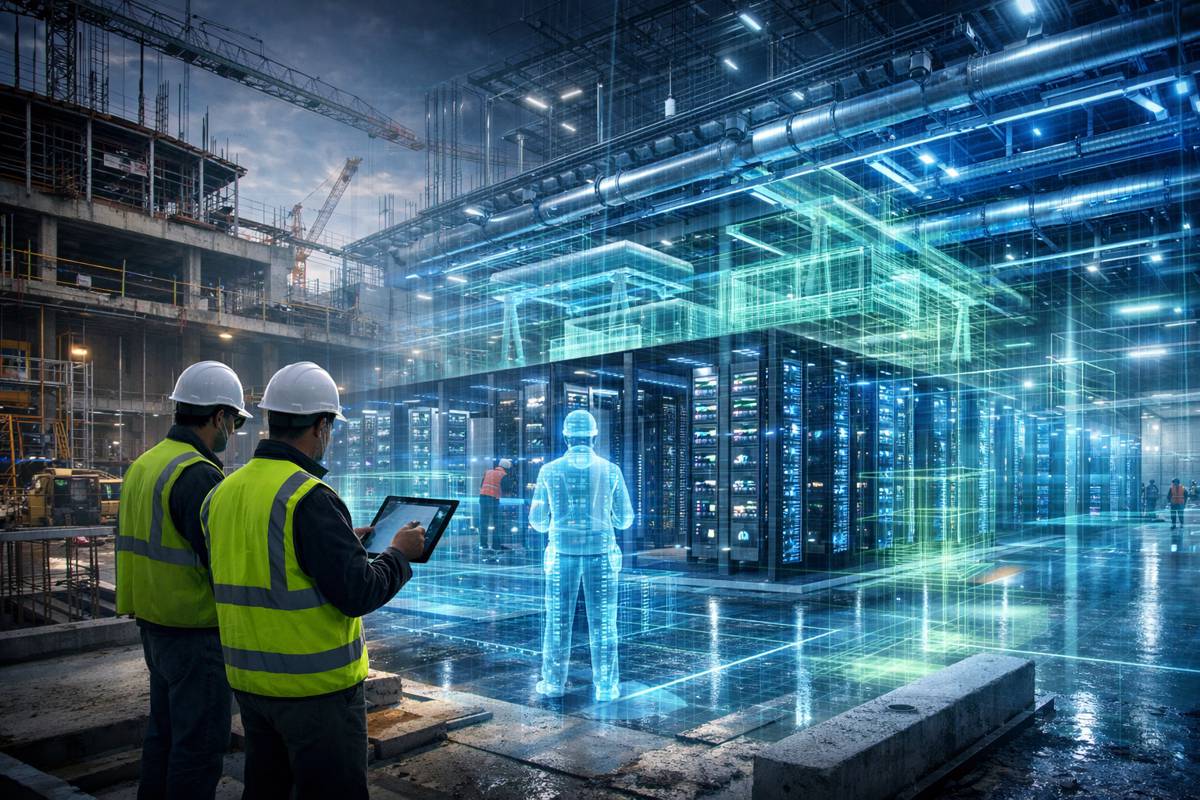
This shift is particularly relevant for infrastructure-heavy sectors. Construction and industrial operations are rarely static. Weather, supply delays, workforce availability and fluctuating demand all influence outcomes. Agentic AI offers a pathway for machines to adapt in real time, supporting safer operations, smoother workflows and better use of resources. In that context, the Richtech-Microsoft collaboration is less about retail robotics and more about proving that physical AI can be trusted beyond controlled pilot projects.
A Hands-On Engineering Collaboration, Not a Technology Showcase
Unlike many headline-grabbing AI partnerships, this collaboration was not framed as a marketing exercise. Engineers from Richtech Robotics worked side by side with specialists at the Microsoft AI Co-Innovation Labs to design, test and deploy capabilities directly onto live robotic systems. The emphasis was on solving practical problems rather than showcasing abstract potential.
By leveraging Azure AI, the teams focused on embedding intelligence that could operate reliably at the edge while drawing on cloud-based models for perception and reasoning. This hybrid approach reflects a broader trend in industrial technology, where cloud intelligence complements, rather than replaces, on-site systems. For infrastructure operators wary of overdependence on connectivity, this balance is a critical consideration.
ADAM as a Flagship for Context-Aware Robotics
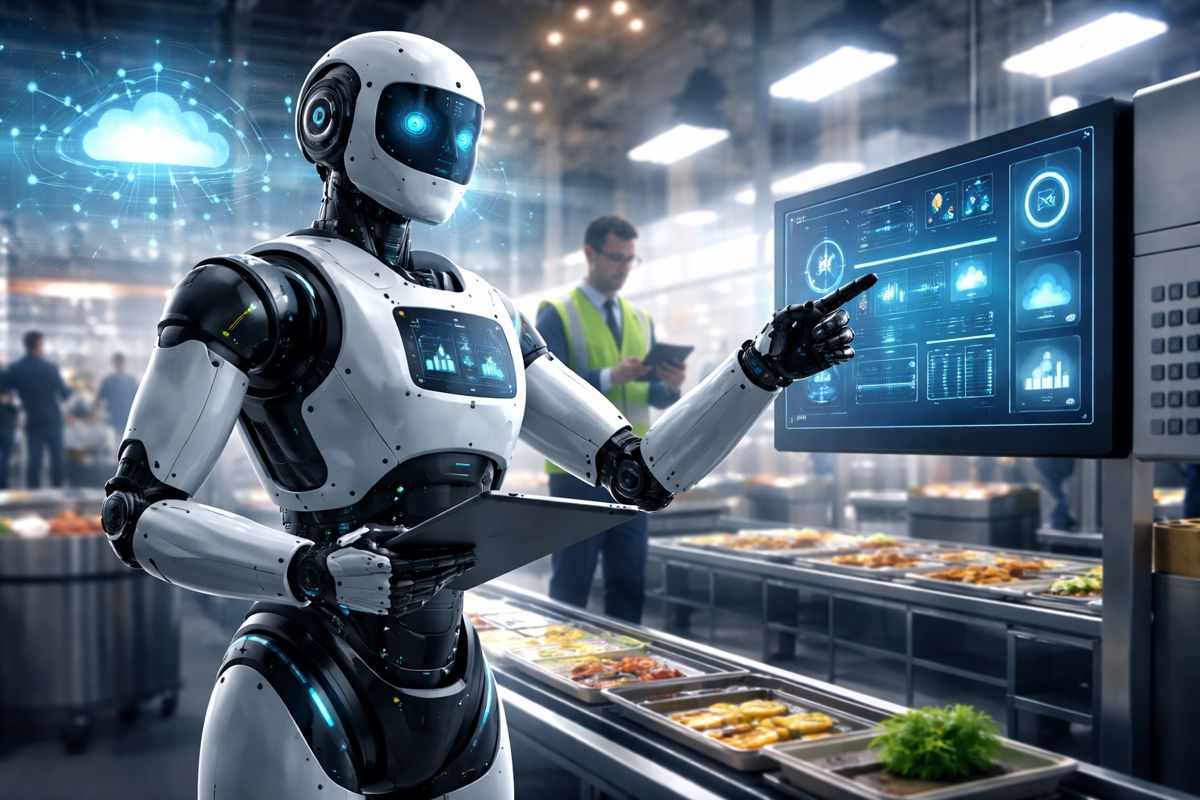
At the centre of the collaboration is Richtech’s ADAM robot, which served as a proving ground for agentic AI capabilities. While ADAM is often associated with customer-facing environments, the technical advances made through the partnership extend well beyond hospitality or retail.
Enhanced with additional layers of context awareness, ADAM can now incorporate variables such as time of day, environmental conditions and operational signals into its decision-making. Vision-based models allow it to maintain consistency during peak demand, while voice and conversational AI enable more natural interactions. Crucially, these capabilities are not isolated features but interconnected systems that allow the robot to reason about its environment and adjust behaviour accordingly.
For industrial observers, ADAM’s evolution demonstrates how robots can move from reactive machines to proactive operational assets. The same principles underpinning these enhancements can be applied to equipment monitoring, site logistics and automated inspection tasks across construction and infrastructure projects.
Operational Intelligence Beyond the Robot Itself
One of the more understated but commercially significant aspects of the collaboration is its focus on operational awareness. By integrating perception and reasoning, the enhanced system can identify potential issues before they escalate into disruptions. In ADAM’s case, this includes notifying staff of ingredient shortages or equipment anomalies.
Translated into construction or industrial contexts, this capability points towards robots that can flag material shortfalls, detect equipment wear or highlight safety concerns in real time. Such early-warning systems align closely with industry priorities around productivity, risk reduction and cost control. External research from organisations such as McKinsey has consistently highlighted predictive maintenance and real-time monitoring as key drivers of digital transformation in industrial sectors, reinforcing the relevance of these developments.
Scaling Intelligence Without Rebuilding Hardware
A persistent barrier to robotics adoption in construction and infrastructure has been the cost and complexity of hardware upgrades. The Richtech–Microsoft collaboration addresses this challenge by emphasising software-driven intelligence. By applying agentic AI through cloud-connected models, Richtech can extend advanced capabilities across its portfolio without extensive new hardware investments.
This approach resonates with infrastructure operators managing long asset lifecycles. Roads, plants and logistics facilities are not easily retrofitted with entirely new systems. Software-led upgrades offer a more practical pathway, allowing organisations to incrementally enhance capability while preserving existing investments. In this sense, the collaboration reflects a broader industry shift towards modular, upgradeable technology stacks.
Implications for Logistics, Manufacturing and Construction
While ADAM provides a tangible example, the collaboration’s implications stretch across multiple sectors. Logistics facilities, for example, rely heavily on real-time perception and decision-making to manage throughput and safety. Manufacturing environments demand consistency and reliability under varying conditions. Construction sites, with their inherent unpredictability, represent one of the most challenging frontiers for autonomous systems.
By demonstrating that agentic AI can function reliably in physical environments, Richtech Robotics and Microsoft contribute to a growing body of evidence that autonomous systems are ready to support core operations. This aligns with wider industry research from the World Economic Forum, which has identified intelligent automation as a cornerstone of future industrial competitiveness.
A Shared Focus on Practical Deployment
Leadership commentary around the collaboration reinforces its pragmatic orientation. Wayne Huang, Founder and Chief Executive Officer of Richtech Robotics, framed the partnership in terms of applied outcomes rather than technological ambition: “Our collaboration with Microsoft reflects a shared focus on applying advanced AI to practical, real-world use cases. By working closely with the Microsoft AI Co-Innovation Labs, our teams were able to jointly develop and deploy intelligent capabilities that strengthen reliability, enhance customer interactions, and support scalable automation across physical environments.”
The emphasis on deployment and scalability mirrors the priorities of construction and infrastructure stakeholders, who increasingly demand technologies that deliver measurable value rather than conceptual promise.
Physical AI as a Strategic Investment
The collaboration underscores Richtech Robotics’ broader investment in physical AI, an area gaining traction as industries look to bridge the gap between digital intelligence and real-world operations. By combining perception, reasoning and cloud intelligence, physical AI systems can support decision-making at the point of action, where delays or errors carry tangible consequences.
For policymakers and investors, this direction aligns with strategic goals around productivity, resilience and workforce augmentation. Rather than replacing human roles outright, agentic AI offers tools that can support skilled workers, improve safety and enable more efficient use of expertise. This narrative is increasingly reflected in policy discussions around industrial automation and digital skills development.
From Pilot Projects to Industry Infrastructure
Perhaps the most important takeaway from the Richtech-Microsoft collaboration is its contribution to moving agentic AI beyond pilot projects. By embedding these capabilities into live robotic systems and demonstrating their reliability, the partnership helps normalise AI-driven autonomy as part of standard operational infrastructure.
For the global construction and infrastructure ecosystem, this represents a step towards more adaptive, intelligent environments. As projects grow in scale and complexity, the ability to deploy machines that can reason, adapt and support human decision-making becomes less of a novelty and more of a necessity. In that sense, the collaboration is not simply about enhancing a robot, but about laying groundwork for the next phase of industrial automation.