Heavy-Duty Electric Truck Charging Moves with Pilot Projects
The electrification of long-haul trucking has reached a point where infrastructure decisions now matter as much as vehicle development itself. Without reliable, high-power charging positioned where freight actually moves, battery-electric heavy goods vehicles remain confined to pilots and publicity runs. Against that backdrop, the agreement between Pilot Travel Centers LLC and Tesla signals a practical step toward making electric trucking workable at scale across North America.
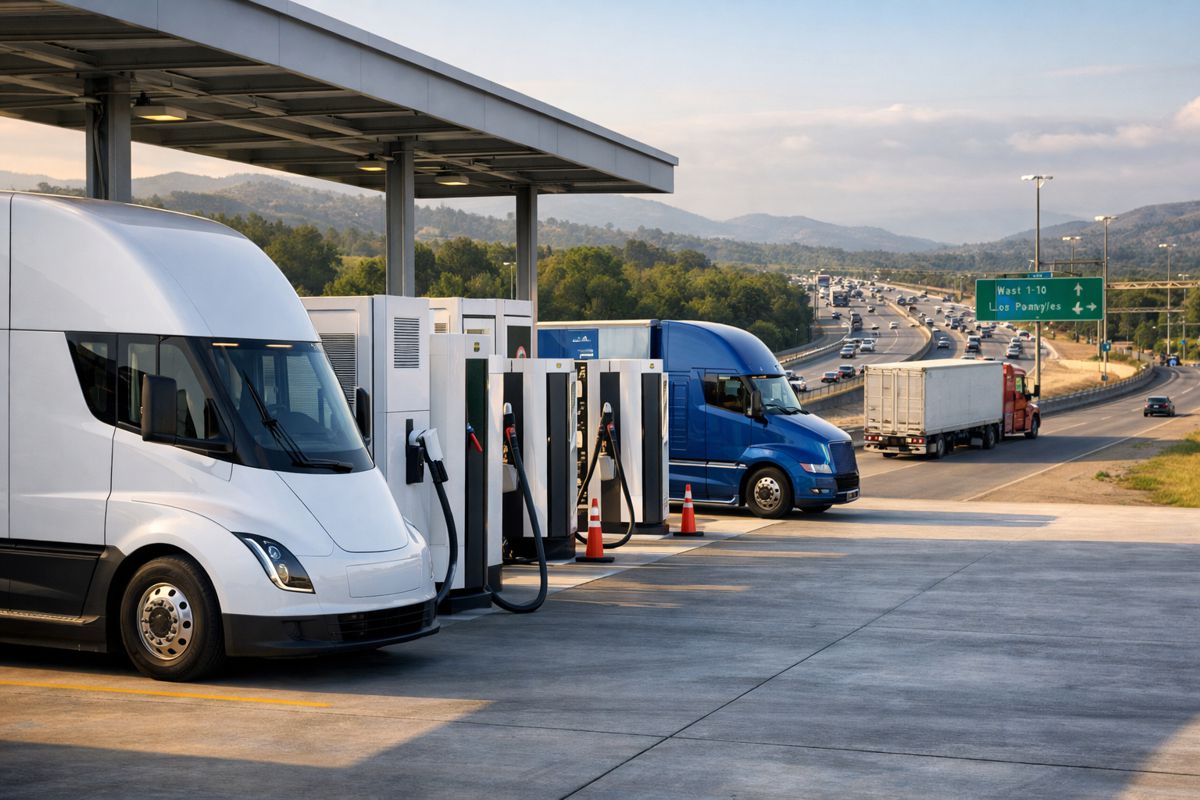
Rather than focusing on depots or isolated demonstration sites, the partnership targets the backbone of interstate freight movement. Semi Chargers are planned for select Pilot locations along I-5 and I-10, as well as other major corridors where heavy-duty charging demand is expected to be highest. These are not marginal routes. They connect ports, manufacturing centres, logistics hubs and border crossings that underpin the US economy. By anchoring charging infrastructure in established travel centres, the initiative aligns new technology with decades-old driver habits and freight patterns.
The first sites are expected to open in summer 2026, with construction beginning in the first half of the year. While that timeline may sound cautious in consumer EV terms, for heavy-duty infrastructure involving grid upgrades, megawatt-scale power delivery and multi-state coordination, it reflects a realistic pace that prioritises reliability over speed.
Charging Power That Matches Freight Reality
One of the defining features of this rollout is its technical ambition. Each Pilot site equipped with Tesla Semi Chargers will host between four and eight charging stalls, using Tesla’s V4 cabinet charging technology. These systems are designed to deliver up to 1.2 megawatts of power per stall, placing them firmly in the emerging category of megawatt charging systems for heavy vehicles.
That level of power matters. Long-haul trucks operate under tight schedules governed by hours-of-service regulations, freight contracts and delivery windows. Tesla has stated that the majority of a Semi truck’s 500-mile range can be recovered in around 30 minutes, aligning charging time with a normal mandated rest break for professional drivers. If achieved consistently in real-world conditions, that parity between rest and recharge could remove one of the most persistent operational objections to battery-electric trucking.
Industry research reinforces why this alignment is critical. Studies by the International Council on Clean Transportation and the US National Renewable Energy Laboratory have repeatedly shown that charging downtime, rather than vehicle range alone, is the key barrier to fleet electrification in long-haul applications. High-power charging located at predictable stopping points reduces both scheduling risk and total cost of ownership, particularly for fleets operating fixed corridors.
Why Location Strategy Is as Important as Technology
Selecting Pilot travel centres as charging hosts is not incidental. These sites already function as logistical ecosystems, offering fuel, food, rest facilities, parking, maintenance access and payment services. For professional drivers, they are familiar, trusted and operationally efficient. Embedding electric charging into that environment reduces friction during the transition away from diesel.
From an infrastructure planning perspective, travel centres also offer advantages that purpose-built sites often lack. They are typically located close to high-capacity transmission lines, designed for continuous operation, and accustomed to handling heavy vehicle traffic. That combination can lower both construction risk and long-term operational costs.
The initial rollout will focus on California, Georgia, Nevada, New Mexico and Texas. Collectively, these states account for a significant share of US freight movement and include key east-west and north-south corridors. California, in particular, continues to push aggressive zero-emission vehicle mandates for heavy-duty fleets, while Texas and the Southwest form critical long-haul routes linking ports, energy infrastructure and inland distribution centres.
A Transitional Network With Eyes on Interoperability
At launch, the network will primarily support Tesla Semi trucks. That focus reflects both vehicle availability and the maturity of Tesla’s charging ecosystem. However, the agreement leaves open the possibility of future expansion to support heavy-duty electric vehicles from other manufacturers.
This point carries broader industry significance. One of the recurring concerns among fleet operators is the risk of proprietary infrastructure locking them into a single vehicle supplier. While early networks often start with brand-specific compatibility, the long-term viability of electric freight corridors will depend on interoperable standards and shared access.
The heavy-duty charging sector is already moving in that direction. The Megawatt Charging System standard, developed under CharIN, aims to create a common framework for high-power truck charging globally. Whether and how future Pilot-Tesla sites evolve toward broader compatibility will be closely watched by manufacturers, utilities and regulators alike.
Alternative Fuels as a Portfolio, Not a Bet
For Pilot, the Tesla partnership sits within a wider diversification strategy rather than a single technological wager. Demand for alternative fuels continues to grow across North America, driven by regulatory pressure, corporate decarbonisation targets and rising scrutiny of supply-chain emissions. In response, Pilot has expanded its offerings across electrification, hydrogen, renewable diesel and higher-blend biodiesel.
This portfolio approach reflects the reality that no single energy solution will dominate all freight use cases in the near term. Battery-electric trucks may suit regional and corridor-based operations, while renewable fuels and hydrogen may play larger roles in other segments. By investing across multiple pathways, Pilot positions itself as an energy provider capable of supporting fleets through a prolonged transition period.
The quote from Pilot’s senior vice president of alternative fuels underscores this positioning: “Helping to shape the future of energy is a strategic pillar in meeting the needs of our guests and the North American transportation industry,” said Shannon Sturgil, senior vice president of alternative fuels at Pilot. “Heavy-duty charging is yet another extension of our exploration into alternative fuel offerings, and we’re happy to partner with a leader in the space that provides turnkey solutions and deploys them quickly.”
Commercial Implications for Fleets and Investors
For fleet operators, the announcement reduces uncertainty around infrastructure availability on key routes. While vehicle costs and residual values remain important considerations, the presence of dependable charging along major corridors directly influences route planning, asset utilisation and driver acceptance. Fleets evaluating pilot deployments of electric trucks now have clearer signals about where operational support is likely to emerge first.
Investors and policymakers, meanwhile, may see the partnership as evidence that private capital is beginning to shoulder more of the infrastructure burden. Public funding and incentives have played a crucial role in early EV deployment, but long-term scalability depends on commercially viable models. Travel-centre-based charging, integrated with existing services and revenue streams, offers one such model.
Grid impact will remain a critical variable. Megawatt-scale charging places substantial demands on local distribution networks, particularly when multiple stalls operate simultaneously. Coordinating with utilities, deploying on-site energy management and potentially integrating storage will be essential to avoid bottlenecks. How these Pilot sites address grid constraints may influence future permitting and replication across other corridors.
From Symbolic Progress to Operational Change
Heavy-duty electrification has often been characterised by ambitious announcements followed by limited deployment. What distinguishes this initiative is its focus on corridors, power levels and operational alignment with driver routines. While the first sites will not open until 2026, the planning signals a shift from experimentation toward infrastructure that freight operators can realistically use.
The partnership does not resolve every challenge facing electric trucking. Vehicle availability, upfront costs, residual value uncertainty and grid readiness all remain in play. Yet by embedding high-power charging into the everyday geography of freight movement, it narrows the gap between promise and practice.
For the construction, infrastructure and transport sectors, the message is clear. Electrification is no longer confined to urban delivery vans or regional pilots. It is beginning to stake a claim on the interstate highways that move the bulk of North America’s goods, and it is doing so through partnerships that blend new technology with established operational networks.