Rockwell Automation to promote Smart Tire Manufacturing at Tire Technology Expo
The global tire industry is undergoing a structural shift that reaches far beyond incremental efficiency gains. Manufacturers are under mounting pressure to deliver higher performance products while cutting energy use, improving traceability, and complying with a new wave of digital and environmental regulation. Against this backdrop, automation is no longer just about faster machines. It is about intelligence, integration, and control across an increasingly complex industrial ecosystem.
At the centre of that transition sits Rockwell Automation, which is set to showcase its latest smart manufacturing capabilities at Tire Technology Expo 2026 in Hannover. The company’s presence at the event signals a broader trend across heavy manufacturing, where digital transformation is becoming inseparable from competitiveness, resilience, and regulatory readiness. For tire producers, the stakes are particularly high, given the sector’s energy intensity, globalised supply chains, and tightening sustainability expectations.
Rather than positioning technology as an end in itself, Rockwell Automation’s focus reflects a deeper industry conversation. The question facing tire manufacturers today is not whether to digitise, but how to do so in a way that delivers measurable operational value while preparing for the next decade of compliance and market scrutiny.
Why Digital Transformation Has Become Mission Critical for Tire Makers
Tire manufacturing sits at the intersection of advanced materials science, precision engineering, and large scale industrial throughput. Even small variations in process control can translate into quality inconsistencies, higher scrap rates, or premature product failure. As margins tighten and competition intensifies, producers are being forced to scrutinise every stage of the value chain.
Digital transformation offers a way to regain control over that complexity. By integrating operational data across machines, materials, and quality systems, manufacturers can move beyond reactive decision making and towards predictive, data driven operations. This shift is particularly relevant as the industry faces rising energy costs, volatile raw material prices, and growing expectations around product transparency.
Regulatory pressure adds another layer of urgency. The European Union’s forthcoming Digital Product Passport requirements, due to take effect in 2026, will compel manufacturers to document material origins, environmental impact, and lifecycle data in far greater detail than before. For tire producers supplying European markets, the ability to trace products from source to finished asset is fast becoming a commercial necessity rather than a compliance afterthought.
From Automation to Autonomy on the Factory Floor
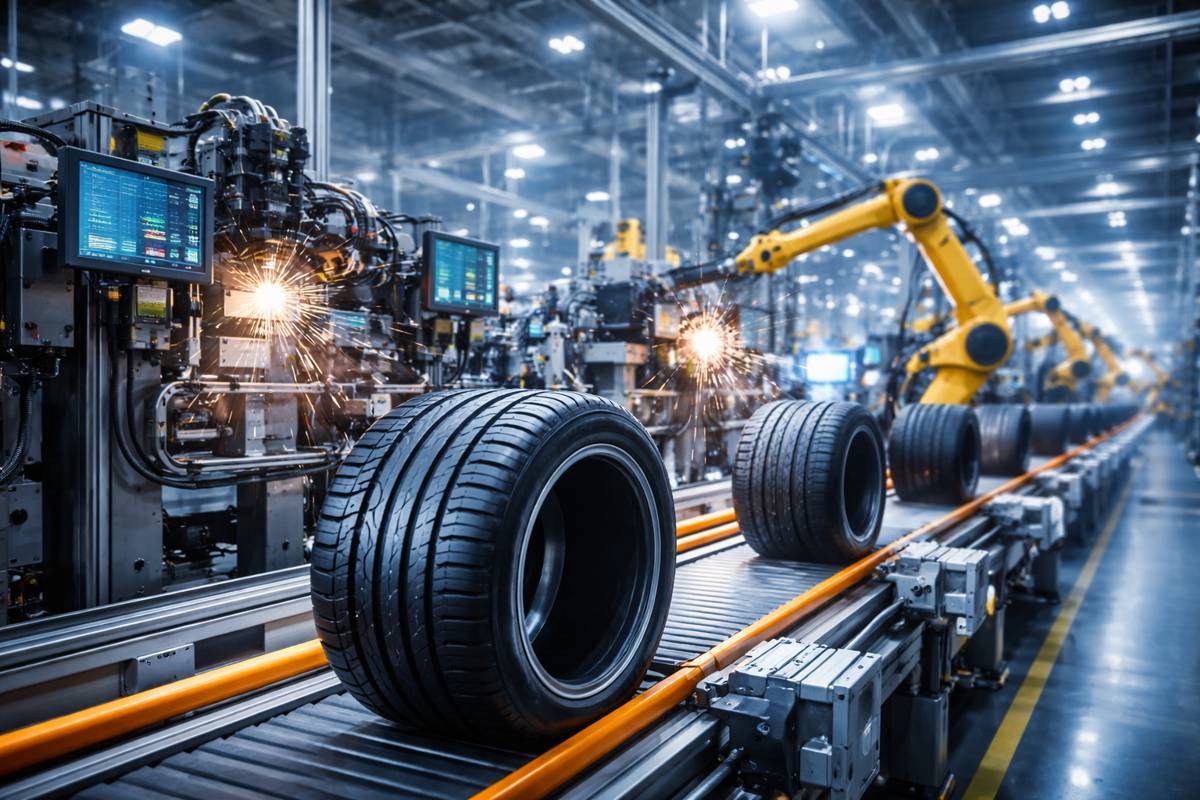
Rockwell Automation’s portfolio, as presented at Tire Technology Expo, is designed to support a shift from conventional automation towards more autonomous manufacturing systems. This evolution reflects a wider industrial trend, where factories are expected not only to execute instructions, but to learn, adapt, and optimise in real time.
In the context of tire production, autonomy translates into tighter process control, improved yield, and more consistent quality. By combining industrial IoT infrastructure with artificial intelligence and machine learning, manufacturers can begin to close the loop between process data and operational decision making. The result is a production environment that responds dynamically to variation, rather than relying solely on predefined tolerances.
According to Dan Paul, director of global industry sales for tire at Rockwell Automation, the challenge facing producers is as much organisational as it is technical. He noted: “Tire manufacturers are facing unprecedented challenges and opportunities as the industry evolves toward greater sustainability, digitalization and operational excellence. We combine deep domain expertise with innovative technology to help our customers expand what’s possible in their operations. By connecting people, processes and technology, we empower tire producers to achieve higher quality, greater efficiency, and a more sustainable future.”
That emphasis on connection is critical. Digital transformation efforts often falter when systems are implemented in isolation. Rockwell’s approach seeks to integrate manufacturing execution systems, maintenance platforms, and quality management tools into a single operational framework, reducing data silos and enabling more informed decision making at every level of the organisation.
Data as the New Backbone of Tire Manufacturing
One of the defining characteristics of modern industrial transformation is the elevation of data from a by product of production to a strategic asset. In tire manufacturing, data is generated at every stage, from compound formulation and curing to inspection and logistics. Harnessing that information effectively can unlock significant performance gains.
Rockwell Automation’s digital services are designed to use AI enabled closed loop optimisation to improve tire uniformity, performance, and energy efficiency. By continuously analysing process variables and production outcomes, these systems can identify subtle patterns that would be impossible to detect through manual monitoring alone.
This data centric approach aligns with broader trends across advanced manufacturing, where digital twins, predictive analytics, and model based optimisation are becoming standard tools. Industry research consistently shows that manufacturers who invest in integrated data platforms achieve higher asset utilisation, lower downtime, and improved product consistency. For tire producers operating at scale, even marginal gains in these areas can translate into substantial financial returns.
The Digital Thread and Right First Time Production
A recurring challenge in tire manufacturing is the fragmentation between design, production, and quality assurance. Design changes may not always be fully reflected in manufacturing parameters, while quality feedback can take too long to influence upstream processes. This disconnect undermines efficiency and increases the risk of defects.
The concept of the digital thread aims to address this gap by linking design data, material specifications, machine settings, and quality outcomes into a continuous information flow. When implemented effectively, it enables right first time production, reducing rework and waste while accelerating time to market.
Rockwell Automation’s solutions highlight how this digital thread can be established across the tire lifecycle. By connecting engineering data with manufacturing execution systems and quality management platforms, producers gain a holistic view of their operations. This visibility supports faster root cause analysis, more effective process optimisation, and greater confidence in product integrity.
Such integration is particularly valuable as tire designs become more complex, incorporating advanced materials and performance characteristics tailored to electric vehicles, heavy duty applications, and emerging mobility models.
Preparing for the Digital Tire Passport Era
Sustainability and transparency are no longer peripheral concerns for the tire industry. Regulators, customers, and investors are demanding verifiable evidence of responsible sourcing, reduced environmental impact, and ethical production practices. The EU’s Digital Product Passport framework formalises these expectations, requiring manufacturers to provide detailed, standardised product data throughout the lifecycle.
Rockwell Automation’s Digital Tire Passport concept addresses this requirement by enabling traceability from raw material sourcing through to the finished tire. By leveraging integrated data systems, manufacturers can document material provenance, production conditions, and quality metrics in a structured and auditable manner.
Beyond compliance, this capability offers strategic advantages. Transparent product data can support sustainability reporting, enhance customer trust, and enable new service models such as lifecycle performance monitoring and circular economy initiatives. In an industry where brand reputation and regulatory alignment are increasingly intertwined, digital traceability becomes a differentiator rather than a burden.
Human Expertise Still Matters in a Digital Factory
While automation and AI play a growing role, the human element remains central to successful transformation. Rockwell Automation’s presence at Tire Technology Expo emphasises the role of consultants and technical specialists in guiding manufacturers through complex change programmes.
Visitors to the company’s stand are invited to engage in discussions around industrial data operations, scalable manufacturing management, and practical implementation strategies. Topics such as manufacturing execution systems, computerised maintenance management systems, and quality management platforms are framed not as standalone tools, but as components of an integrated operational strategy.
This emphasis on end to end solution delivery reflects lessons learned across the manufacturing sector. Technology alone cannot deliver transformation. It must be aligned with organisational processes, workforce skills, and long term business objectives. By combining domain expertise with digital capability, manufacturers are better positioned to translate innovation into sustained operational improvement.
Turning Tire Data into Value Across the Mobility Ecosystem
The value of manufacturing data does not stop at the factory gate. Increasingly, tire performance data is being used to inform downstream activities, from vehicle design and fleet management to sustainability analysis and end of life recycling.
Rockwell Automation will explore this theme through a dedicated presentation by Steven Nguyen, sales executive for secure digital operations in the automotive and tire sector. His session, titled “From Materials to Mobility: Turning Tire Data into Intelligent Manufacturing,” examines how insights generated during production can be leveraged across the broader value chain.
This perspective aligns with a growing recognition that manufacturing data is a strategic asset for the entire mobility ecosystem. As vehicles become more connected and data driven, the ability to link component level information with operational performance opens new opportunities for collaboration between manufacturers, OEMs, and service providers.
A Signal of Where the Industry Is Headed
Rockwell Automation’s participation in Tire Technology Expo 2026 offers a snapshot of an industry in transition. Tire manufacturing is moving beyond incremental efficiency gains toward a more holistic model of digital, sustainable, and autonomous production. The technologies on display are less about isolated innovation and more about building resilient, compliant, and future ready operations.
For construction professionals, infrastructure planners, and policymakers, these developments matter because tires remain a foundational component of global mobility. From construction equipment and logistics fleets to public transport and emerging electric vehicle platforms, tire performance and sustainability have far reaching implications.
As regulatory frameworks tighten and market expectations evolve, the manufacturers that succeed will be those that treat digital transformation as a strategic imperative rather than a technical upgrade. In that sense, the innovations showcased in Hannover are not just about better tires. They are about redefining how heavy industry adapts to a rapidly changing world.