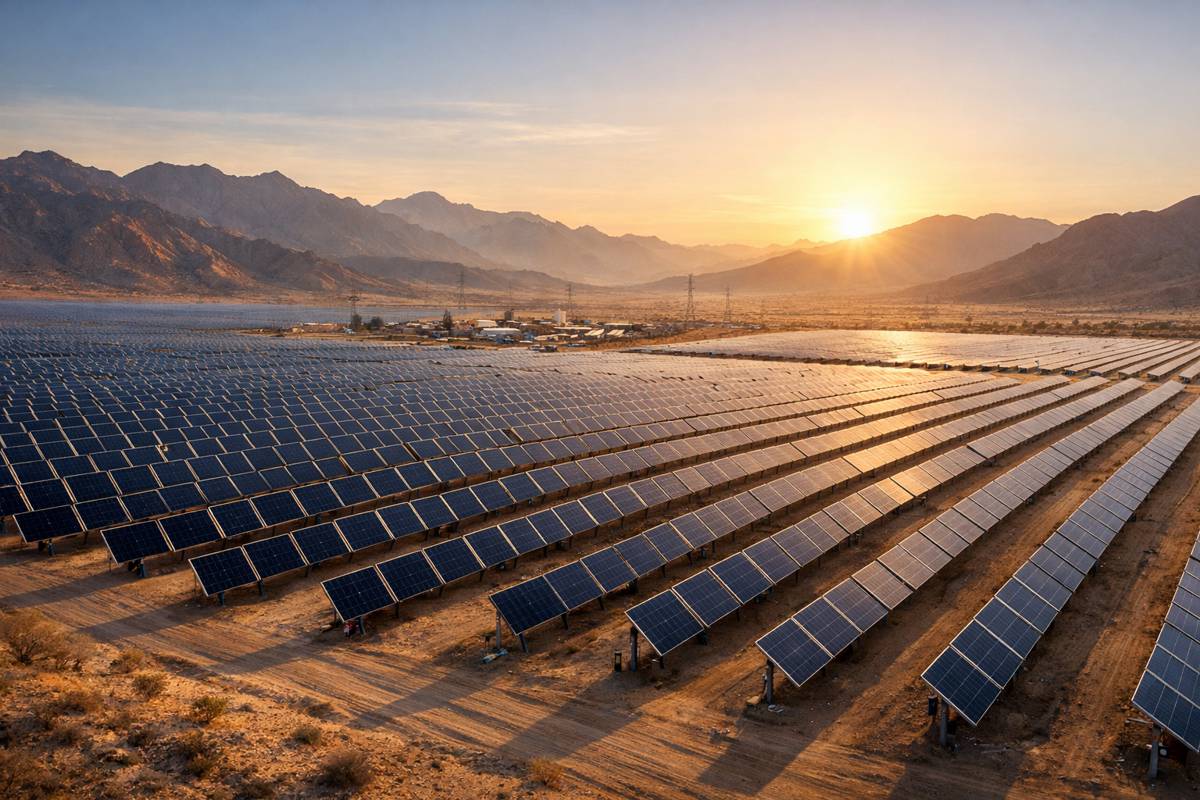
Saudi Arabia Accelerates Utility-Scale Solar with Local Supply Chains
Saudi Arabia’s renewable energy ambitions have entered a more industrial phase, where scale, localisation and delivery capability matter as much as headline capacity numbers. A newly announced 2.25 gigawatt-peak supply agreement for advanced solar tracking systems at the Bisha Solar project illustrates that shift clearly. Beyond the sheer size of the project, the announcement signals how the Kingdom is aligning energy transition goals with domestic manufacturing, supply chain resilience and long-term infrastructure strategy.
At the centre of the deal is Nextpower Arabia, a recently established joint venture between US-based solar technology firm Nextpower and regional infrastructure heavyweight Abunayyan Holding. The company will deliver solar tracking systems to Larsen & Toubro, which is executing the Bisha project on behalf of an ACWA Power-led consortium.
The project forms part of Wave 6 of Saudi Arabia’s National Renewable Energy Program, overseen by the Ministry of Energy and procured by the Saudi Power Procurement Company. Yet its importance extends well beyond procurement mechanics. Bisha represents a test case for how international technology providers can embed themselves within Saudi Arabia’s industrial ecosystem rather than operating purely as external suppliers.
Utility-Scale Solar as Strategic Infrastructure
Bisha Solar, located in the Asir Province, is the largest project in Wave 6 and one of the most significant utility-scale solar developments currently underway in the Kingdom. With 2.25 GWp of tracking systems alone, the project sits firmly in the category of national infrastructure rather than isolated power generation.
For Saudi Arabia, large-scale solar plants are no longer experimental or symbolic. They are foundational assets that support grid stability, long-term energy security and economic diversification. As oil-export revenues face structural pressure over the coming decades, renewable energy infrastructure is increasingly treated as a strategic hedge, enabling domestic demand growth while freeing hydrocarbons for higher-value uses.
International energy analysts have consistently highlighted Saudi Arabia’s solar potential as among the highest globally, driven by irradiation levels, available land and capital depth. The Kingdom’s challenge has been execution at scale, particularly in ensuring projects are delivered on time, within budget and under harsh operating conditions. Bisha addresses those concerns by pairing experienced EPC delivery with technologies designed for desert environments.
Why Solar Tracking Technology Matters at This Scale
At gigawatt scale, the choice of solar tracking systems becomes a commercial and operational decision with long-term implications. Trackers directly influence energy yield, maintenance requirements and lifecycle costs. In high-temperature, dusty environments such as southern Saudi Arabia, resilience and reliability are critical.
Nextpower’s tracking systems are designed to optimise panel orientation throughout the day, increasing output without expanding land use. While single-axis tracking is now standard across many utility-scale projects globally, regional adaptation remains essential. Wind loading, sand accumulation and thermal expansion can all undermine performance if systems are not engineered for local conditions.
The Bisha project reflects a growing preference among developers and EPC contractors for solutions that combine global design experience with regional manufacturing and support. Localised production reduces shipping costs, shortens lead times and simplifies after-sales service, all of which matter when deploying thousands of tracker units across vast sites.
Localisation as a Competitive Advantage
The formation of Nextpower Arabia marks a deliberate shift towards localisation rather than simple market entry. Rather than serving Saudi Arabia through imports alone, the joint venture has been structured around in-Kingdom manufacturing, supply chain integration and workforce development.
This approach aligns closely with Saudi Arabia’s broader industrialisation strategy under Vision 2030. Renewable energy projects are increasingly assessed not only on cost per kilowatt-hour, but also on their contribution to local content, skills transfer and industrial capability. By embedding manufacturing and logistics within the Kingdom, Nextpower Arabia positions itself as a long-term partner rather than a transactional supplier.
From an EPC perspective, localisation also reduces exposure to geopolitical risk and global supply chain disruptions. Recent years have shown how international shipping constraints and material shortages can derail infrastructure schedules. A regionalised supply chain offers greater predictability, particularly for multi-gigawatt programmes planned years in advance.
Engineering Confidence from the EPC Perspective
For Larsen & Toubro, the selection of Nextpower Arabia reflects a focus on delivery certainty and performance optimisation. L&T has decades of experience executing complex energy and infrastructure projects across challenging environments, and its involvement signals the project’s technical seriousness.
Bharathi Kumar, general manager of Renewable International at L&T, emphasised the importance of both technology and localisation in supporting long-term performance: “We have tremendous confidence in Nextpower Arabia to provide the most advanced utility-grade solar solutions that will help us deliver maximum performance and low-cost clean energy through the new Bisha Solar Plant long into the future. Localizing the production of these new systems that will form the foundation of the Bisha plant will deliver greater efficiencies throughout the development process while reducing the cost and impact of international shipping.”
Such statements underline a broader trend in utility-scale renewables, where EPC contractors increasingly value supply chain integration as highly as component specifications.
Strengthening the MENA Solar Supply Chain
The Bisha project is also significant in the context of regional supply chain development across the Middle East and North Africa. Historically, many large solar projects in the region have relied heavily on imported equipment, particularly from Asia, exposing developers to currency risk and long lead times.
By manufacturing tracker systems within Saudi Arabia, Nextpower Arabia contributes to a more diversified and resilient regional ecosystem. Over time, this could support the development of adjacent industries, from steel fabrication to control systems and maintenance services. For policymakers, such clustering effects are central to turning renewable energy investment into broader economic value.
Dan Shugar, founder and CEO of Nextpower, framed the joint venture as a strategic milestone rather than a single project win: “The MENA region is a top strategic priority for Nextpower. This project builds on our longstanding partnerships with ACWA Power and L&T and marks an important milestone for our new joint venture with Abunayyan Holding. Through Nextpower Arabia, we are localizing the industry’s most resilient and intelligent solar plant technologies, engineered specifically for the region’s demanding conditions, while strengthening the local supply chain to support Saudi Arabia’s long-term energy transition goals.”
Alignment with Saudi Arabia’s Expanding Renewable Pipeline
Bisha does not stand alone. Earlier this year, ACWA Power, alongside Badeel and Saudi Aramco Power Company, announced plans to invest $8.3 billion in seven large-scale renewable energy plants, adding around 15 GW of capacity to the national grid.
This pipeline underscores the scale of Saudi Arabia’s ambition and the need for delivery partners capable of operating at pace. As project volumes increase, the availability of local manufacturing capacity becomes a strategic bottleneck. Joint ventures such as Nextpower Arabia address that constraint directly.
For investors and policymakers, the message is clear. Renewable energy in Saudi Arabia is transitioning from episodic mega-projects to a sustained programme of infrastructure delivery. That shift favours companies with a permanent regional presence and the ability to scale operations over multiple project waves.
Building on a Proven Regional Track Record
Nextpower’s involvement in the region is not new. The company supplied technology for the 405 MW Sakaka Solar Park in 2018, Saudi Arabia’s first utility-scale solar project, and has since supported more than 6 GW of installations across the MENA region.
That track record matters as Saudi Arabia accelerates deployment. Early projects often focus on proving feasibility, while later phases prioritise efficiency, localisation and long-term performance. The creation of Nextpower Arabia suggests that both partners see the Kingdom not as a one-off market, but as a base for sustained regional growth.
Abunayyan Holding’s role is particularly significant in this respect. With decades of experience developing and operating energy and water infrastructure across the region, the group brings local market knowledge, regulatory familiarity and operational depth that complements Nextpower’s technology portfolio.
Turki Al-Amri, Chairman and CEO of Nextpower Arabia and CEO of Abunayyan Holding, highlighted the strategic alignment: “The Bisha project will significantly contribute to national and regional renewable energy transformation objectives. By manufacturing and producing Nextpower Arabia systems in the Kingdom, we can deliver a wide range of benefits from our newly localized solar supply chain for our development partners while advancing Saudi’s national industrialization strategy.”
What Bisha Signals for the Global Solar Industry
From a global perspective, the Bisha project reflects a broader evolution in utility-scale solar markets. As capacity scales into the gigawatt range, success increasingly depends on industrial capability rather than isolated technological breakthroughs.
Countries with ambitious decarbonisation targets are demanding more from project developers, including local content, workforce development and long-term economic value. Saudi Arabia’s approach mirrors trends seen in other large markets, where renewable energy policy is tightly linked to industrial strategy.
For technology providers, this raises the bar. Competing on price alone is no longer sufficient. Instead, companies must demonstrate an ability to integrate into local ecosystems, manage complex supply chains and support projects over multi-decade lifecycles.
A New Phase for Saudi Utility-Scale Solar
The Bisha Solar project and the emergence of Nextpower Arabia together mark a new phase in Saudi Arabia’s renewable energy journey. The focus is shifting from ambition to execution, from imported solutions to localised systems, and from standalone projects to a coherent national programme.
For the global construction, infrastructure and energy sectors, the implications are significant. Saudi Arabia is signalling that future opportunities will favour partners prepared to invest locally, adapt technologies to regional conditions and align with long-term national objectives. Bisha may be one project, but it offers a clear preview of how the Kingdom intends to build its renewable future.