Terahertz Breakthrough a Turning Point for 6G Infrastructure
The global race to define the architecture of 6G networks has entered a decisive phase, and a significant portion of that momentum is gathering in South Australia. At Adelaide’s Terahertz Engineering Laboratory, researchers are translating years of experimental physics and materials science into tangible hardware that could underpin the next era of wireless communication. The shift from theory to device level innovation marks a pivotal step for an industry that increasingly depends on faster, more resilient data transmission to support infrastructure, mobility and industrial automation.
Terahertz frequencies occupy a long overlooked region of the electromagnetic spectrum, positioned between microwaves and infrared light. Historically, technical limitations made them difficult to generate, manipulate and measure. Recent advances in micro and nanofabrication, however, have changed the equation. Adelaide researchers are now designing devices that do not merely explore terahertz signals in controlled environments but actively aim to deploy them in real world communication systems. For infrastructure planners, policymakers and technology investors, that shift carries implications that extend far beyond mobile connectivity.
Why 6G Development Matters for Infrastructure and Industry
The evolution from 5G to 6G is not simply about incremental speed improvements. It represents a broader transformation in how digital infrastructure supports physical infrastructure. Construction projects, transport networks, logistics hubs and energy systems increasingly rely on continuous, high volume data exchange. The prospect of wireless data rates exceeding one terabit per second opens the door to applications that currently remain constrained by bandwidth and latency.
At the Adelaide facility, researchers are exploring the boundaries of what terahertz technology can realistically deliver across several kilometres. That distance factor is particularly important for transport corridors, remote infrastructure monitoring and regional development. Wireless communication that maintains ultra high speed over extended ranges could reshape how major projects manage equipment fleets, safety systems and environmental sensors. In effect, terahertz technology is emerging as a foundational layer for digital infrastructure that mirrors the scale and ambition of physical infrastructure investment.
Professor Withawat Withayachumnankul, Group Leader at the Terahertz Engineering Laboratory, emphasised the potential reach of the work underway: “We’re exploring devices that could enable wireless data rates above one terabit per second across several kilometres.”
Such capability would not only influence telecommunications providers but also the construction and transport sectors, where high fidelity data exchange increasingly determines operational efficiency and safety outcomes.
Manufacturing Precision Becomes the Enabler of Communication Evolution
The progress achieved in Adelaide would not be possible without parallel advances in fabrication technologies. Translating theoretical terahertz concepts into practical devices requires microscopic precision, consistent material quality and repeatable manufacturing processes. This is where collaboration with the Australian National Fabrication Facility plays a decisive role.
The Mawson Lakes facility provides access to micro and nanofabrication capabilities valued at approximately thirty million dollars. That investment reflects the growing recognition that communication infrastructure is no longer just about towers and cables. Instead, it depends on semiconductor level innovation that can support higher frequencies and more complex signal processing.
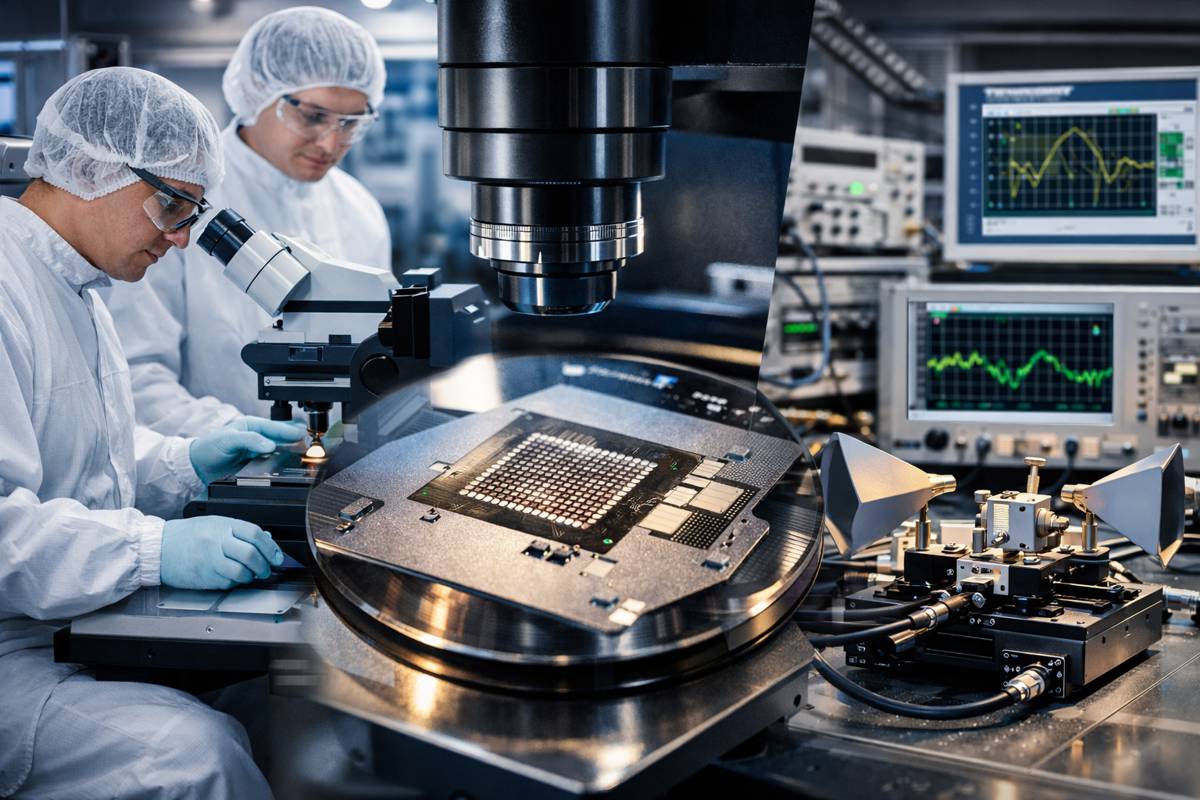
While researchers at the Terahertz Engineering Laboratory lead device design and performance measurement, fabrication specialists refine and manufacture components that meet exacting tolerances. This partnership ensures that ideas developed in research environments can realistically transition into scalable production. Professor Withayachumnankul highlighted the importance of this collaboration: “ANFF-SA’s fabrication expertise is critical to the success of our projects.
“Their advice helps us to navigate challenges early in the design stage, ensuring our devices can be manufactured reliably and with the precision required.”
For infrastructure stakeholders, this emphasis on manufacturability signals a shift away from experimental demonstrations toward technologies that can eventually support commercial deployment.
Silicon Microstructures Shape the Next Generation of Wireless Systems
At the heart of Adelaide’s terahertz progress lies silicon engineering at a scale measured in microns. Advanced fabrication techniques such as photolithography and deep reactive ion etching allow engineers to create intricate structures that would have been impossible just a decade ago. These processes enable the development of specialised antennas and components capable of handling terahertz frequencies with minimal signal loss.
One particularly significant innovation involves through silicon vias, commonly known as TSVs. These structures provide vertical electrical connections through silicon wafers, allowing compact integration of multiple functional layers. For communication systems, TSVs play a vital role in reducing signal delays and improving overall device performance. Their development highlights how semiconductor architecture directly influences wireless capability.
Dr Jing Ho Pai, Microfabrication Team Lead at the facility, described the precision required: “These silicon components are extremely precise – often perforated with patterns just a few microns wide.
“This level of detail is vital for achieving the performance required for next-generation communication systems.”
The implications extend well beyond telecommunications. High precision fabrication techniques developed for terahertz applications often find their way into sensing technologies, robotics and advanced construction monitoring systems. In other words, breakthroughs in one domain tend to ripple across multiple industries.
Terahertz Sensing Expands Beyond Communications
While 6G development attracts significant attention, the sensing capabilities of terahertz frequencies present equally compelling opportunities. Terahertz waves can penetrate various materials without causing damage, making them suitable for security inspections, quality control and agricultural analysis. Their ability to detect molecular signatures opens possibilities in fields ranging from material science to astronomy.
Professor Withayachumnankul pointed to these broader applications: “On the sensing front, we’re looking at safe, see-through scanners for security inspection, manufacturing quality control and agricultural monitoring. Terahertz frequencies also hold key molecular signatures that are vital for radio astronomy.”
For infrastructure sectors, non invasive sensing technologies could significantly enhance maintenance strategies. Bridges, tunnels and transport hubs could benefit from advanced scanning methods capable of identifying structural anomalies before they become critical. In agriculture, terahertz monitoring may assist in soil and crop analysis, supporting more efficient land use and resource management.
Global Competition and Strategic Importance
The push toward terahertz enabled communication is not unique to Australia. Research centres in Asia, Europe and North America are actively exploring similar technologies, often supported by national digital transformation strategies. However, the integration of fabrication expertise with applied engineering research gives Adelaide’s initiative a distinctive advantage.
Infrastructure investment increasingly depends on digital readiness. Governments worldwide recognise that communication networks underpin economic competitiveness, supply chain resilience and urban development. By contributing to the foundational technology behind 6G, research institutions position themselves within a broader ecosystem that influences policy decisions, funding priorities and international collaboration.
The work underway in Adelaide demonstrates how regional research facilities can shape global technological directions. It also reinforces the idea that future infrastructure projects will rely as much on semiconductor innovation as they do on civil engineering expertise.
From Laboratory Innovation to Industry Integration
Translating terahertz devices from laboratory prototypes into deployable infrastructure components will require collaboration across multiple sectors. Telecommunications providers, construction firms and equipment manufacturers must adapt their systems to accommodate new frequency bands and data capabilities. Standards development will also play a crucial role, ensuring compatibility across networks and devices.
The partnership between researchers and fabrication specialists already reflects this integrated approach. By addressing manufacturing challenges early, teams increase the likelihood that new technologies can move smoothly into commercial environments. Dr Pai highlighted the collaborative process: “Working closely with the research team, we are exploring fabrication options for these complex structures, ensuring reliability at every step. It’s incredibly rewarding to see ambitious concepts come to life.”
For industry stakeholders, this progress signals that terahertz communication is no longer confined to theoretical discussions. Practical pathways toward deployment are emerging, supported by engineering expertise and fabrication infrastructure capable of meeting real world demands.
Terahertz Technology as a Cornerstone of Future Connectivity
The development of terahertz devices in Adelaide represents more than a regional research achievement. It reflects a broader shift in how communication technology intersects with infrastructure development. As data demands continue to grow, the ability to transmit information quickly and reliably becomes essential for sectors ranging from transport logistics to urban planning.
The hardware being developed today could form part of the backbone of future networks, enabling applications that extend beyond consumer devices. Autonomous systems, smart cities and large scale industrial operations will depend on communication technologies capable of handling vast data flows without delay. Terahertz frequencies offer the bandwidth and responsiveness required to support these ambitions.
As Professor Withayachumnankul observed: “The work being done today at Adelaide University will help unlock wireless speeds vastly beyond what is possible today. With their vast bandwidth, sensing capabilities and ultra-low latency, terahertz waves are set to become a cornerstone of future telecommunications.”
For construction professionals, investors and policymakers, this research underscores the interconnected nature of modern infrastructure. Digital capacity increasingly shapes physical development, and innovations in one field often redefine expectations in another. Adelaide’s progress in terahertz engineering offers a glimpse into how future networks might operate and how industries can prepare for a world where data moves as quickly as ideas.