Building a Trustworthy Industrial AI Stack for the Physical World
Dassault Systèmes and NVIDIA have moved well beyond a conventional technology tie up. Their newly announced long term strategic partnership sets out to define a shared industrial architecture for mission critical artificial intelligence, aimed squarely at sectors where errors are expensive, safety is non negotiable and complexity is the norm rather than the exception.
For the global construction, infrastructure, manufacturing and industrial technology ecosystem, the significance lies not in faster graphics cards or smarter algorithms, but in the ambition to ground artificial intelligence in validated science, physics and industrial knowledge. This is an attempt to move industrial AI out of the experimental phase and into something engineers, operators, regulators and investors can rely on at scale.
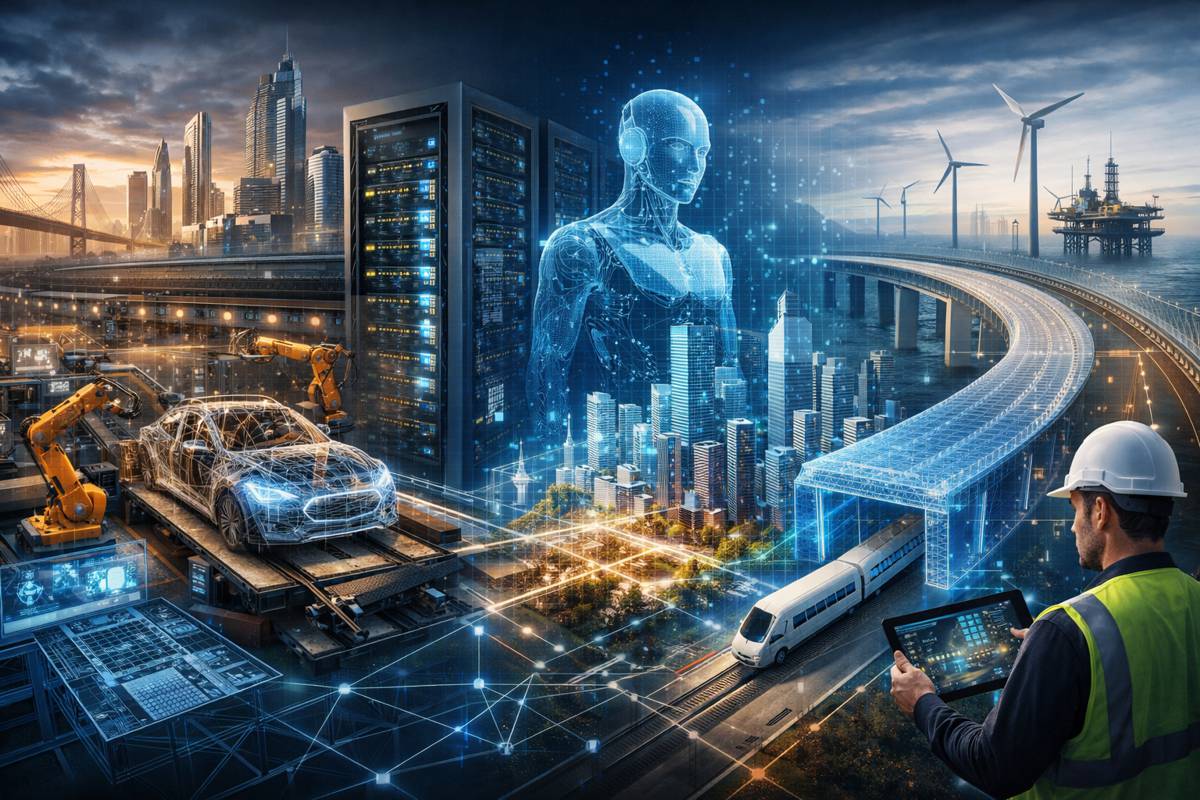
At the centre of the partnership is the convergence of Dassault Systèmes’ Virtual Twin technologies with NVIDIA’s AI infrastructure, open models and accelerated computing libraries. Together, they are working toward what they describe as science validated industry World Models. These models are designed to reflect how complex systems behave in the real world, not just how data suggests they might.
For industries grappling with tighter margins, stricter regulation and rising sustainability pressure, that distinction matters. Digital predictions are useful. Digital systems that can be trusted to mirror reality are transformative.
Why Industrial AI Needs a New Foundation
Artificial intelligence has already found its way into construction planning, asset monitoring and manufacturing optimisation. Yet much of this adoption has remained fragmented, with models trained on limited datasets and outputs that still require heavy human validation. In safety critical environments such as transport infrastructure, aviation, energy systems and large scale manufacturing, that uncertainty is a barrier to wider deployment.
The Dassault Systèmes and NVIDIA partnership is explicitly framed as a response to that gap. By combining decades of industrial modelling expertise with accelerated computing and AI frameworks, the two companies are positioning industrial AI as something that understands physical constraints, regulatory boundaries and engineering trade offs.
“We are entering an era where artificial intelligence does not just predict or generate, but understands the real world. When AI is grounded in science, physics and validated industrial knowledge, it becomes a force multiplier for human ingenuity,” said Pascal Daloz, CEO of Dassault Systèmes.
The emphasis on understanding, rather than prediction alone, is critical. In construction and infrastructure, decisions ripple through design life cycles that can span decades. AI systems that fail to account for materials behaviour, structural physics or operational constraints introduce risk rather than reducing it.
Virtual Twins Meet Accelerated Computing
Dassault Systèmes’ Virtual Twin concept has long been central to its approach. These digital representations are not static models but living systems that evolve alongside their physical counterparts, integrating design data, operational feedback and environmental conditions.
By integrating NVIDIA’s AI infrastructure and open model ecosystem, these Virtual Twins are being extended into what both companies describe as industry World Models. The goal is to simulate and operate complex systems across biology, materials science, engineering and manufacturing with a higher degree of confidence and speed.
From an infrastructure perspective, this has immediate implications. Virtual Twins of bridges, rail networks or energy systems could move from planning tools to continuous decision support systems, informing maintenance strategies, resilience planning and decarbonisation pathways.
“Physical AI is the next frontier of artificial intelligence, grounded in the laws of the physical world,” said Jensen Huang, founder and CEO of NVIDIA. “Together with Dassault Systèmes, we’re uniting decades of industrial leadership with NVIDIA’s AI and Omniverse platforms to transform how millions of researchers, designers and engineers build the world’s largest industries.”
Scaling Industrial AI Through Sovereign Infrastructure
One of the less visible, but arguably most important, aspects of the partnership is infrastructure sovereignty. Through its OUTSCALE brand, Dassault Systèmes is deploying AI factories as part of a sustainable and sovereign cloud strategy, harnessing NVIDIA AI infrastructure across three continents.
These AI factories are designed to operate models directly within the 3DEXPERIENCE platform, while guaranteeing data privacy, intellectual property protection and regulatory compliance. For infrastructure owners, defence contractors and public sector clients, this approach addresses long standing concerns around cloud dependency and data jurisdiction.
At the same time, NVIDIA is adopting Dassault Systèmes’ model based systems engineering approach to design its own AI factories, starting with the NVIDIA Rubin platform and integrating into the NVIDIA Omniverse DSX Blueprint for large scale deployment. This cross adoption underlines how tightly coupled the collaboration has become.
Rather than a vendor customer relationship, the partnership resembles a shared reference architecture for how industrial AI systems are designed, validated and scaled.
Impact Across Science, Engineering and Production
The combined architecture is already being positioned across several domains with direct relevance to construction and infrastructure supply chains.
In materials science and chemistry, NVIDIA BioNeMo combined with Dassault Systèmes’ BIOVIA platforms aims to accelerate discovery of new molecules and materials. For construction, this could influence the development of lower carbon cements, advanced composites and longer lasting infrastructure materials.
In engineering and simulation, SIMULIA Virtual Twin Physics Behaviour is being enhanced using NVIDIA CUDA X libraries and AI physics models. This allows engineers to predict outcomes faster and with greater fidelity, reducing the iteration cycles that often slow complex infrastructure projects.
On the factory floor, NVIDIA Omniverse physical AI libraries integrated into DELMIA Virtual Twin Factory systems point toward more autonomous and software defined production environments. For construction equipment manufacturers and modular builders, this opens the door to digitally validated production lines that can adapt in real time.
Virtual Companions and the Human Factor
Beyond simulation and automation, the partnership also addresses how professionals interact with complex industrial data. The agentic 3DEXPERIENCE platform integrates NVIDIA AI technologies and Nemotron open models to create what Dassault Systèmes calls Virtual Companions.
These AI driven assistants are designed to operate within deep industrial context, drawing on World Models rather than generic language datasets. For engineers, planners and asset managers, the promise is actionable intelligence that respects design intent, compliance requirements and operational realities.
In sectors such as transport infrastructure, where knowledge silos and documentation gaps are common, Virtual Companions could help bridge generational expertise gaps and improve decision continuity across project life cycles.
Early Signals From Industry Leaders
Several global organisations have already highlighted how the partnership could influence their operations.
“Bel Group is building a sustainable food future through responsible formulation and packaging. Through the NVIDIA-Dassault Systèmes collaboration, we gain the computational power to model and optimize our products at scale accelerating innovation while delivering on our sustainability commitments,” said Cécile Béliot, CEO of Bel Group.
In industrial automation, OMRON sees the combination of Physical AI frameworks and Virtual Twin Factory systems as a path toward fully autonomous and digitally validated production environments.
“By combining NVIDIA Physical AI frameworks with Dassault Systèmes’ Virtual Twin Factory and OMRON’s automation technologies, manufacturers can move from design to deployment with greater confidence and speed,” said Motohiro Yamanishi, President of Industrial Automation at OMRON.
Automotive manufacturer Lucid also points to faster iteration without sacrificing accuracy, a balance that infrastructure projects increasingly demand as timelines compress and regulatory scrutiny grows.
Implications for Construction and Infrastructure
For the construction and infrastructure sectors, the broader implication is the emergence of a coherent industrial AI stack that spans design, simulation, production and operation. This matters at a time when the industry faces acute skills shortages, increasing asset complexity and mounting climate resilience requirements.
Digital Twins are already influencing how roads, bridges and tunnels are designed. The shift toward science validated World Models and AI grounded in physics could push this further, enabling predictive maintenance, adaptive asset management and scenario testing under extreme conditions.
Investors and policymakers will also take note. Infrastructure funding decisions increasingly depend on transparent risk modelling and long term performance projections. Industrial AI systems that can demonstrate traceability, validation and regulatory alignment strengthen the case for digital first investment strategies.
A Long Term Vision for Industrial AI
The partnership was unveiled at 3DEXPERIENCE World, Dassault Systèmes’ annual gathering of design and engineering communities, where both CEOs outlined a shared vision for how industrial AI should be built and governed.
What sets this collaboration apart is its explicit rejection of black box intelligence. Instead, it proposes an architecture where AI systems are understandable, auditable and grounded in real world behaviour.
For construction, infrastructure and industrial technology professionals, that approach aligns closely with how the physical world actually works. Complex systems rarely fail because of a lack of data. They fail when models drift away from reality.
By anchoring artificial intelligence in Virtual Twins, validated physics and sovereign infrastructure, Dassault Systèmes and NVIDIA are betting that the future of industrial AI will be less about spectacle and more about trust.