Analog Intelligence Sets a New Course for Software Defined Vehicles
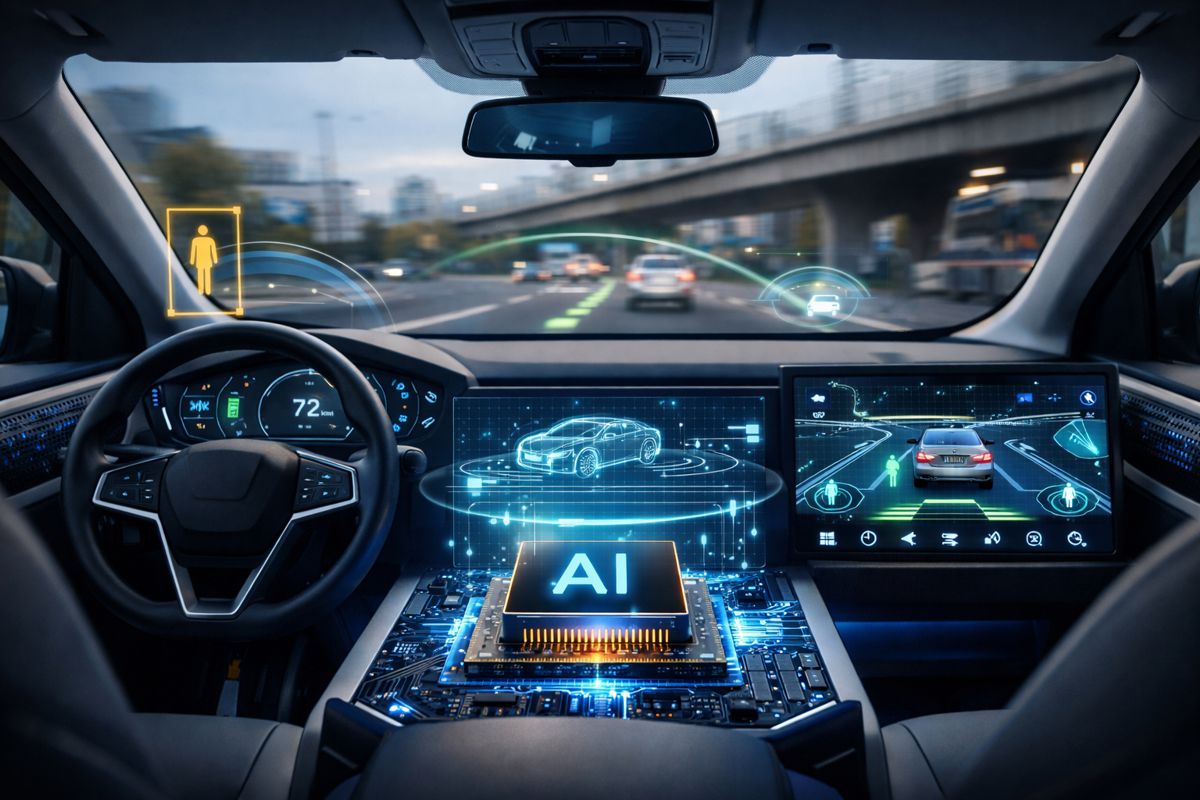
As vehicles evolve into fully software defined platforms, the limiting factor is no longer mechanical capability but compute efficiency. Advanced driver assistance systems, automated driving stacks and increasingly sophisticated in vehicle intelligence demand orders of magnitude more processing power, yet vehicles remain tightly constrained by energy, thermal and cost envelopes. Against that backdrop, the joint development agreement between Honda Motor Co., Ltd. and Mythic marks a meaningful inflection point for the automotive and wider mobility ecosystem.
Rather than following the well trodden path of scaling conventional digital processors, Honda’s research arm has opted to explore a fundamentally different computing paradigm. The collaboration centres on licensing and co developing Mythic’s analog compute in memory technology to create an automotive grade AI system on chip designed for deployment in Honda’s next generation software defined vehicles by the late 2020s and early 2030s. The strategic importance lies not just in incremental gains, but in the potential to redefine how intelligence is delivered inside vehicles without breaching power limits.
At stake is Honda’s long standing safety ambition to eliminate traffic collision fatalities involving its motorcycles and automobiles by 2050. Achieving that goal depends on the ability to run far more complex perception, prediction and control models on board, reliably and continuously, without dependence on the cloud. The Honda Mythic partnership is therefore less about a single chip and more about unlocking a new class of vehicle intelligence.
Why Energy Efficient AI Matters for Automotive Safety
Vehicles are, by their nature, power limited systems. Every watt allocated to computing is a watt not available for propulsion, comfort or auxiliary systems. In electric vehicles, the trade off is even starker, with compute loads directly influencing range and battery longevity. This constraint has become one of the principal bottlenecks in deploying higher levels of automated driving at scale.
Today’s digital AI accelerators have delivered impressive performance gains, but they do so at increasing energy cost. Training and inference workloads for vision based perception, sensor fusion and motion planning continue to grow in size and complexity. External research from the International Energy Agency and academic studies on automotive electrification consistently point to electronics efficiency as a critical lever in reducing lifecycle energy consumption across vehicle fleets.
Analog compute in memory architectures approach the problem from a different angle. By performing computation directly where data is stored, they avoid the constant movement of data between memory and processing units that dominates power consumption in digital systems. Mythic’s architecture, inspired by the way biological neural systems operate, integrates memory and compute into a single layer. The result, according to the companies, is approximately 100 times better energy efficiency than conventional digital AI chips for relevant workloads.
For Honda, this efficiency is not an abstract metric. It directly translates into the ability to deploy more advanced models, run them more frequently and maintain redundancy for safety critical functions, all within a strict automotive power envelope. In practical terms, it opens the door to richer situational awareness and faster response times without compromising vehicle efficiency.
From Incremental Gains to Orders of Magnitude Change
One of the most striking aspects of the joint development vision is the scale of compute being discussed. The collaboration envisages future Honda vehicles equipped with over 100,000 trillion operations per second of AI processing capability. In today’s terms, that level of performance would typically be associated with data centre class systems rather than embedded automotive platforms.
The significance is not simply headline performance. What matters is performance per watt. Delivering such compute capacity within the limited thermal and electrical budget of a vehicle has remained elusive for digital architectures. Neuromorphic and analog approaches, long explored in research environments, have struggled to cross into automotive grade deployment due to reliability, manufacturability and integration challenges.
By licensing Mythic’s Analog Processing Unit technology through Honda R&D Co., Ltd., the companies are attempting to bridge that gap. The goal is to co develop a system on chip that meets automotive standards for safety, durability and lifecycle support while preserving the efficiency advantages of analog compute. If successful, it would represent one of the most significant shifts in automotive computing architecture in decades.
The Strategic Rationale Behind Honda’s Approach
Honda has historically taken a measured, engineering led approach to automation and safety. Rather than racing to deploy partially mature technologies, the company has prioritised reliability, predictability and human centred design. The decision to partner with Mythic aligns with this philosophy.
Atsushi Ogawa, Chief Operating Officer at Honda R&D Co., Ltd., framed the collaboration in terms of long term capability building rather than short term product differentiation. His remarks underscore the strategic intent behind the agreement: “Mythic’s cutting-edge analog compute technology makes them a strategic partner for Honda as we develop the next generation of intelligent, safe vehicles. We are excited to collaborate with Mythic on the future of automotive computing. This relationship will continue to grow as we jointly develop, test & integrate Mythic’s unique capabilities across our future vehicle lineup, supporting Honda’s commitments to safety and innovation.”
For Honda, the partnership is as much about learning and co creation as it is about technology acquisition. By engaging early in the development cycle, Honda positions itself to shape how analog AI is integrated into vehicle architectures, software stacks and safety validation processes.
Enabling New Classes of On Board Intelligence
The jointly developed AI system on chip is intended to support a broad range of machine learning workloads critical to next generation vehicles. These include advanced perception models such as vision transformers, which have demonstrated superior performance in complex visual environments, as well as physics informed neural networks used for vehicle dynamics and control.
Of particular note is the intention to support cloud free large language models for in car assistants. As vehicles become more autonomous and connected, human machine interfaces must evolve to handle more nuanced interactions without introducing latency or privacy concerns. Running language models locally allows vehicles to interpret and respond to driver intent even in environments with limited connectivity, while keeping sensitive data on board.
From an infrastructure perspective, this shift has implications beyond individual vehicles. Reduced reliance on continuous cloud connectivity lowers network load and enhances resilience in regions with less developed digital infrastructure. For fleet operators and policymakers, it also simplifies compliance with data sovereignty and privacy regulations.
Mythic’s Perspective on the Automotive Compute Challenge
For Mythic, the automotive sector represents both an opportunity and a proving ground. Vehicles demand extreme reliability, long service lives and consistent performance across harsh operating conditions. Success in this domain signals maturity for any new computing architecture.
Dave Fick, Co Founder and Chief Technology Officer of Mythic, articulated the broader context in which the partnership sits: “Cars are quickly becoming petascale supercomputers on wheels – in the near future, the most powerful computer in your home will be parked in your garage. Vehicles will soon require computing performance on par with data centers, but with far tighter energy budgets. That’s exactly what Mythic’s analog technology delivers. We’re thrilled to partner with Honda to usher in a new era of energy-efficient automotive computing, where every vehicle can have the AI brainpower of a data center, without the power draw.”
The analogy of vehicles as mobile supercomputers is increasingly reflected in industry analysis. Autonomous driving stacks now integrate perception, localisation, prediction, planning and control modules that rival complex robotics systems. Delivering that capability efficiently is the central challenge Mythic aims to address.
A Broader Industry Implication for Autonomous Systems
The implications of analog AI extend beyond Honda’s own product roadmap. If the technology delivers on its promise, it could lower the barrier to deploying high capability automated systems across a wider range of vehicles, not just premium models. This democratisation of compute capability is particularly relevant for safety outcomes, where broad adoption matters more than niche excellence.
Taner Ozcelik, Chief Executive Officer of Mythic and former founder of NVIDIA’s automotive division, positioned the technology as a necessary step change for autonomy: “Digital computing architectures simply cannot meet the combined performance and power-efficiency requirements of safe autonomous driving – but Mythic’s analog technology can. Much as GPUs transformed computing by accelerating AI next to CPUs, Mythic’s incredibly energy-efficient APUs will be the accelerators that democratize full self-driving across all vehicles. We are the only company delivering a computing architecture with the efficiency needed to enable the level of AI intelligence that truly safe autonomous vehicles demand for everyone.”
While such claims will ultimately be judged by deployment and real world performance, the underlying argument aligns with a growing body of research into alternative computing paradigms for edge AI. Neuromorphic and analog approaches are increasingly seen as viable complements to digital systems in power constrained environments.
Timelines, Trials and Commercial Reality
According to the companies, initial prototype chips resulting from the collaboration are expected to be tested in vehicles in the late 2020s or early 2030s. Following successful trials, the jointly developed analog AI system on chip is intended to enter production shortly thereafter.
This timeline reflects the realities of automotive development cycles, where validation, safety certification and supply chain readiness take precedence over rapid iteration. For Honda, consistently ranked among the world’s top ten automotive manufacturers by sales volume, integrating a new compute architecture at scale requires confidence not only in performance but in long term support and manufacturability.
For Mythic, the partnership represents a significant commercial milestone. The company recently closed a 125 million dollar funding round led by deep technology investors including DCVC, NEA, SoftBank and Future Ventures, alongside strategic participation from Honda. Securing an OEM partner of Honda’s scale provides a pathway from promising technology to volume deployment.
Setting a New Benchmark for Performance Per Watt
Ultimately, the significance of the Honda Mythic collaboration lies in its potential to reset expectations around on board AI efficiency. Performance per watt and performance per watt per cost are emerging as the defining metrics for automotive intelligence, particularly as vehicles integrate more sensors, features and autonomous capability.
If analog compute in memory architectures can be industrialised at automotive scale, they could influence design decisions across the sector, from vehicle electrical architectures to regulatory approaches for automated driving systems. For infrastructure planners and policymakers, more capable and energy efficient vehicles also offer downstream benefits in terms of traffic safety, congestion management and energy consumption.
The partnership does not promise an immediate transformation, nor does it claim to solve autonomy overnight. What it does offer is a credible pathway toward the kind of efficient, high capability intelligence required to make safer roads a practical reality rather than a distant aspiration.