Gather AI Raises $40m to Embed Physical AI Across Logistics Infrastructure
The global logistics sector is at a turning point. After decades of digitisation, automation and enterprise software investment, one stubborn gap continues to undermine performance across warehouses, factories and yards: the mismatch between what systems believe exists and what is physically present on the ground. This disconnect, often described by operators as the physical digital divide, costs the logistics and manufacturing ecosystem billions every year through missed shipments, excess inventory, labour inefficiencies and eroded margins.
To capitalise on this opportunity, Gather AI has closed a $40 million Series B funding round, led by Smith Point Capital Management, with participation from Bain Capital Ventures, Tribeca Venture Partners, Bling Capital, Dundee Venture Capital, XRC Ventures and new investor The Hillman Company. The raise brings total funding to $74 million and signals growing confidence that Physical AI is moving from pilot technology into critical infrastructure for modern supply chains.
More than a capital milestone, the investment reflects a broader shift in how logistics leaders, investors and policymakers are thinking about operational intelligence. Software alone has not been enough. Visibility without ground truth has proven fragile. What Gather AI is proposing, and increasingly delivering at scale, is a continuous intelligence layer that connects digital decision making directly to the physical world.
Why Physical Intelligence Has Become Mission Critical
Warehouses have long been digitised environments, rich with WMS, ERP and planning tools. Yet these systems still rely heavily on manual updates, periodic cycle counts and operator inputs that can lag reality by hours or days. In fast moving environments, that delay compounds quickly. A single inaccurate inventory record can cascade into delayed outbound loads, inefficient labour allocation and unnecessary safety risks.
Industry studies consistently underline the scale of the issue. Research from organisations such as McKinsey and the World Economic Forum has shown that inventory inaccuracies of just one to three percent can translate into millions in lost working capital for large distribution networks. In high velocity sectors such as food and beverage or automotive, the tolerance for error is even smaller.
Physical AI addresses a structural problem rather than a process failure. Instead of asking workers to update systems, it enables systems to continuously observe, verify and reconcile what is actually happening on the floor. In doing so, it changes the operating model from reactive correction to proactive control.
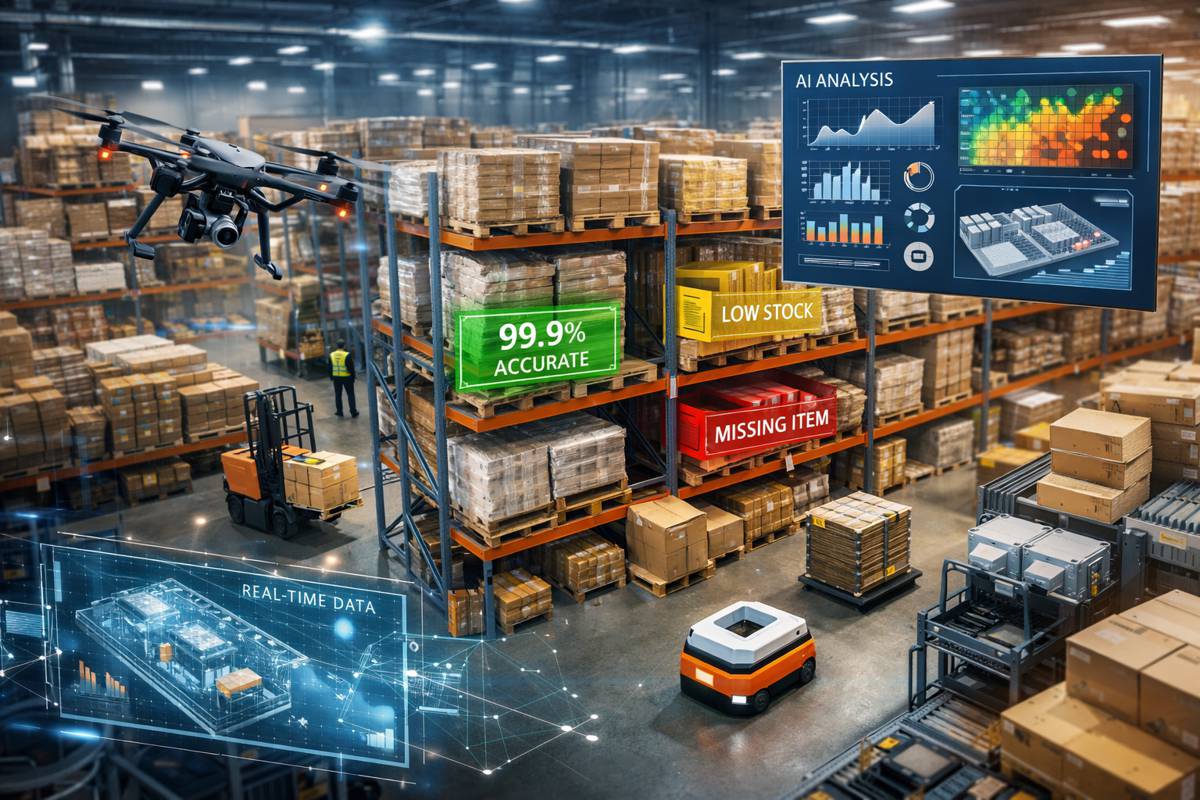
Gather AI’s approach is built around continuous physical intelligence, using computer vision to observe static and moving inventory in real time. This matters because many of the most costly failures in logistics are not caused by bad planning, but by blind spots that emerge between planning cycles.
From Counting to Continuous Intelligence
Traditional inventory accuracy programmes depend on periodic audits and labour intensive counts. While these methods can improve confidence temporarily, accuracy degrades quickly once normal operations resume. Gather AI’s platform replaces episodic checking with continuous verification.
Using AI powered vision deployed on consumer grade hardware, including drones and material handling equipment, the platform digitises pallets, tasks and movements as they happen. The result is a constantly updated ground truth that synchronises with existing WMS and ERP systems without requiring new fixed infrastructure.
This architectural choice has commercial significance. Infrastructure heavy solutions often struggle to scale across diverse building layouts and operational models. By avoiding fixed sensors and bespoke hardware, Gather AI lowers both deployment friction and capital cost, making enterprise wide rollouts more viable.
Customers report inventory accuracy levels of 99.9 percent, alongside reductions in manual counting effort of up to 80 percent and productivity improvements of up to five times. While performance figures vary by operation, the consistent theme is speed of impact. Many deployments achieve return on investment in under six months, a threshold that matters deeply in a margin constrained sector.
The Investment Signal From Capital Markets
The Series B round is notable not only for its size, but for the profile of its lead investor. Keith Block, Founder and CEO of Smith Point Capital Management, brings deep enterprise software and scaling experience to the board.
Block framed the opportunity in infrastructure terms rather than feature enhancement, stating: “Gather AI is redefining how the physical world gets measured, understood, and operated. What Sankalp and his team have built isn’t just a better way to count inventory; it’s a foundational intelligence layer for the modern supply chain. We believe Gather AI will become the system of record for every warehouse, factory, and yard, and we’re thrilled to help accelerate that future.”
That language mirrors a broader shift among institutional investors. Physical AI is increasingly being viewed not as a niche automation play, but as a core data layer that underpins resilience, productivity and safety across critical infrastructure.
Learning From the Real World, Not the Internet
While much of the AI boom has focused on text and image models trained on internet scale datasets, Physical AI operates under very different constraints. Warehouses are cluttered, dynamic and safety critical environments where standard sensors often struggle.
Gather AI’s models are trained on millions of proprietary warehouse images, capturing real world complexity that generic datasets cannot replicate. This allows the system to identify, count and verify inventory across a range of lighting conditions, layouts and motion scenarios.
This distinction is more than technical. It addresses one of the core limitations of many automation initiatives: brittleness. Systems that work well in controlled environments often fail at scale when exposed to operational variability. By learning directly from real facilities, Physical AI becomes more robust as deployments expand.
From Visibility to Autonomous Orchestration
The latest funding will support Gather AI’s evolution from real time visibility into predictive and autonomous capabilities. The goal is not simply to surface problems faster, but to prevent them entirely by anticipating bottlenecks before they cascade.
CEO and Co Founder Sankalp Arora positioned the shift clearly, saying: “For too long, supply chains have operated with a fundamental blind spot: they couldn’t see what was actually happening on the floor. This funding allows us to expand from real time visibility to full autonomous orchestration. Our customers aren’t just finding problems faster. They’re preventing them entirely. That shift from reactive to proactive is what transforms Physical AI from a nice to have into the operating system for modern logistics.”
Autonomous orchestration has implications beyond efficiency. By reducing firefighting, it stabilises labour planning, improves safety outcomes and strengthens resilience during demand shocks or disruption events.
Enterprise Adoption Across Critical Sectors
Gather AI’s momentum over the past year reflects growing enterprise confidence in Physical AI. The company has doubled its operational footprint and grown bookings by 250 percent, becoming the operational standard for logistics and manufacturing organisations including GEODIS, NFI Industries, Kwik Trip, Axon, dnata, Barrett Distribution and Langham Logistics.
The diversity of this customer base is significant. Logistics, manufacturing, food and beverage, aerospace and automotive operations each present different physical challenges. Success across these environments suggests the platform is not narrowly tuned, but adaptable at scale.
Scaling Globally as Infrastructure, Not Pilot
With Series B funding secured, Gather AI plans to expand into hundreds of additional facilities worldwide while scaling engineering and customer success teams to support enterprise wide deployments. Expansion across North America, Europe and Asia reflects the global nature of the physical digital divide and the universal demand for reliable ground truth.
Recognition from organisations such as CB Insights and the Inc Power Partner Awards underscores growing industry validation. The company is also set to showcase its platform at Manifest and MODEX throughout 2026, placing Physical AI firmly on the agenda for logistics leaders and technology buyers.
From Robotics Research to Operational Reality
Founded in 2017 and headquartered in Pittsburgh, Gather AI’s roots lie in advanced robotics research, drawing on expertise from Carnegie Mellon University and operational scaling experience from Amazon Robotics. This blend of academic rigour and commercial execution has shaped a platform designed for safety, autonomy and scale.
By positioning itself as a co pilot for intralogistics teams rather than a replacement for human decision making, the company aligns with a pragmatic vision of AI adoption. Physical intelligence augments human operators, enabling them to act with confidence rather than rely on outdated data or intuition.
Infrastructure Implications for the Global Supply Chain
For policymakers and infrastructure investors, the rise of Physical AI carries broader implications. Warehouses, factories and yards are critical nodes in national and global supply chains. Improving their reliability and efficiency strengthens economic resilience, reduces waste and supports sustainability goals by optimising working capital and energy use.
As supply chains become more complex and geographically distributed, the ability to maintain accurate, real time physical intelligence may prove as important as transport capacity or digital connectivity. Gather AI’s latest funding round suggests that capital markets increasingly see Physical AI as foundational infrastructure rather than optional optimisation.
In that sense, the Series B is less about a single company’s growth and more about the maturation of a category. Physical intelligence is no longer an experiment. It is becoming an operating requirement.