Barco Launches BABA Compliant Recycled Rubber Speed Bumps
In recent years, the global construction conversation has largely revolved around megaprojects, digital twins and decarbonisation strategies. Yet much of the real transformation is happening at a far smaller scale. Across towns and cities, seemingly modest components such as traffic calming devices, kerbside protection and parking management hardware are being re-evaluated through the lens of procurement policy and supply chain resilience.
The United States’ Buy America, Build America framework has quietly altered the procurement calculus for public works. Enacted through the Infrastructure Investment and Jobs Act, the rules require federally funded projects to prioritise domestically manufactured iron, steel, manufactured products and construction materials. For municipalities and contractors, compliance is no longer optional paperwork. It directly determines whether projects qualify for funding.
This regulatory shift has created demand not only for heavy equipment and structural materials but also for the smaller safety elements that shape day-to-day road use. Traffic calming infrastructure now sits inside the same compliance environment as bridges and highways. Consequently, suppliers that can deliver compliant products without inflating project costs are becoming strategically important partners rather than commodity vendors.
The Overlooked Role of Traffic Calming Infrastructure
Speed management rarely grabs headlines, yet it influences safety outcomes more consistently than many high-profile engineering interventions. According to international road safety research, small reductions in vehicle speed dramatically reduce the severity of collisions, particularly in mixed-use urban environments where pedestrians and vehicles interact frequently.
Parking areas, logistics yards, industrial estates and school zones all depend on predictable vehicle behaviour. Physical traffic calming devices remain one of the most reliable ways to achieve it because they operate independently of driver attention, enforcement or technology adoption. Even as intelligent transport systems expand, passive safety infrastructure still forms the foundation of risk mitigation.
That’s why contractors increasingly specify modular rubber systems rather than traditional asphalt or concrete alternatives. Installation is quicker, maintenance is simpler and relocation is possible as site layouts evolve. For temporary works, construction staging and phased developments, flexibility can matter more than permanence.
Barco’s Response to Procurement Pressure
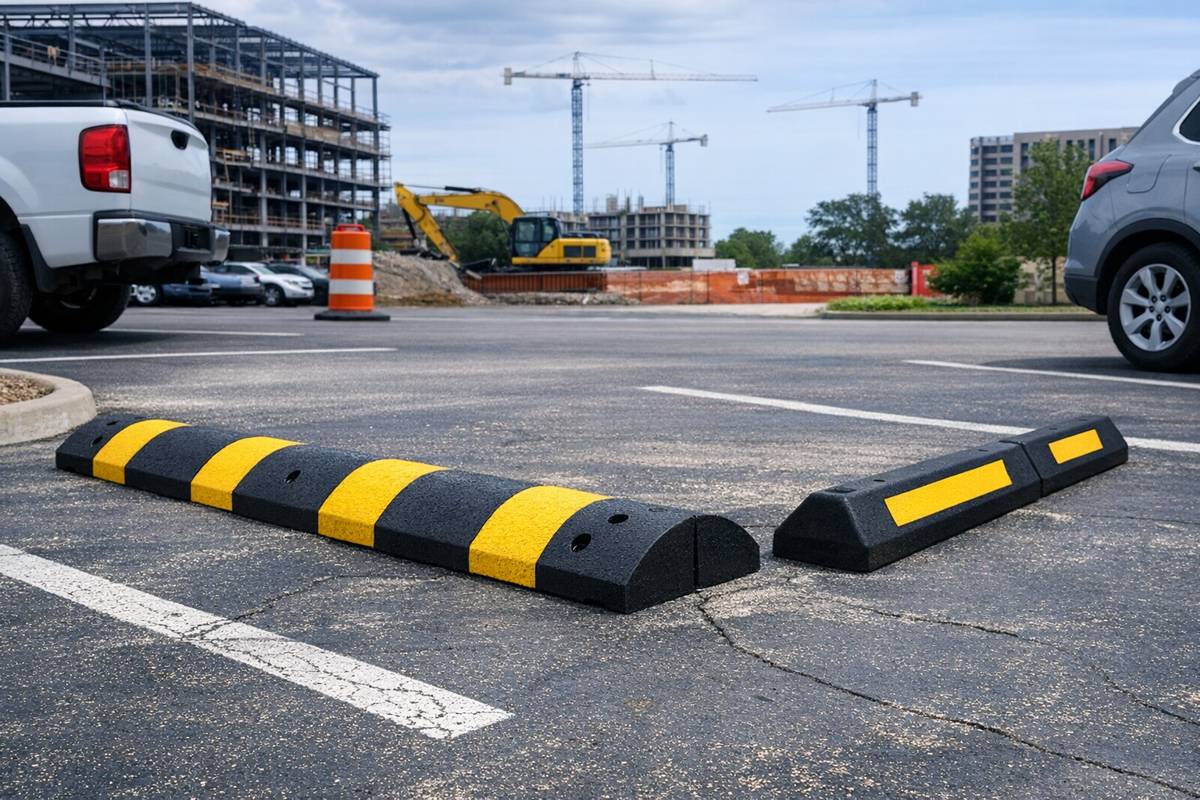
Barco Products has introduced a line of recycled rubber speed bumps and wheel stops manufactured in the United States to align with federal domestic content requirements. The range includes complete speed bump kits, modular sections, end caps and wheel stops designed to be configured according to site layout rather than fixed dimensions.
The company positions the products primarily as a compliance solution for government funded projects. Alisha Hairston, Traffic Safety Specialist at the company, explained: “Our new BABA-compliant traffic safety products help government and municipal customers meet federal funding requirements. We’re proud to offer American-made solutions that simplify compliance and make it easier for our customers to choose products that meet their project needs.”
For project owners, the practical implication is straightforward. If a project uses federal funds, every component must be traceable to domestic manufacturing criteria. Even relatively small imported items can delay approvals or jeopardise reimbursement. Providing compliant components reduces administrative risk as much as construction risk.
Sustainability Through Recycled Materials
The material choice matters as much as the manufacturing location. The speed control devices are produced from 100 percent recycled rubber, typically sourced from end-of-life tyres. This aligns with a broader industry movement to incorporate circular economy principles into infrastructure construction.
Tyre recycling remains a significant global environmental challenge. Millions of tonnes of waste tyres are generated annually worldwide, and while recycling rates have improved, stockpiling and disposal remain concerns in many regions. Using recycled rubber in durable infrastructure applications converts a problematic waste stream into a long-life engineered product.
Unlike poured asphalt features, modular rubber systems also reduce lifecycle disruption. If pavement is resurfaced or site layouts change, the units can be removed and reinstalled. That reduces demolition waste and lowers embodied carbon associated with repeated reconstruction. Sustainability in this context is not only about materials but also about avoiding unnecessary reconstruction cycles.
Practical Advantages on Construction and Municipal Sites
From a contractor’s perspective, installation time directly affects project margins. Traditional speed humps formed in asphalt require surface preparation, curing time and weather dependent scheduling. Modular rubber alternatives can be installed rapidly using anchors, allowing crews to complete works without extended road closures.
Flexibility also matters for temporary traffic management. Construction projects frequently adjust access routes as phases progress. Permanent infrastructure can become an obstacle when staging changes. Removable traffic calming devices allow project managers to adapt layouts without costly rework.
Municipal operators face a different challenge: maintenance budgets. Replacing cracked concrete or degraded asphalt features can require partial resurfacing. Modular components isolate repairs to individual sections. If a unit is damaged, only that segment needs replacement, reducing maintenance expenditure and disruption.
Compliance as a Competitive Differentiator
Domestic content legislation is influencing procurement far beyond major contractors. Smaller municipalities often lack the resources to audit complex supply chains. Products certified as compliant effectively transfer verification responsibility to the manufacturer.
For suppliers, this shifts competition away from lowest cost toward lowest compliance risk. Contractors now evaluate whether a product simplifies documentation, not merely whether it performs its physical function. In many cases, administrative certainty carries measurable financial value because funding eligibility depends on it.
Barco’s broader portfolio of site furnishings, including benches, picnic tables and waste receptacles produced with recycled materials, positions the company within this emerging procurement model. Instead of selling isolated products, suppliers increasingly offer compliance ready ecosystems for public space development.
Broader Industry Implications
The significance extends beyond one product category. Domestic manufacturing requirements are accelerating regional production capacity across infrastructure supply chains. While originally associated with steel and heavy materials, the policy now influences small hardware items and finishing components as well.
This change may appear incremental, yet collectively it reshapes construction logistics. Projects can no longer assume global sourcing for low value items. Instead, procurement strategies are aligning with national industrial policy. The result is a gradual localisation of manufacturing for infrastructure components that were historically imported.
In parallel, sustainability standards are pushing materials toward recycled or low carbon alternatives. The intersection of these trends means compliant products increasingly need to be both locally manufactured and environmentally responsible. Suppliers unable to satisfy both conditions risk exclusion from publicly funded projects.
Safety Outcomes in Everyday Spaces
Ultimately, the impact is felt where infrastructure meets daily life. Parking facilities, transit hubs, schools and logistics centres rely on predictable traffic movement to prevent accidents. Physical speed management devices remain among the simplest and most reliable interventions available.
As urban density increases and mixed mobility environments expand, managing low speed zones becomes more important than building higher speed corridors. Micromobility users, delivery vehicles and pedestrians share increasingly complex spaces. Passive safety infrastructure provides baseline protection regardless of vehicle technology level.
By combining recycled materials, modular installation and compliance certification, products like these illustrate how policy, sustainability and practical engineering intersect. The transformation of infrastructure does not always come through grand projects. Often, it arrives through small, standardised components quietly aligning construction practice with broader economic and environmental goals.