AGCO Power Wins Diesel Of The Year With Core80 Engine
The off-highway sector does not hand out accolades lightly. When an engine platform is recognised by one of the industry’s most respected technical awards, it tends to reflect more than incremental refinement. It signals a shift in engineering direction, commercial strategy and long-term powertrain thinking.
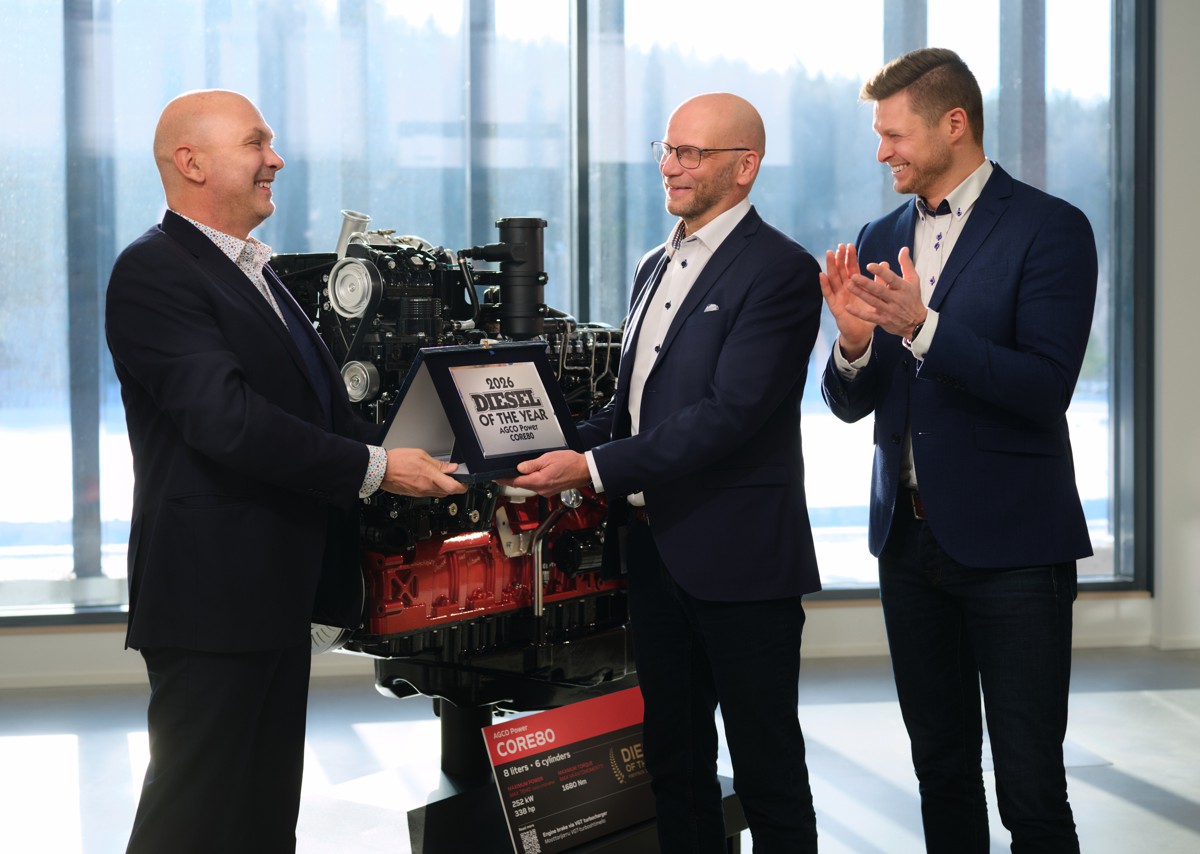
That is precisely the context in which the Core80 engine from AGCO Power has been named Diesel of the Year 2025 by Powertrain International. Developed and manufactured at AGCO Power’s Linnavuori facility in Finland, the Core80 forms part of the company’s new Core engine family, a modular platform designed to serve agricultural, construction, forestry and material-handling applications at a time when emissions legislation, fuel economics and decarbonisation pressures are reshaping heavy equipment design.
For contractors, fleet owners and policymakers, the award matters because it underlines a wider truth: internal combustion engines are not standing still. While electrification dominates headlines, high-efficiency diesel platforms remain central to productivity in high-load, high-duty off-highway environments.
A Recognition of Technical Direction
The Diesel of the Year award has marked significant milestones in off-highway powertrain development for two decades. In announcing the 2025 winner, Powertrain International Editor-in-Chief Fabio Butturi made clear that the decision reflected more than a single model: “Core80 represents exactly the kind of technical courage and innovation we want to highlight. The award truly belongs to the entire Core engine family, which opens a new era for AGCO Power across tractors and other off-highway applications.”
That comment is telling. Rather than celebrating a peak power figure or emissions benchmark in isolation, the award recognises a platform architecture that is designed to scale across multiple applications and future energy pathways. In an industry increasingly defined by system integration rather than component optimisation, that platform thinking is commercially significant.
AGCO Power Vice President Juha Tervala framed the achievement as organisational rather than individual: “This award belongs to our entire AGCO Power organization. Our Linnavuori plant brings engineering and manufacturing, quality, purchasing, aftermarket and the whole corporation’s powertrain R&D under one roof. Core is a result of that unique synergy.”
From a manufacturing strategy perspective, this vertical integration at Linnavuori strengthens supply chain resilience and quality control, both critical factors in a volatile global equipment market.
Efficiency Gains in a Fuel Sensitive Market
Fuel efficiency is no longer a marginal metric. According to the International Energy Agency, diesel consumption in agricultural and construction machinery remains a significant contributor to global oil demand, even as electrification progresses in light vehicles. For operators facing volatile fuel prices and tightening emissions rules, incremental efficiency gains translate directly into lower operating costs and improved carbon intensity.
Within the Core family, tested variants have already demonstrated measurable improvements. The Core50 engine, powering the Fendt 620 Vario, recorded 245 g/kWh in DLG Powermix field tests. The Core75 engine in the Fendt 728 Vario achieved 242 g/kWh under comparable conditions. These figures represent roughly a five percent improvement over earlier AGCO Power engines in the same output range.
While five percent may appear modest on paper, in high-hour agricultural or construction duty cycles it compounds rapidly. Over thousands of annual operating hours, lower specific fuel consumption reduces total cost of ownership, cuts CO₂ output and improves compliance margins under Stage V and equivalent emissions frameworks.
The Core80 itself has yet to undergo independent DLG testing. However, the performance trajectory established by the Core50 and Core75 suggests that the larger engine is positioned within the same efficiency philosophy.
Engineering Choices That Prioritise Reliability
Beyond fuel consumption, the Core80 reflects a deliberate approach to mechanical simplicity and durability. Producing up to 1680 Nm of torque, it is the most powerful engine in the Core family. Steel pistons and a variable-geometry turbocharger support rapid transient response and strong engine braking, attributes valued in both agricultural draft work and heavy material handling.
Notably, the design achieves performance targets without a complex exhaust gas recirculation system or two-stage turbocharging. According to Juha-Pekka Asikainen, Project Manager, Engineering at AGCO Power: “The low-RPM Core engines are an ideal match for Fendt tractors, delivering high performance with low noise and exceptional drivability.”
He further added: “We achieved top-tier performance without a complex EGR system or two-stage turbocharging, significantly improving reliability.”
From an asset management standpoint, reduced system complexity can lower maintenance costs and improve uptime. In sectors where machine availability drives revenue, reliability is often more valuable than marginal peak output.
Integration with Fendt and Market Alignment
The Core engines were developed in close cooperation with Fendt, ensuring alignment with real-world agricultural operating profiles from the outset. That collaboration is strategically important. OEM-engine partnerships that begin at the concept stage allow torque curves, transmission logic and electronic control systems to be optimised as a unified system rather than retrofitted around an existing block.
For AGCO, which owns both AGCO Power and Fendt, the integrated development model shortens innovation cycles and improves differentiation in a competitive tractor market that includes global brands such as John Deere and CNH Industrial.
The low-RPM operating philosophy of the Core engines also aligns with broader industry trends toward downspeeding. By delivering high torque at reduced engine speeds, manufacturers can cut noise, improve fuel economy and enhance operator comfort without sacrificing pulling power.
Internal Combustion in the Energy Transition
One of the more significant aspects of the Core family is its positioning within the energy transition debate. Electrification is advancing rapidly in compact machinery and urban equipment, yet high-horsepower agricultural and construction applications remain challenging for battery systems due to energy density and duty cycle requirements.
Butturi addressed this directly: “Core engines demonstrate that modern internal combustion technology continues to have a clear role in the energy transition.”
AGCO Power’s approach is pragmatic rather than defensive. All of its engines are already approved to operate on renewable HVO diesel, a hydrotreated vegetable oil fuel that can reduce lifecycle greenhouse gas emissions depending on feedstock sourcing. At the company’s Clean Energy Laboratory, development work is under way to expand testing capabilities for hydrogen, methanol and other alternative fuels.
Kelvin Bennett, Vice President, Engineering at AGCO, emphasised the long-term trajectory: “The Core family is just the beginning. We are developing solutions that serve customers today, and are ready for tomorrow’s energy systems.”
For infrastructure planners and policymakers, this signals that the transition path in heavy equipment is likely to be multi-track. High-efficiency diesel compatible with renewable fuels, hybridisation and selective electrification will coexist rather than compete in the near to medium term.
Commercial Implications for the Off Highway Sector
The commercial impact of the Core80 extends beyond a single engine launch. By introducing a modular, future-ready platform manufactured within Europe, AGCO Power strengthens its supply security at a time when global component shortages and geopolitical tensions have exposed vulnerabilities in complex machinery supply chains.
For contractors and fleet operators, improved fuel efficiency and reliability enhance competitiveness. For OEM partners, a scalable engine architecture reduces development costs across multiple machine platforms. For investors, the award reinforces AGCO’s positioning as a technology-driven manufacturer rather than a commodity engine supplier.
More broadly, the recognition underscores a continuing truth in heavy industry: progress is often evolutionary rather than revolutionary. While battery-electric and hydrogen concepts attract attention, incremental gains in combustion efficiency, durability and fuel flexibility can deliver substantial cumulative impact across millions of operating hours worldwide.
A Platform Built for the Long Haul
The Core80’s recognition as Diesel of the Year 2025 reflects not just a performance benchmark but a strategic alignment with the realities of global agriculture and construction. High torque at low revs, measurable fuel savings, simplified emissions architecture and compatibility with renewable fuels collectively represent a coherent engineering philosophy.
As global infrastructure demand expands and food production pressures intensify, reliable and efficient off-highway powertrains remain fundamental to productivity. In that context, AGCO Power’s Core family illustrates how established technologies can be refined to meet contemporary environmental and economic expectations without sacrificing operational performance.