Reinforcing Reliability Inside the Engine Air System with ArmorSeal
For decades, filtration performance in heavy equipment has largely been judged by media efficiency. Capture the particles, protect the engine, carry on working. Yet the reality in modern construction, mining and off-highway operations has shifted. Today the decisive factor is often not the filtration media at all but the integrity of the seal that holds the system together.
Modern machines operate under conditions that were once considered extreme but are now routine. Higher power density engines, longer service intervals, greater vibration loads and ultra-fine dust exposure have converged into a single operational challenge. Particles that bypass the filter through imperfect sealing can cause wear at a rate disproportionate to their size. Research across diesel engine durability studies has repeatedly shown that silica particles smaller than 20 microns are capable of accelerating piston ring and cylinder liner wear, reducing engine life and increasing oil contamination rates.
The economic impact lands squarely on owners and operators. Downtime in construction and resource industries is often measured in thousands of euros per hour once labour, equipment availability, production delay and contractual penalties are considered. Filtration therefore sits quietly at the centre of productivity. When it works consistently, nobody notices. When it fails, entire schedules collapse.
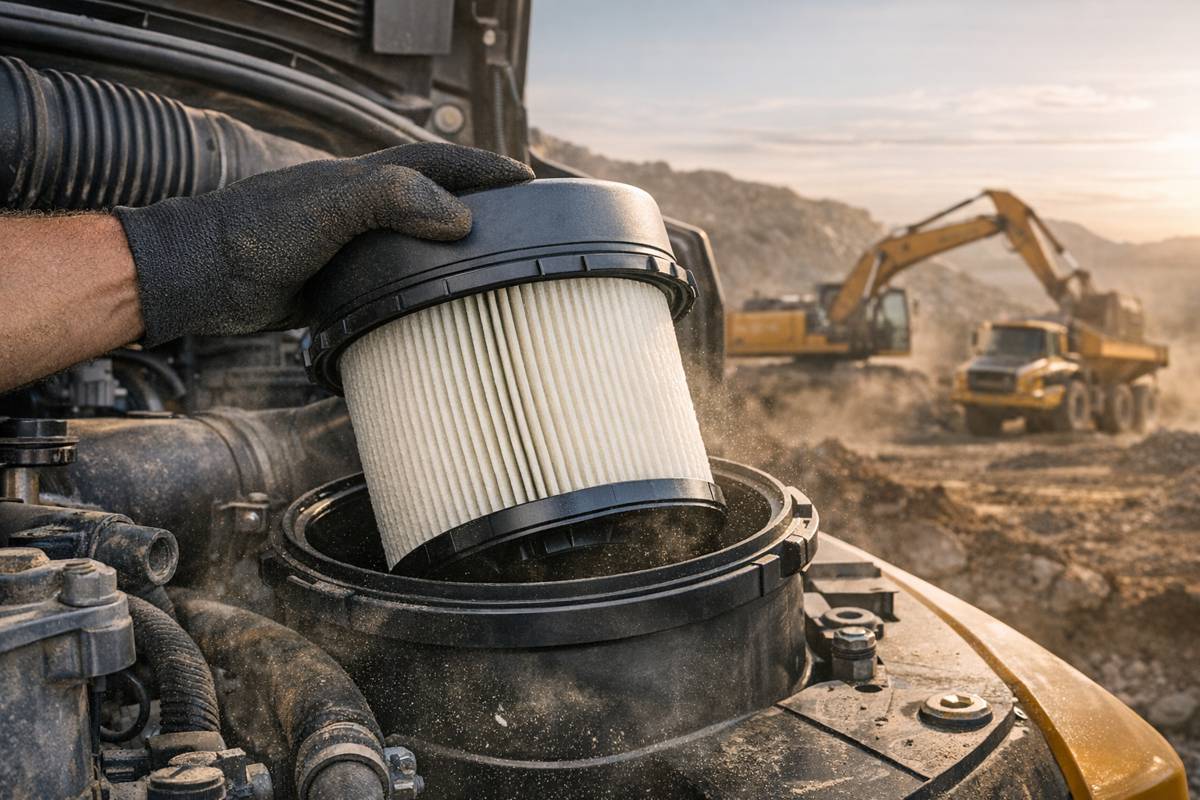
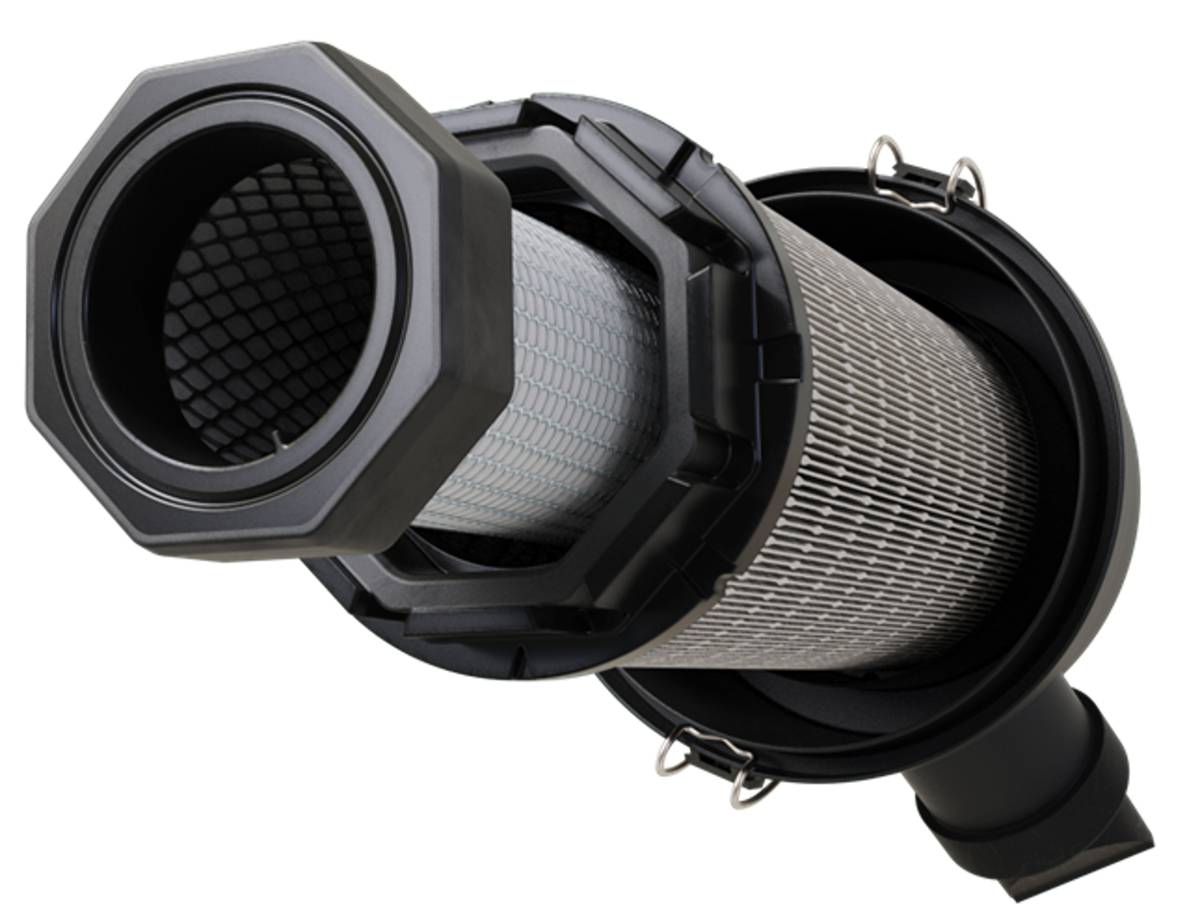
Donaldson Company has introduced ArmorSeal™, a new air filtration sealing technology aimed directly at this problem. Rather than focusing on capture efficiency alone, the design addresses the mechanical reliability of the filter interface itself.
Mark Sala, Director of Air Product Management, explained the rationale: “Unplanned downtime remains one of the biggest cost drivers for equipment owners, and effective air filtration plays a critical role in reducing it. The ArmorSeal technology was created to eliminate the variability and failure modes we’ve historically seen in high-vibration, dusty environments. It delivers a more robust, user-friendly, and reliable air filtration solution that directly supports equipment uptime.”
The Hidden Failure Mode Inside Air Filtration Systems
Air filtration failures in heavy equipment rarely originate from catastrophic rupture of filter media. Instead they occur gradually, often invisibly, through micro-movement and sealing inconsistencies between the filter element and housing.
Heavy equipment experiences constant oscillation. Tracks, tyres, engine harmonics and hydraulic pulses create vibration profiles that can loosen conventional snap or adhesive-based filter interfaces over time. Dust accumulates at the sealing surface, installation forces vary between technicians and housings distort slightly during operation. The result is a minute pathway for contaminants.
Industry technical publications, including Power Progress coverage on sealing innovations, have highlighted that even small sealing gaps allow particulate ingress capable of damaging turbochargers and accelerating engine wear. The problem is particularly acute in quarrying, mining and earthmoving where airborne dust concentrations remain elevated for extended periods.
This explains why operators often encounter unexplained increases in oil analysis contamination despite using high efficiency filters. The filtration media performs as designed, yet contaminants still enter the intake stream. The weak point is not the filter material but the interface that holds it in place.
ArmorSeal targets that interface directly. Instead of relying on mechanical snaps or adhesives, the technology uses a precision spin-welded joint combined with a geometry-controlled sealing surface intended to maintain consistent pressure throughout the service interval.
Engineering Out Installation Variability
A persistent challenge in heavy equipment maintenance lies in human variability. Two technicians installing the same filter can apply different forces and achieve different sealing outcomes. Over-tightening can deform components, under-tightening leaves gaps and debris on sealing surfaces can prevent proper seating.
ArmorSeal attempts to remove that variability through a guided installation geometry. The interface controls contact pressure automatically rather than depending entirely on technician judgement. By maintaining uniform sealing pressure, the system reduces micro-movement that can otherwise occur as machines vibrate during operation.
Donaldson reports the design reduces filter removal force by approximately 30 percent. While that figure relates primarily to service ergonomics, it also indicates a controlled compression environment. Excessive force often suggests over-compression and deformation, whereas too little force allows movement. A balanced mechanical interface aims to avoid both extremes.
From an operational perspective, maintenance consistency matters as much as raw component performance. Large fleets frequently operate across multiple sites with varying skill levels among technicians. A filter system that tolerates installation variation reduces the probability of early failure across the fleet.
Extending Machine Life in Dust Intensive Environments
Construction and mining engines are particularly vulnerable to dust ingress because they operate continuously near ground level. Unlike on-road vehicles that encounter intermittent dust exposure, off-highway equipment often works inside dust clouds generated by its own activity.
Particles that bypass filtration accelerate wear in several subsystems simultaneously:
- Cylinder liners and piston rings
- Turbocharger compressor wheels
- EGR and intake valves
- Engine oil contamination levels
Laboratory testing and field analysis consistently show that abrasive contaminants increase wear metals in oil analysis long before visible performance loss occurs. By the time operators notice power reduction, damage may already be extensive.
Maintaining seal integrity therefore becomes a preventative maintenance strategy rather than a reactive repair measure. Preventing ingress reduces not only mechanical wear but also oil change frequency and secondary filtration loads. Over a machine lifecycle, this translates into measurable total cost of ownership improvements.
ArmorSeal’s design aims to maintain sealing pressure throughout the service interval rather than degrading progressively. The geometry-based seal interface prevents debris intrusion during installation and limits movement during vibration exposure, both primary causes of contamination bypass.
Compatibility and Fleet Scalability
Fleet operators rarely operate identical equipment models. Mixed fleets spanning generations of machines complicate adoption of new technologies unless backward compatibility exists.
ArmorSeal has been designed to integrate with multiple air cleaner architectures and remain compatible with Donaldson’s legacy FPG platform. That matters commercially because operators can adopt new sealing technology gradually rather than replacing entire filtration assemblies across fleets.
OEM manufacturers also benefit from scalable manufacturing. The spin-welded joint provides repeatability suitable for automated production, reducing variation between production batches. For manufacturers supplying machines globally, consistent performance across climate zones and operating conditions is essential.
Global construction markets increasingly require equipment reliability in environments ranging from desert heat to arctic cold. Filtration sealing systems must maintain elasticity, compression and dimensional stability across wide temperature ranges. A controlled geometry interface reduces reliance on adhesive performance, which can vary under thermal cycling.
Filtration as an Infrastructure Reliability Issue
Filtration technology rarely appears in discussions about infrastructure productivity, yet it underpins the availability of nearly every machine that builds infrastructure. Road construction, tunnelling, quarry production and material handling all depend on diesel or hybrid powertrains operating continuously under load.
When filtration fails, project schedules suffer. A single excavator failure can halt dependent operations such as hauling or grading. In tightly sequenced infrastructure projects, cascading delays multiply financial impact.
The industry’s growing emphasis on predictive maintenance further elevates filtration importance. Oil analysis and telematics provide early warning indicators, but preventing contamination remains more efficient than detecting it after the fact. Reliable sealing reduces the variability predictive systems must interpret.
From a sustainability perspective, extended engine life reduces embodied carbon associated with replacement parts and major rebuilds. Infrastructure sectors increasingly account for lifecycle emissions, and durability improvements contribute directly to sustainability targets without altering fuel or powertrain technology.
Demonstration and Industry Adoption
ArmorSeal will debut publicly at CONEXPO-CON/AGG, one of the construction sector’s largest equipment exhibitions. Such events serve as practical proving grounds where OEM engineers, fleet managers and maintenance specialists evaluate technologies under real-world scrutiny rather than marketing claims.
The filtration industry historically evolves incrementally, building upon established interface standards such as axial and radial seals. Each advancement tends to address operational shortcomings discovered over years of field use rather than introducing entirely new concepts.
ArmorSeal represents another step in that progression. By targeting mechanical repeatability and installation consistency, the technology addresses operational reliability rather than simply improving laboratory filtration efficiency.
Reliability Over Specification Sheets
In modern heavy equipment operations, specification sheets rarely capture the full picture of performance. Operators judge equipment by whether it starts every morning and runs until the shift ends. Reliability therefore emerges from the interaction of many small components working consistently together.
Air filtration sealing may appear minor compared with engines, hydraulics or digital controls, yet it influences them all. Preventing abrasive particles from entering the engine protects lubrication systems, emissions components and performance stability simultaneously.
As equipment utilisation rises and service intervals extend, tolerance for small failures shrinks. Infrastructure projects increasingly operate on compressed schedules with contractual penalties for downtime. Technologies that reduce variability rather than merely improve peak performance align closely with those operational realities.
ArmorSeal enters the market at a time when reliability, not just efficiency, defines productivity. In environments where dust is unavoidable and vibration constant, consistent sealing becomes a cornerstone of machine longevity and operational continuity.