Vietnam Pushes Ahead With Transformational North South High Speed Railway
Vietnam’s proposed North South high speed railway is moving steadily through feasibility assessment, marking one of the most consequential infrastructure decisions in Southeast Asia this decade. The Ministry of Construction has formally responded to expressions of interest from 13 domestic and international investors for the project, which carries an estimated project finance value of about US$67 billion.
Rather than rushing procurement, authorities are deliberately sequencing the process. Officials confirmed that the final investment model, whether structured as a public private partnership or commercial investment framework, will be announced only after approval by the National Assembly and central government. Only then will qualified firms be invited to submit detailed proposals. That order of operations matters because large rail concessions in emerging markets often fail not for engineering reasons but for poorly structured financing and risk allocation.
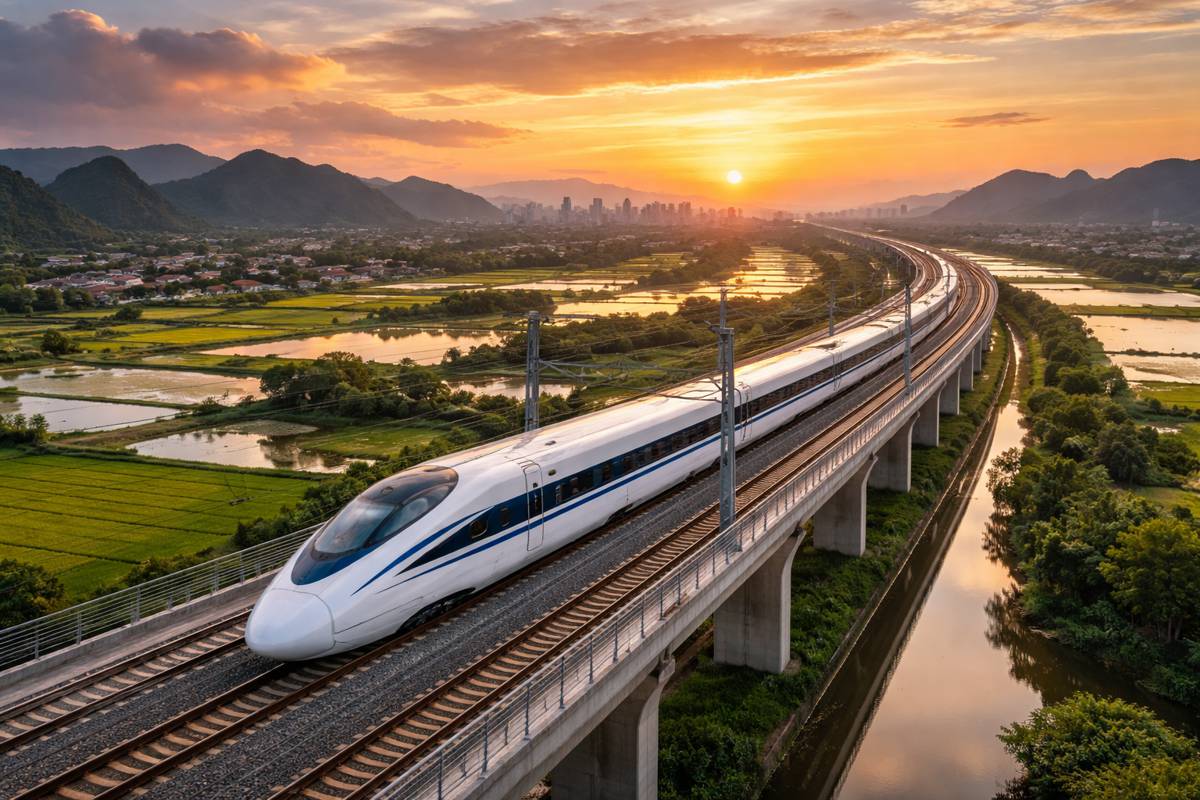
The scale alone places the scheme among Asia’s defining transport investments. Stretching 1,541 kilometres between Hanoi and Ho Chi Minh City, the line will cross 20 provinces and cities and include 23 passenger stations alongside five freight terminals. Designed for speeds up to 350 kilometres per hour, it aims to reduce rail travel time from roughly 32 hours today to about five hours.
For Vietnam, this is less about prestige and more about structural economics. The country’s growth has been export driven for two decades, yet logistics costs remain significantly higher than in many competing manufacturing economies. The railway is therefore positioned not merely as transport infrastructure but as a productivity platform linking labour markets, ports and industrial clusters into a single integrated corridor.
Why High Speed Rail Matters in Vietnam’s Development Model
Vietnam’s geography explains the urgency. The country is long and narrow, with economic centres spread along a coastal spine rather than concentrated inland. Freight currently relies heavily on trucking along National Highway 1 and coastal shipping, both vulnerable to congestion and climate disruption.
According to international transport research from organisations such as the World Bank and Asian Development Bank, logistics costs in many Southeast Asian economies typically range between 18 and 25 percent of GDP, compared with around 8 percent in advanced industrial economies. Rail modernisation is widely regarded as a critical lever for reducing those costs and improving export competitiveness.
High speed rail systems elsewhere have shown a pattern of economic rebalancing. In Japan, the Shinkansen network reshaped regional development by bringing secondary cities into commuting distance of major metropolitan centres. China’s high speed rail expansion created new economic belts by clustering manufacturing, services and research hubs along fast passenger corridors. Vietnam’s proposal follows the same logic, linking its two largest cities while unlocking intermediate provinces that currently sit outside efficient labour mobility.
By cutting travel times to around five hours, the line would make same day business travel between Hanoi and Ho Chi Minh City routine. More importantly, it would allow regional cities to function as satellite economic zones rather than isolated markets.
Investors Positioning for a Generational Contract
The Ministry of Construction confirmed interest from major domestic players including Truong Hai Group, Vietnam Railway Transport Corporation, Vinaconex Group, Thang Long National Construction JSC, Quang Trung Industrial Group, DISCOVERY Group and a Mekolor Great USA investor consortium. Vingroup, one of the country’s largest conglomerates, withdrew in late 2024 to focus on other strategic infrastructure and urban projects.
The breadth of interest reflects the project’s duration and scale. With construction targeted to begin by the end of 2026 and completion scheduled for 2035, the railway represents a decade long pipeline of civil engineering, systems integration and rolling stock contracts. For local contractors, participation would accelerate technology transfer into signalling, electrification and railway operations that Vietnam has historically relied on foreign suppliers to provide.
The government has assigned oversight of the feasibility study to the Thăng Long Project Management Board, a move intended to tighten control over cost discipline and delivery schedule. This approach mirrors lessons learned globally, where megaproject governance has become as important as engineering design. Countries that created dedicated delivery authorities for rail megaprojects have historically achieved more stable outcomes than those relying on fragmented agency oversight.
Engineering and Land Preparation Already Underway
Although still in feasibility review, preparatory activity has begun. Twelve provinces have initiated resettlement area development for communities affected by the alignment, while Vietnam Electricity Group is assessing power infrastructure crossings along the route.
Starting land and utility work early is not unusual in Asian infrastructure programmes. It reduces future delays caused by compensation disputes and service relocations, two of the most common sources of schedule overruns in railway construction worldwide. Experience from projects such as Taiwan High Speed Rail and Indonesia’s Jakarta Bandung line shows that unresolved land acquisition issues can delay projects by years and inflate budgets substantially.
The Vietnamese approach suggests authorities are attempting to de risk the construction phase before procurement even begins. By the time contractors mobilise, critical corridor constraints may already be cleared, enabling faster civil works progress.
Technology Choices Will Shape the Outcome
The planned operational speed of 350 km per hour places the railway in the same performance category as leading high speed systems globally. That specification narrows technology options because only a limited number of suppliers can deliver proven systems at that speed range with mature safety certification.
International experience shows that high speed rail success depends less on headline speed and more on integration between track, signalling, rolling stock and maintenance regimes. Fragmented procurement frequently produces reliability problems. Vietnam’s decision to define the investment structure first and invite proposals later suggests a recognition that financing model and technology model are closely linked.
Energy supply will also be significant. Electrified high speed rail requires stable grid capacity along the entire corridor. Vietnam Electricity Group’s early review of power crossings indicates planning for traction power substations and transmission reinforcement, a critical step as electricity demand in Vietnam continues to grow rapidly alongside industrial expansion.
Economic Integration Rather Than Competition With Aviation
At first glance, a five hour rail journey may appear to compete directly with domestic aviation. However, international experience suggests the opposite often occurs. In countries with mature high speed networks, rail tends to replace short haul flights while complementing longer routes, freeing airport capacity for international travel.
Vietnam’s busiest air corridor currently lies between Hanoi and Ho Chi Minh City. High speed rail could absorb a large portion of that demand while reducing airport congestion and emissions intensity. Meanwhile, aviation can shift focus toward regional and international routes where rail cannot compete on distance.
Freight terminals included in the design also point to broader ambitions. While high speed rail primarily carries passengers, integrated logistics hubs along the corridor can support express cargo and time sensitive goods. That capability becomes valuable for electronics manufacturing, one of Vietnam’s fastest growing export sectors.
Regional Implications Across Southeast Asia
The railway has implications beyond Vietnam’s borders. Southeast Asia lacks a continuous high speed network comparable to East Asia or Europe. Several countries are now exploring cross border rail connectivity, including Thailand’s north south high speed corridors and proposed extensions toward Laos and China.
A modern Vietnamese trunk line could eventually form part of a larger regional rail backbone connecting ports, manufacturing zones and trade corridors across mainland Southeast Asia. That would align with broader economic integration goals under regional trade agreements and supply chain diversification strategies adopted by global manufacturers.
For investors and contractors, the project is therefore both a national contract and a regional reference project. Delivering it successfully would position Vietnam as a credible market for future large scale rail investment.
A Long Horizon With Strategic Consequences
The planned timeline, construction beginning by late 2026 and completion around 2035, reflects realistic expectations for a project of this magnitude. Megaprojects of comparable scale in Japan, China and Europe have typically required a decade or more from early works to full operation.
What matters now is not speed of announcement but stability of preparation. By resolving land, governance and financing structures before procurement, Vietnam is attempting to avoid the pitfalls that have troubled several high profile infrastructure programmes worldwide.
If executed effectively, the North South high speed railway will do more than connect two cities. It will compress a nation’s geography, integrate labour markets, reshape logistics and alter investment patterns across twenty provinces. For an export driven economy seeking to move up the value chain, that may prove more significant than any single industrial policy initiative.