Samsara Compact Asset Tag Targets Hidden Costs of Missing Equipment
Across construction, utilities, logistics and municipal services, the biggest operational disruption often isn’t a collapsed structure or mechanical breakdown. It’s the quiet disappearance of tools, attachments and mobile equipment. A missing laser level can halt a survey crew. A stolen generator can idle a paving team. A misplaced excavator attachment can delay a subcontractor chain for days.
Samsara has introduced a new generation of connected tracking hardware and software workflow designed to address a long-standing blind spot in physical operations. The latest Asset Tag and the smaller Asset Tag XS expand the company’s Connected Operations platform beyond vehicle telematics into granular equipment accountability, supported by an expanded detection network and AI-driven investigation tools.
The significance reaches beyond product refresh cycles. The announcement highlights a broader shift taking place across infrastructure delivery. Digital visibility is moving from fleet level oversight to object level accountability, changing how companies manage risk, insurance exposure and productivity.
The Hidden Cost Of Missing Equipment
Asset loss has traditionally been treated as a nuisance rather than a systemic operational risk. Yet industry research increasingly shows the opposite. Construction productivity studies from organisations such as McKinsey and the Construction Industry Institute repeatedly identify coordination inefficiencies and material availability as primary schedule disruptors. Missing equipment sits squarely inside that category.
Samsara’s forthcoming State of Connected Operations research adds quantitative weight to the issue. In the past year, 77% of organisations experienced a shutdown or delay caused by a missing critical asset. The financial exposure is substantial. Companies operating without tracking solutions lose an average of more than 13 million dollars annually to asset shrinkage, with smaller tools responsible for over 70% of that total.
That pattern aligns with broader industry data. Large machinery theft is visible and reported, but small equipment loss is persistent and cumulative. Power tools, survey instruments, safety equipment and attachments are frequently shared across crews, subcontractors and shifts. Over time, replacement costs combine with downtime, overtime and rescheduling penalties.
David Gal, Vice President of Connected Equipment at Samsara, framed the operational impact as follows: “The scale of equipment loss in physical operations goes far beyond the cost of the tools themselves—it’s about lost productivity and project delays.”
In other words, the financial damage isn’t just procurement replacement. It’s schedule erosion.
From Fleet Tracking To Object Level Visibility
Telematics transformed transport fleets by making vehicles visible in real time. However, fleets represent only part of operational complexity. Construction sites and service organisations manage thousands of non-powered assets that historically remained invisible once removed from a depot.
The latest generation of Samsara Asset Tags aims to close that gap by combining hardware tracking devices with a continuously listening detection network. Over two years, the company’s industrial Bluetooth network has doubled in density, now leveraging millions of connected gateways moving across 99 percent of major United States roads.
In practical terms, this creates a distributed sensing environment. Any gateway vehicle passing near tagged equipment can detect and relay its location. The system then integrates with Hubble’s terrestrial network of approximately 90 million consumer smartphones, extending detection into buildings and indoor spaces where industrial gateways cannot reach.
Gal described the effect succinctly: “The integration with Hubble complements Samsara’s existing network.”
The operational implication is significant. Traditional GPS trackers rely on installed power sources and direct satellite visibility. Bluetooth mesh detection allows passive tracking without constant energy consumption while dramatically increasing detection probability in dense urban environments and job sites.
The result is not continuous GPS positioning but continuous discoverability, which is often more valuable for recovery.
A Workflow Rather Than A Tracker
Hardware alone rarely solves operational problems. The larger change lies in the workflow built around the tracking data.
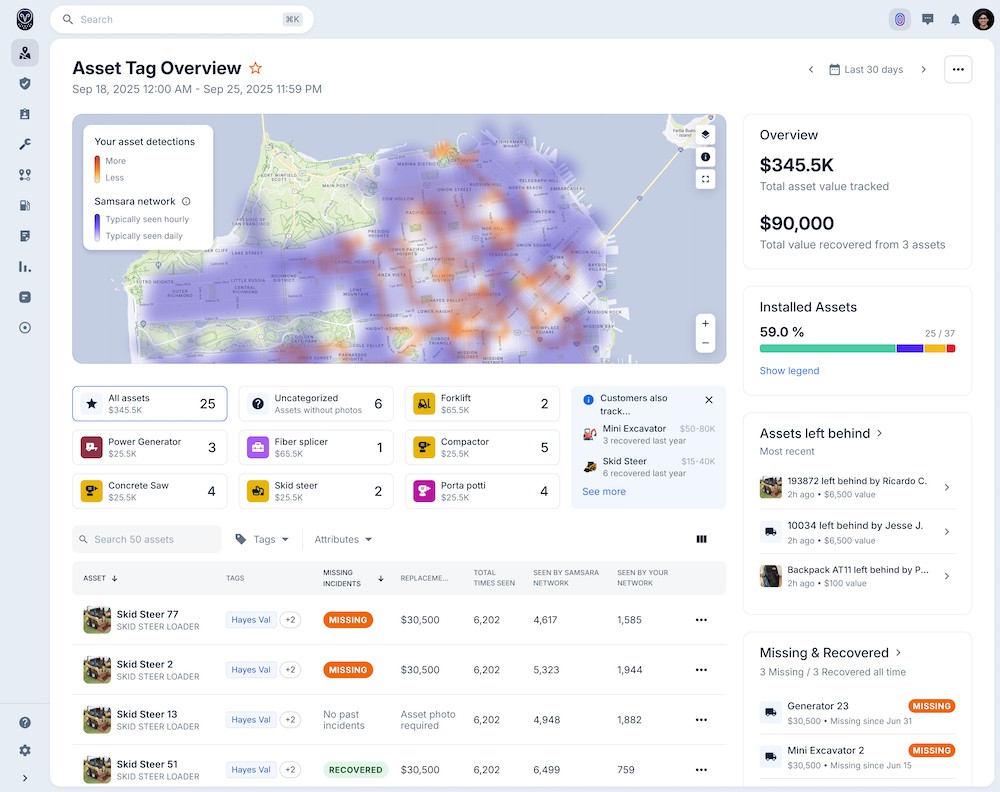
The updated platform introduces a theft and loss lifecycle designed to identify risk early, guide investigation and accelerate recovery. Instead of discovering missing tools days later during inventory checks, the system can alert managers immediately when equipment separates from its assigned vehicle outside a defined geofence.
This feature, called Left Behind Incident detection, changes response timing. Early detection typically determines recovery success. In theft prevention research, recovery probability drops dramatically after the first 24 hours. Immediate notification therefore shifts outcomes from investigation to intervention.
Once flagged, managers can access contextual information powered by StreetSense, including last associated vehicle and user imagery. The aim is not surveillance but operational clarity. Knowing which crew last handled a tool often resolves issues without escalation.
For confirmed loss, recovery coordination becomes operational rather than administrative. Teams can dispatch a nearby driver or share location with authorities while crews use a proximity guidance mode to pinpoint the asset on arrival.
Rich Poppoff, Equipment Superintendent at DeSilva Gates, described the practical impact: “Since we started using the Asset Tags, our recovery rate on thefts of everything from $1,000 gas-powered saws to $2.8 million heavy machinery is 100%.”
He added: “I didn’t think the devices could be better than they were, but the enhanced features on the Asset Tags, like the even more precise find nearby capabilities, make finding assets in congested areas even simpler.”
The workflow therefore moves tracking from passive monitoring into an operational response system.

Hardware Built For Mixed Fleets And Harsh Environments
Construction and field service environments demand devices that operate unattended for years, tolerate weather and vibration, and fit diverse equipment profiles.
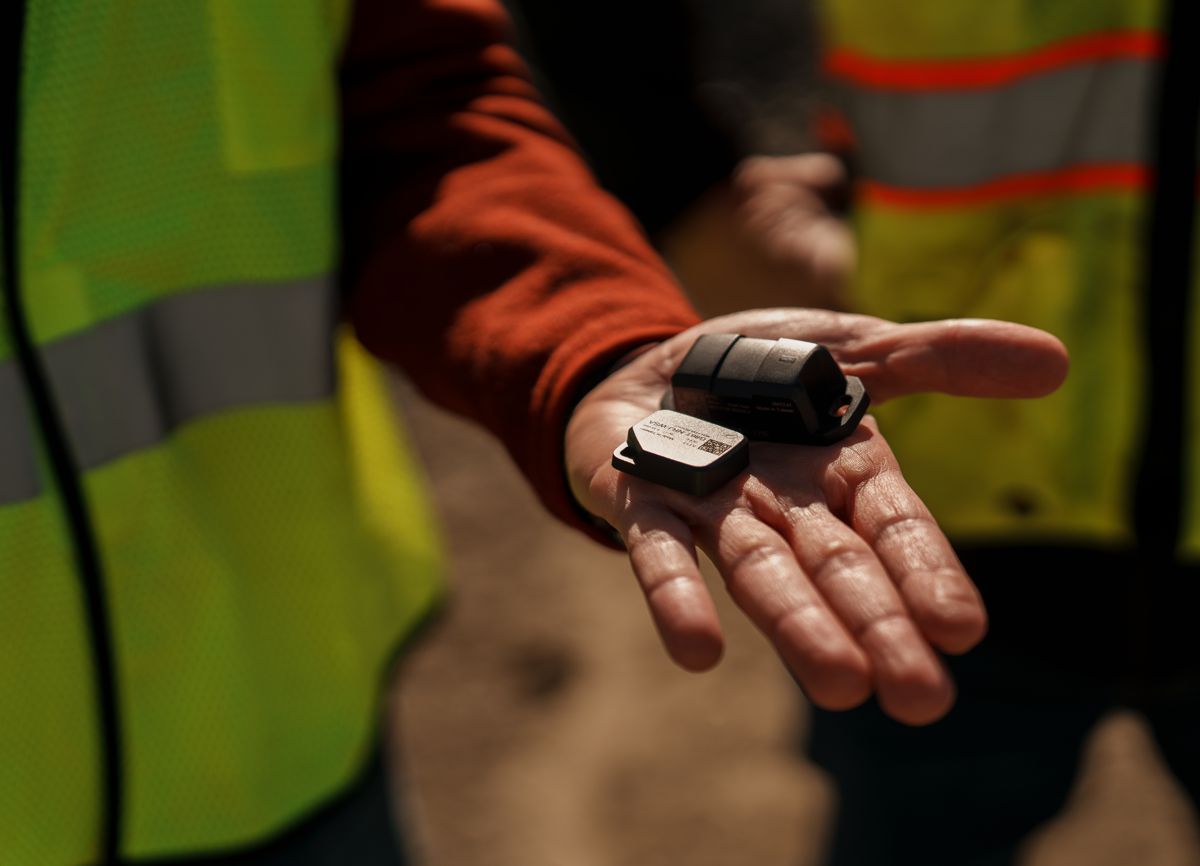
The updated Asset Tag is designed for general equipment and provides up to six years of battery life, representing a 50 percent increase over the previous generation. The smaller Asset Tag XS targets handheld or specialised tools and operates for approximately three years.
The introduction of a miniaturised device is particularly relevant to infrastructure operations. While excavators attract attention, the majority of jobsite disruption stems from small items such as scanners, measurement tools and safety equipment. The ability to tag these objects economically expands tracking coverage to the operational long tail.
Mounting flexibility also matters. Tags must attach securely to irregular shapes, protective casings or safety enclosures without interfering with use. The smaller form factor allows tagging of equipment previously considered impractical to track.
From a systems perspective, coverage density matters more than tracking precision. If only high value machines are monitored, operational blind spots remain. Extending tracking to thousands of minor assets changes inventory accuracy, utilisation metrics and loss prevention economics.
Turning Visibility Into Financial Accountability
One of the persistent challenges in technology adoption is demonstrating return on investment. Loss prevention often produces avoided cost rather than visible revenue, making justification difficult in procurement processes.
The platform attempts to address this through automated valuation analysis. An overview dashboard uses AI to analyse asset imagery and calculate the value of protected and recovered equipment. By quantifying avoided losses, organisations can translate operational improvements into financial reporting.
For infrastructure owners and contractors, this connects directly to insurance negotiations and risk management frameworks. Insurers increasingly evaluate digital monitoring capability when determining premiums, especially for mobile plant and distributed tools.
In addition, lenders and project financiers are beginning to consider digital asset visibility as part of operational resilience assessment. A contractor capable of demonstrating equipment accountability presents lower delivery risk, which may influence bonding capacity and project qualification.
In that sense, tracking shifts from a maintenance function into a governance capability.
The Wider Infrastructure Sector
The construction industry is undergoing a gradual transition from manual coordination to data informed execution. BIM models, digital twins and telematics have already improved planning and fleet management. The next step is operational awareness of physical objects themselves.
Missing assets represent a breakdown between digital planning and physical execution. A project schedule can be perfect, yet still fail because a specific tool is unavailable at a critical moment. Closing that gap increases schedule reliability more effectively than incremental planning refinement.
At a macro level, infrastructure productivity has stagnated globally for decades. Organisations such as the World Economic Forum repeatedly cite logistics inefficiency and coordination gaps as major contributors. Equipment availability is a direct component of that problem.
By linking object level tracking with operational workflows, platforms like this move the industry closer to real time operational control. Not automation, but situational awareness.
The broader implication is subtle but important. Digital transformation in construction is shifting from design optimisation toward execution reliability. Sensors, networks and AI are increasingly focused on preventing disruption rather than analysing it afterwards.
In practical terms, fewer lost tools means fewer delays. Fewer delays mean fewer claims. Fewer claims mean more predictable project delivery.
And in infrastructure, predictability is often worth more than speed.