Baguio Building a Transport Gateway for Northern Luzon Mobility
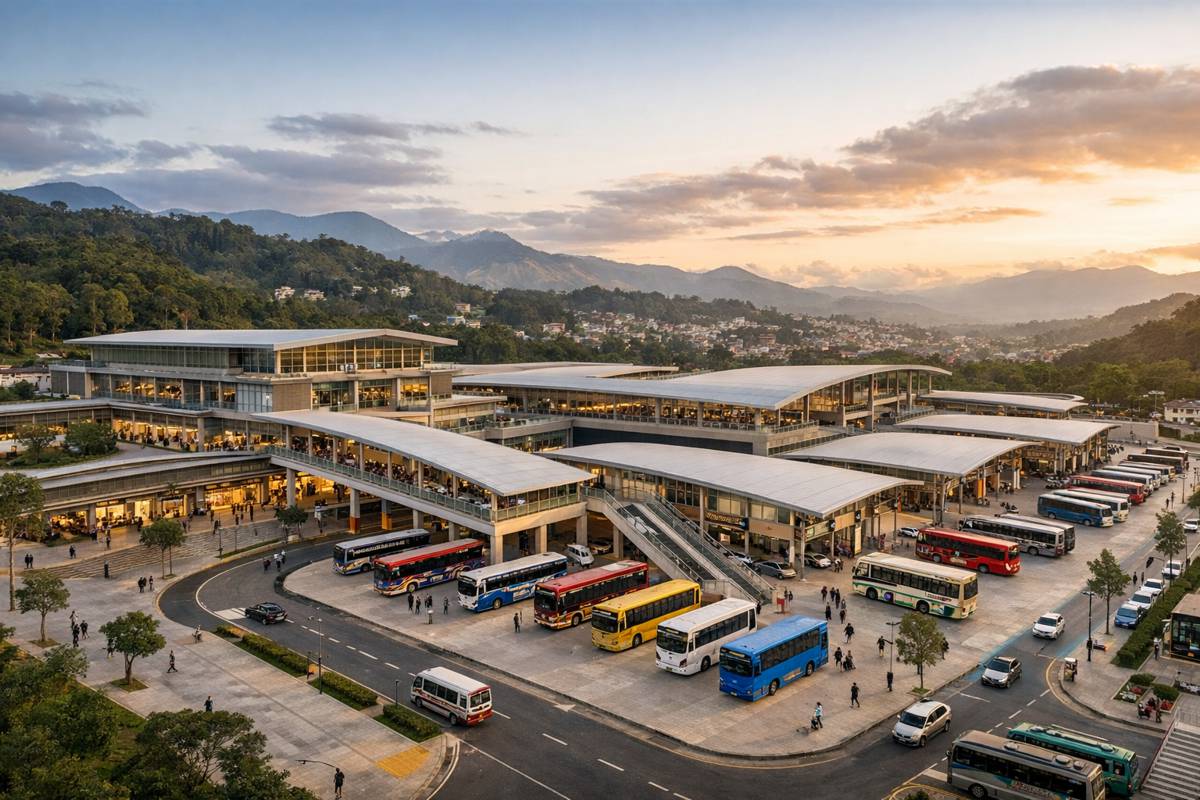
Baguio City has taken a decisive step towards reorganising transport flows across Northern Luzon by signing a public private partnership agreement with Megawide Construction Corporation for the PHP1.19 billion project finance Baguio Integrated Terminal Project. Planned for Barangay Dontogan along Marcos Highway, the facility is designed as a regional arrival and dispatch hub for buses and public utility vehicles entering the mountain city from surrounding provinces and Metro Manila.
For decades, Baguio’s growth has outpaced the capacity of its roads. Built originally as a hill station during the American colonial period, the city’s narrow streets and limited land area now struggle to accommodate modern traffic volumes. Peak tourist seasons frequently push congestion to gridlock levels, particularly at the southern gateway where buses and private vehicles converge. The proposed terminal tackles that structural problem directly by relocating long distance transport activity outside the urban core before passengers disperse into smaller city routes.
The implications stretch far beyond convenience. Centralised intermodal terminals are increasingly regarded as critical urban infrastructure across Southeast Asia because they separate long haul and local transport functions. Removing large buses from dense city streets improves safety, lowers emissions in populated areas and allows local transit planning to function predictably. In practical terms, Baguio is shifting from reactive traffic control to engineered transport management.
Why Integrated Terminals Matter in Modern Cities
Integrated transport terminals have become standard components of mobility planning in rapidly urbanising economies. Cities such as Jakarta, Bangkok and Manila have introduced similar facilities to regulate intercity buses and reduce road conflicts between large vehicles and urban traffic. The Philippines already offers a working precedent through the Parañaque Integrated Terminal Exchange, also delivered through a Megawide led concession, which restructured bus operations entering Metro Manila from southern provinces.
The logic is straightforward. Instead of multiple operators competing for curb space across scattered locations, a single terminal consolidates arrivals, dispatching and passenger handling. Traffic modelling consistently shows that decentralising heavy vehicles outside city centres reduces congestion more effectively than road widening in constrained urban environments. For mountain cities like Baguio, where expanding road corridors would require extensive earthworks and environmental disruption, a transport hub is one of the few scalable solutions available.
The Baguio terminal will primarily serve seven southbound routes including La Union, Pangasinan, Tarlac, Pampanga, Bulacan, Metro Manila and Cavite. Once operational it is projected to handle approximately 400 buses and around 25,000 daily commuters. Those numbers may appear modest compared with metropolitan terminals, yet for a city of Baguio’s size they represent a fundamental shift in passenger handling capacity and flow management.
The PPP Model Behind the Project
The decision to implement the terminal through a public private partnership reflects broader infrastructure policy in the Philippines. Over the past two decades, the country has expanded PPP frameworks to accelerate delivery of transport and utility projects without placing immediate strain on public budgets. Under this approach, private partners design, finance, construct and operate infrastructure for a concession period while government retains regulatory oversight and ownership.
For local governments, the model offers technical expertise and construction capability that municipal administrations rarely possess in house. For contractors and investors, it provides predictable long term revenue tied to usage rather than a one off construction contract. In the case of Baguio, the partnership aligns municipal mobility goals with a contractor experienced in transport infrastructure operations rather than only civil works.
Megawide’s involvement is significant because integrated terminals are operationally complex facilities. Beyond concrete and steel, they require passenger circulation planning, scheduling systems, retail integration and security management. Many cities underestimate the operational dimension and end up with underperforming infrastructure. Choosing a concessionaire familiar with running a transport exchange reduces that risk considerably.
Designing a Functional Mobility Gateway
The planned facility will include bus bays, public utility vehicle loading areas and commercial spaces. While retail elements may appear secondary, experience from similar projects suggests they are essential to financial viability. Passenger waiting time creates demand for services, and those commercial revenues help offset operational costs and reduce reliance on fare surcharges.
Location also plays a central role. Barangay Dontogan sits along Marcos Highway, one of the main southern approaches to Baguio. Positioning the terminal at this entry point intercepts provincial buses before they enter the city centre. Passengers will then transfer to local transport modes, distributing traffic across smaller vehicles suited to urban roads rather than concentrating large coaches in narrow streets.
Urban planners often refer to this as modal filtering. Instead of banning buses, which would isolate communities, cities manage vehicle types by geography. Large vehicles operate efficiently between regions, while smaller vehicles operate efficiently within cities. The terminal effectively becomes a mobility filter positioned at the urban edge.
Economic Implications for Tourism and Commerce
Baguio functions as the primary tourism and education centre of the Cordillera Administrative Region. Visitor numbers surge during holidays, festivals and the cooler summer months when residents of lowland cities escape heat and humidity. Congestion during these peaks has long affected local businesses, as travel unpredictability discourages short stays and complicates logistics deliveries.
By improving arrival efficiency, the terminal may influence the local economy in ways that extend beyond transport. More reliable travel times encourage same day trips and short duration visits, a trend observed in other destinations after mobility upgrades. Retail areas within the terminal also create new commercial nodes outside the traditional central district, gradually redistributing economic activity and easing pressure on historic streets.
There is also a safety dimension. Removing heavy bus traffic from densely pedestrian areas reduces collision risk and allows the city to prioritise pedestrian friendly streetscapes. Tourism driven cities increasingly adopt such measures because walkability directly correlates with visitor spending duration and satisfaction.
Environmental Considerations in a Mountain City
Baguio’s geography makes environmental management inseparable from infrastructure decisions. Situated at high elevation with surrounding forested slopes, the city faces recurring landslide risks and air quality concerns during heavy traffic periods. Concentrating bus operations at a controlled terminal allows emissions monitoring and more efficient idling management compared with dispersed roadside waiting areas.
Integrated terminals also enable future electrification strategies. While not specified in the project details, centralised depots create practical charging points if electric buses are introduced later. Southeast Asian transport authorities increasingly consider terminals as stepping stones toward cleaner fleets because decentralised charging infrastructure is impractical in dense urban cores.
In that sense, the project is not only a traffic intervention but a platform for long term fleet modernisation. Infrastructure often determines whether environmental policy remains theoretical or becomes implementable.
Lessons from Other Philippine Transport Projects
The Philippines has experimented with several transport consolidation schemes, with mixed success depending on design execution. Projects that focused solely on relocating buses without providing passenger amenities faced resistance from operators and commuters. Facilities that integrated comfort, retail and reliable connections gained acceptance more quickly.
The inclusion of commercial facilities in the Baguio terminal suggests planners have learned from earlier experiences. A transport hub functions best when it operates as a destination rather than merely a holding area. Passenger comfort reduces informal roadside loading, which is often the primary cause of operational failure in bus relocation programmes.
Local governments across the country are watching closely because secondary cities share similar spatial constraints. If the Baguio terminal operates effectively, it may become a template for other upland urban centres seeking congestion solutions without extensive road expansion.
Implications for the Construction and Infrastructure Sector
From an industry perspective, the project highlights a shift in the type of infrastructure demand emerging across Asia. Rather than focusing solely on highways and bridges, governments increasingly invest in operational efficiency infrastructure that improves the performance of existing networks. Terminals, logistics hubs and traffic management systems often deliver faster economic returns than new road corridors in constrained environments.
Contractors able to combine construction capability with operational expertise are positioned to benefit. Infrastructure today is measured by lifecycle performance rather than completion date. PPP concessions reinforce that shift by linking revenue to functionality over decades rather than to project handover milestones.
Investors are similarly interested because transport terminals produce steady usage based income with relatively predictable demand patterns. Unlike toll roads, passenger flows in regional centres remain stable across economic cycles due to commuting and education travel. That stability makes mid scale mobility infrastructure an attractive asset class.
A Step Towards Managed Urban Growth
Baguio’s integrated terminal does not expand the city physically, yet it expands its functional capacity. By controlling how vehicles enter and disperse, the city effectively gains room to operate without widening streets carved into mountain slopes more than a century ago. Urban resilience often depends less on size and more on organisation.
In the coming years, success will depend on local transport integration and enforcement. A terminal alone cannot solve congestion if buses continue to stop inside the city. But with coordinated policy and operator cooperation, it can reshape travel patterns gradually until the new system becomes routine.
Rather than a single infrastructure announcement, the project represents a transition in how regional cities handle mobility growth. It signals recognition that managing movement is as important as building roads. For mountainous urban centres across Asia facing similar constraints, that lesson may prove the most valuable outcome of all.