Keeping Rural Alabama Moving With an Acrow Modular Bridge Solution
Infrastructure renewal rarely grabs headlines when it happens in rural communities, yet projects like the bridge replacement on State Route 273 in northeast Alabama demonstrate just how vital small links in the transport network can be. In Cherokee County, where winding roads cut through the foothills of the Appalachian Mountains, a single bridge failure can disrupt entire communities.
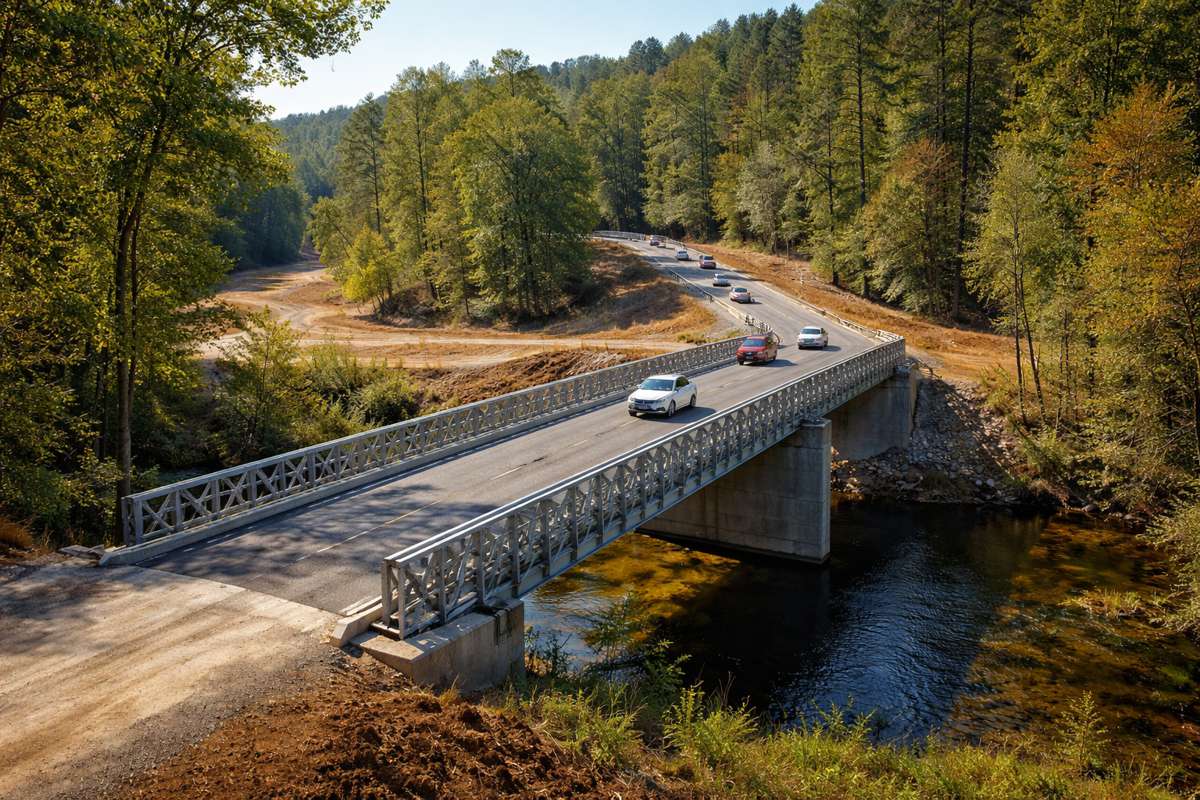
To prevent that disruption, a temporary modular steel bridge supplied by Acrow has been installed to maintain traffic flow during the replacement of a century-old structure over Daniels Branch. The detour bridge now carries vehicles north of Leesburg, ensuring that residents, businesses and emergency services retain reliable access while the permanent replacement structure is built.
Although the population density in this part of Alabama is relatively low, SR-273 plays an outsized role in connecting rural communities. Without an alternative crossing, drivers would have faced detours of roughly 40 miles, a journey that could significantly delay daily commutes and emergency response times. By installing a temporary bridge adjacent to the ageing structure, project teams have ensured the route remains open while construction progresses.
Temporary Bridges for Infrastructure Renewal
Across the United States, thousands of bridges are approaching or exceeding their intended service life. According to the American Society of Civil Engineers, more than 40 percent of US bridges are at least 50 years old, placing increasing pressure on state transportation agencies to modernise infrastructure while keeping traffic moving.
Temporary bridging solutions have become an important tool in addressing this challenge. Rather than closing routes for extended periods or sending traffic onto long detours, modular bridges can maintain connectivity during construction phases. This approach reduces disruption, supports local economies and ensures emergency services retain reliable access to rural communities.
In the case of the SR-273 project, the temporary bridge is doing precisely that. By carrying traffic while the old structure is demolished and replaced, the modular crossing allows construction work to proceed without cutting off a vital transport artery.
The End of a Century of Service
The bridge over Daniels Branch had served motorists for roughly a century before engineers determined it had reached the end of its operational life. Many bridges built in the early twentieth century were designed for lighter traffic volumes and smaller vehicles than those seen today.
Over decades, the cumulative effects of heavier loads, environmental exposure and natural ageing can weaken structural components. When that happens, replacement becomes the safest and most cost-effective option.
For state and local authorities, however, replacing an ageing bridge involves more than simply constructing a new structure. The challenge lies in maintaining transport connectivity during the construction period, particularly in areas where alternative routes are limited or impractical.
A Modular Bridge Designed for Modern Standards
To maintain access along SR-273, project planners selected a Mabey Universal modular steel bridge supplied by Acrow. Modular bridging systems have evolved significantly over the past several decades, building on engineering concepts first popularised during the Second World War with Bailey bridges.
Today’s modular bridges are designed to meet modern engineering standards and can support heavy highway traffic while remaining relatively quick to install. The detour bridge installed in Cherokee County spans 140 feet and provides a two-lane carriageway measuring 24 feet in width.
The bridge features an asphalt overlay deck surface and was engineered to comply with AASHTO HS20-44 loading requirements, a widely recognised standard used for highway bridge design across the United States. Meeting these standards ensures the temporary structure can safely carry everyday traffic, including commercial vehicles and emergency response units.
Rapid Installation Keeps the Project on Track
One of the defining advantages of modular bridges is their ability to be assembled quickly with minimal disruption to surrounding infrastructure. In the SR-273 project, contractor McInnis Construction assembled the bridge on site before launching it into position using crane assistance.
The detour bridge was installed adjacent to the original structure, allowing traffic to transition seamlessly once the temporary crossing was ready. Vehicles were redirected onto the modular bridge in November 2025, marking a key milestone that allowed demolition of the ageing structure to begin.
The new permanent bridge is expected to be completed in late 2026, at which point traffic will be transferred back onto the upgraded infrastructure. Until then, the temporary bridge will continue carrying vehicles along this essential rural route.
Keeping Emergency Services Connected
While traffic volumes on SR-273 may not match those of major highways, the route serves an essential function for local communities and emergency responders. In rural areas, where hospitals, fire stations and other critical services may be located miles away, reliable road connections are vital.
Project stakeholders emphasised the importance of maintaining access throughout the construction process.
Will Smith, Senior Business Development Manager for Southeast US at Acrow, highlighted the practical benefits of temporary bridge systems: “Acrow’s modular steel bridges provide cost-effective, safe detour solutions that reduce disruptions for travelers and local businesses during construction projects. Available for rent or purchase, Acrow’s bridging solutions can help project owners and contractors keep projects on or ahead of schedule.”
The ability to deploy such solutions quickly can be particularly valuable in rural regions where long detours might otherwise compromise emergency response times.
A Practical Solution for Rural Communities
From a construction perspective, modular bridges offer several advantages beyond speed of installation. Because they are manufactured using standardised components, they can be transported easily and assembled using relatively small crews and conventional equipment.
These systems are also highly adaptable. Spans can be adjusted to suit different site conditions, and bridges can be configured for temporary detours, emergency replacement or even permanent installations where appropriate.
For communities like those along SR-273, this flexibility translates into tangible benefits. Instead of facing prolonged closures or inconvenient diversions, residents retain direct access to the roads they rely on daily.
Keith Burnett, Project Manager at McInnis Construction, underscored the importance of maintaining connectivity during the project: “While this project is located in a rural area with a relatively limited population, maintaining reasonable travel access and reliable emergency response capabilities for residents is always a critical concern. For projects in communities with limited alternate routes, Acrow’s versatile detour bridges are ideal solutions to keep traffic—and busy lives—moving during bridge upgrade or replacement projects.”
Modular Bridges in the Global Infrastructure Toolkit
Although the SR-273 project is a relatively small-scale example, it reflects a broader trend within the infrastructure sector. Modular bridging systems are increasingly used worldwide to address a wide range of challenges, from disaster recovery to military logistics and permanent civil infrastructure.
Companies like Acrow have supplied modular bridges for projects across more than 150 countries, including emergency replacements after floods, temporary crossings during major highway upgrades and permanent installations in remote regions.
In developing economies, modular bridges can also play a role in expanding transport networks quickly and affordably. Because they require less specialised equipment and shorter construction times than traditional bridge structures, they can provide rapid connectivity where conventional projects might take years to complete.
Supporting Resilient Infrastructure
As infrastructure networks age and climate pressures increase, resilience has become a central theme in transport planning. Temporary bridges contribute to this resilience by providing a flexible response to unexpected infrastructure failures or planned upgrades.
For example, extreme weather events such as flooding or landslides can damage existing bridges, cutting off communities until repairs are completed. Modular bridges can be deployed rapidly to restore access while permanent reconstruction is undertaken.
Similarly, during planned infrastructure improvements, temporary bridges allow construction teams to work without disrupting traffic flow. This approach minimises economic impacts on local businesses and reduces the social costs associated with long detours or road closures.
Infrastructure Renewal Without Disruption
The bridge replacement project in Cherokee County illustrates how thoughtful planning and adaptable engineering solutions can keep infrastructure renewal moving forward without isolating communities.
By installing a modular detour bridge alongside the ageing structure, project teams ensured that SR-273 remained open throughout the construction process. Residents continue to travel the route they depend on, emergency services maintain critical response capabilities and contractors can carry out demolition and rebuilding work safely.
When the new bridge opens to traffic in late 2026, it will mark the beginning of another long chapter in the life of this rural transport corridor. Until then, the temporary bridge quietly carries the load, a reminder that sometimes the most important infrastructure solutions are the ones that keep everyday life running smoothly.