RENOLIT ALKORPLAN Wins Archiproducts Design Award for Roofing Safety Innovation
Across the construction industry, the most successful innovations rarely come from headline-grabbing megaprojects or towering structures. Instead, progress often emerges from seemingly modest components that quietly improve safety, durability and operational efficiency. Roofing access systems are one such example. Though rarely visible once a building is complete, they play a vital role in maintenance, solar installation and long-term asset management.
Against this backdrop, the RENOLIT ALKORPLAN Slip Resistant Walkway has received the Archiproducts Design Award 2025 in the Construction category, highlighting the growing importance of safety-focused design solutions in modern architecture and infrastructure.
The recognition reflects a broader shift in construction thinking. As buildings become increasingly complex and incorporate technologies such as rooftop solar arrays, HVAC systems and green infrastructure, safe roof access has become a critical design consideration rather than an afterthought. The award therefore signals more than a product accolade. It underscores a wider industry movement toward integrating safety, durability and architectural design into every component of the built environment.
Roofing Safety More Important Than Ever
Maintenance access has always been a necessity in building management. However, the nature of rooftop activity has changed dramatically over the past decade. Today’s roofs frequently host photovoltaic systems, energy equipment, communications hardware and even urban farming installations.
With more personnel accessing rooftops for inspection and servicing, slip hazards have become a major safety concern. According to international workplace safety research, slips, trips and falls remain one of the most common causes of injury across construction and building maintenance environments. The International Labour Organization estimates that millions of workplace accidents each year are linked to fall hazards, many of which occur on roofs and elevated surfaces.
For building owners, these risks translate directly into operational liabilities. Facility managers must ensure safe access routes for contractors and technicians, particularly when working on sloped or weather-exposed roofing systems. As a result, architects and engineers increasingly specify purpose-built walkway systems designed to protect both workers and waterproofing layers.
Solutions such as the RENOLIT ALKORPLAN Slip Resistant Walkway are designed to address these dual requirements. They provide a defined pathway for foot traffic while preserving the integrity of the underlying roofing membrane. In doing so, they reduce both safety risks and long-term maintenance costs.
What the Archiproducts Design Awards Represent
The Archiproducts Design Awards have become a recognised benchmark for excellence within the global architecture and design community. Now in its tenth edition, the awards celebrate products and systems that demonstrate innovation, creativity and technical sophistication across a wide range of construction and design sectors.
Each year, submissions are evaluated by a multidisciplinary international jury composed of architects, designers, engineers and industry specialists. Their role is to identify solutions that not only perform technically but also contribute to the evolution of contemporary architecture.
Winning entries are selected based on criteria such as:
- Innovation in materials or engineering
- Functional performance in real-world applications
- Integration with modern architectural design
- Contribution to sustainability and durability
- Quality of industrial research and development
By securing recognition in the Construction category, the RENOLIT ALKORPLAN walkway membrane joins a shortlist of products considered to have made a meaningful contribution to modern building design and functionality.
Engineering a Walkway for Safety and Durability
At its core, the RENOLIT ALKORPLAN Slip Resistant Walkway is a flexible synthetic PVC membrane reinforced with polyester. While that description may sound straightforward, the engineering behind the material reflects decades of research into roofing performance and durability.
Roof membranes must withstand extreme environmental stress. Exposure to ultraviolet radiation, temperature fluctuations, mechanical impact and moisture can degrade materials over time. For walkway membranes, the challenge is even greater because they must also handle repeated foot traffic without compromising waterproofing.
The RENOLIT solution addresses this challenge through reinforced PVC construction combined with a textured slip-resistant surface. This surface is engineered to maintain grip even when exposed to moisture or debris.
Its performance metrics include:
- Slip resistance rating PTV greater than 36
- R13 slip resistance classification
The R13 rating represents one of the highest categories of slip resistance used in industrial flooring and roofing applications, particularly in environments where surfaces may become wet or inclined. Such classifications are commonly used in safety-critical areas such as industrial platforms and maintenance access routes.
By incorporating this level of traction into a roofing membrane, the walkway system provides an added layer of protection for technicians working on roofs during maintenance operations.
Supporting the Rise of Rooftop Solar Infrastructure
One of the most significant trends shaping modern roof design is the rapid expansion of rooftop solar power installations. As countries accelerate their transition toward renewable energy, buildings increasingly serve as platforms for photovoltaic systems.
The International Energy Agency reports that solar photovoltaic capacity has become the fastest-growing source of new electricity generation worldwide. Much of this expansion is occurring on commercial and industrial rooftops, where unused space can be transformed into energy-producing infrastructure.
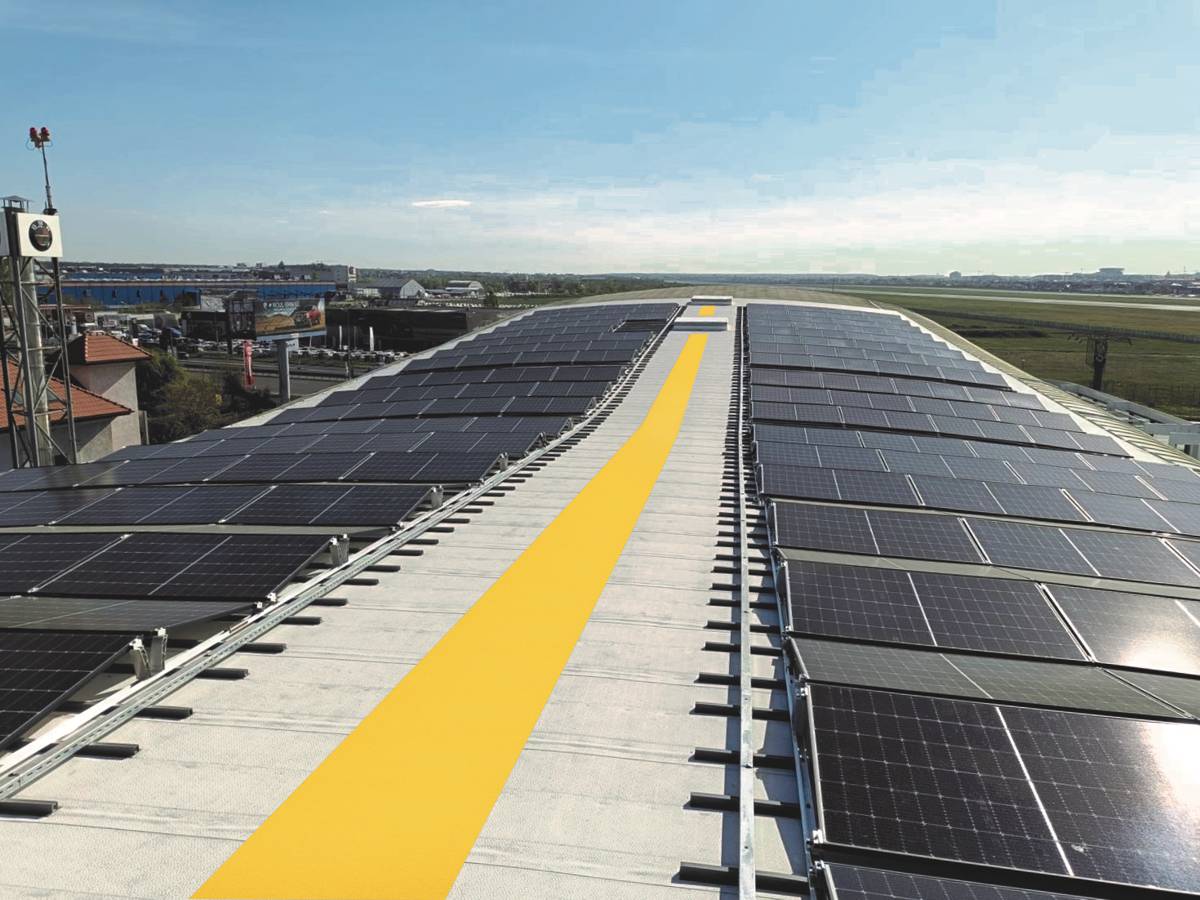
However, installing solar panels introduces new operational challenges. Technicians must routinely access panels for inspection, cleaning and maintenance. Without defined access routes, foot traffic can damage waterproofing membranes or create safety hazards.
Walkway membranes designed for photovoltaic installations provide a practical solution. By creating designated paths across roofing surfaces, they allow maintenance teams to reach equipment without stepping directly on sensitive roof structures.
The RENOLIT ALKORPLAN walkway has been developed specifically to accommodate these scenarios. It can be installed alongside photovoltaic panels, lifeline systems and emergency access routes, enabling safe movement across complex rooftop layouts.
Compatibility with Modern Roofing Systems
A key factor in the product’s design is its compatibility with existing RENOLIT ALKORPLAN roofing membranes. The walkway system integrates with the company’s Bright, Smart and Classic membrane ranges, allowing installers to maintain consistent material performance across the entire roofing system.
This compatibility simplifies installation and ensures that walkway areas provide additional protection rather than becoming a weak point in the waterproofing system. By reinforcing high-traffic areas, the walkway helps extend the lifespan of the roof membrane beneath it.
Such integration is particularly important in large commercial buildings where roofing systems must remain operational for decades. Repairing or replacing damaged waterproofing can be both costly and disruptive, especially in facilities such as hospitals, logistics centres or data centres where operational continuity is critical.
In practice, walkway membranes function as sacrificial protective layers. They absorb mechanical stress from foot traffic while shielding the primary waterproofing system from wear and tear.
Industrial Research Behind Synthetic Roofing Membranes
The development of modern synthetic roofing membranes reflects decades of material science innovation. PVC membranes, in particular, have become widely used in commercial roofing due to their durability, flexibility and resistance to environmental degradation.
These membranes are typically reinforced with polyester or fibreglass to enhance tensile strength. This reinforcement allows them to withstand mechanical stress without tearing or deforming. Additionally, advanced manufacturing techniques enable manufacturers to create textured surfaces designed to improve slip resistance.
Manufacturers also continue to refine formulations to enhance performance characteristics such as:
- UV resistance
- Fire performance
- Chemical resistance
- Flexibility in cold temperatures
- Long-term weathering stability
For construction professionals, these improvements translate into roofing systems capable of lasting several decades with minimal maintenance.
RENOLIT’s roofing division produces around one million rolls of membrane each year, supplying projects across commercial construction, civil engineering and swimming pool waterproofing. This scale of production highlights the global demand for high-performance synthetic roofing solutions.
Design Meets Practical Construction Needs
Architectural design often focuses on aesthetics and structural expression, yet the success of a building ultimately depends on how well its components function over time. Walkways, drainage systems and membranes rarely attract attention during design presentations, but they determine whether a structure remains safe and operational for decades.
This is where the intersection between industrial design and construction engineering becomes particularly important. Products recognised by industry awards often demonstrate an ability to combine technical performance with architectural compatibility.
Commenting on the recognition, Daria Barbieri, Head of Marketing RENOLIT ALKORPLAN, noted: “We are delighted to receive this recognition, which confirms our commitment to developing solutions that merge advanced safety with high-level architectural performance.”
She added: “The Slip Resistant Walkway was designed to offer maximum protection and durability for modern roofing, and being honoured by such a prestigious jury validates our ongoing research into materials that support the future of the construction industry.”
While marketing perspectives often emphasise brand achievement, the broader takeaway lies in how material innovations contribute to safer and more resilient buildings.
The Role of Roofing Technology in Future Cities
As cities become denser and buildings more multifunctional, rooftops are evolving into active infrastructure spaces. Beyond solar panels, modern roofs may host ventilation equipment, green spaces, telecommunications hardware and maintenance walkways.
These developments mean roofs are no longer passive surfaces. They are working platforms that require careful design and engineering to ensure long-term functionality.
Looking ahead, several trends are likely to shape rooftop design:
- Greater integration of renewable energy systems
- Expansion of green roofs and biodiversity infrastructure
- Increased demand for rooftop mechanical systems
- Growing emphasis on safe maintenance access
In this context, components such as slip-resistant walkway membranes play a crucial role in ensuring these spaces remain safe and serviceable.
Building Safety Through Small Innovations
Construction innovation often focuses on large-scale technologies such as robotics, digital twins or advanced machinery. Yet many of the improvements that enhance building safety occur at the material level.
Roof membranes, walkway surfaces and protective layers may seem small in isolation, but collectively they influence the durability, safety and performance of entire structures.
Recognition through industry awards therefore highlights more than product design. It acknowledges the ongoing evolution of building materials that quietly support the infrastructure systems modern society relies upon.
As architects and engineers continue to push the boundaries of design and sustainability, these practical innovations will remain central to delivering buildings that are not only visually striking but also safe and resilient for decades to come.