Smart Data Driving Safer Intersections Worldwide
Across the world’s road networks, intersections remain among the most complex and hazardous locations for drivers, cyclists and pedestrians alike. Even on otherwise well designed highways or urban corridors, these convergence points create a dense mix of vehicles, turning movements, signals, distractions and human decision making. When that combination goes wrong, the consequences can be severe.
According to the Federal Highway Administration, intersections account for roughly a quarter of all traffic fatalities in the United States and around half of all injury crashes. This is remarkable given that intersections represent only a small fraction of total roadway mileage. Similar patterns appear in Europe and Asia, where urban junctions frequently dominate crash statistics due to turning conflicts, signal violations, driver distraction and speed misjudgement.
For transport authorities, identifying which intersections are becoming dangerous and understanding why has long been a challenge. Traditional crash statistics provide a historical view, showing where collisions have already occurred. However, these datasets rarely explain the behavioural factors that triggered those crashes or whether risk is increasing before collisions begin to spike.
This gap between crash history and real time behavioural insight has become a major obstacle for road safety professionals attempting to implement preventive strategies rather than reactive fixes.
Cambridge Mobile Telematics Expands the Scope of Road Safety Analytics
To address this challenge, Cambridge Mobile Telematics has introduced new capabilities within its StreetVision road safety analytics platform. The latest update adds intersection level risk insights and integrates federal and state crash records directly with behavioural telematics data.
StreetVision is already widely used by transportation agencies, highway safety offices and infrastructure planners to analyse risk across entire road networks. By incorporating behavioural signals derived from telematics, the platform has enabled authorities to observe patterns such as speeding, sudden braking or phone distraction across millions of journeys.
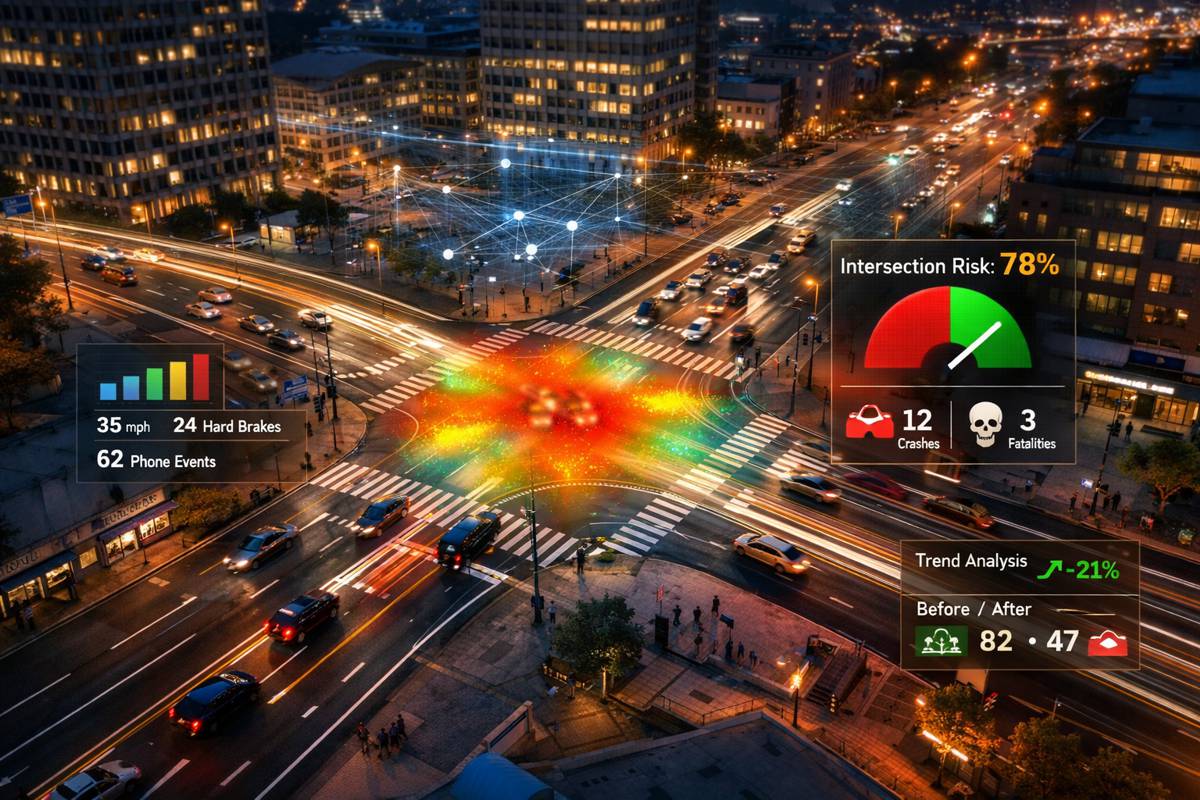
The newly introduced intersection analytics extend that concept further. Instead of analysing risk only at the corridor or city level, the platform can now focus on individual junctions, helping agencies pinpoint where hazardous behaviour is concentrated and where intervention might prevent future collisions.
By integrating official crash and fatality records alongside behavioural data, StreetVision now allows analysts to examine both cause and consequence in the same system. This combination provides a clearer view of whether dangerous behaviour is increasing at specific intersections before crashes escalate.
Behavioural Data Changes the Road Safety Equation
Historically, road safety programmes have relied heavily on crash counts to determine which locations require attention. While these datasets remain essential, they represent a lagging indicator. By the time a pattern appears in crash statistics, multiple collisions may already have occurred.
Behavioural telematics introduces a leading indicator of risk. Instead of waiting for crashes, agencies can monitor dangerous driving patterns such as:
- Excessive speeding approaching intersections
- Sudden or repeated hard braking
- Phone distraction while navigating junctions
- Aggressive acceleration during signal changes
These signals reveal how drivers are interacting with the infrastructure before a collision takes place. When behavioural risk begins to rise at a particular junction, it may indicate poor visibility, confusing lane layouts, signal timing problems or congestion related conflicts.
By combining crash outcomes with behavioural indicators, transport authorities gain a far more complete understanding of how infrastructure design and driver behaviour interact.
Intersection Safety Insights for Transport Authorities
The new StreetVision capabilities allow road safety professionals to examine intersection risk in greater detail than previously possible.
Transport agencies can now identify and rank intersections according to observed risky driving behaviours captured through telematics data. This makes it easier to prioritise locations where safety investments could have the greatest impact.
The platform also enables users to zoom into individual intersections and visualise exactly where high risk behaviours occur. Analysts can observe patterns such as drivers braking suddenly at a particular turning lane or accelerating aggressively through signal changes.
Another key feature involves monitoring trends over time. If risky behaviours begin to increase at an intersection, the system can highlight emerging hazards long before a serious crash occurs.
In addition, StreetVision allows agencies to visualise official crash and fatality records alongside behavioural insights. This dual perspective enables planners to evaluate whether interventions such as signal redesign, lane reconfiguration or improved signage are actually reducing risk.
Practical Applications for Infrastructure Planning
For infrastructure agencies, the implications of these insights extend well beyond academic research. Data driven analysis of intersection risk can directly influence how transport budgets are allocated and how safety improvements are prioritised.
Many road authorities operate within constrained funding environments, often competing for limited safety grants or federal support. Demonstrating the potential impact of a safety intervention has therefore become an essential part of securing investment.
StreetVision’s intersection analysis tools enable agencies to produce evidence based proposals. By showing both behavioural risk and historical crash outcomes, transport planners can justify infrastructure improvements with a clearer analytical foundation.
This capability is particularly valuable for programmes such as Vision Zero initiatives, which aim to eliminate traffic fatalities through systematic safety interventions. Data driven insights help cities identify which junctions require redesign, enforcement or public awareness campaigns.
Supporting Research and Local Decision Making
Researchers and safety analysts are also beginning to explore how integrated behavioural and crash datasets can improve road safety modelling.
Dr. Max Roberts, Senior Research Associate at the Washington Traffic Safety Commission, highlighted how the platform supports collaboration with local authorities: “With StreetVision Intersections, I can quickly and reliably identify locations across communities where high-risk driving behaviors are concentrated and compare them with other locations. This feature allows me to effortlessly provide actionable insights to our city and county partners so they can prioritize risky locations and intervene before a serious crash occurs.”
Insights like these help regional authorities share knowledge across jurisdictions. A pattern identified in one city may reveal a broader infrastructure design issue that affects multiple communities.
By distributing risk analysis tools across planning organisations, the platform supports a more coordinated approach to road safety improvement.
The Growing Role of Telematics in Transport Policy
The expansion of telematics based analytics reflects a wider transformation occurring across the transport sector. Over the past decade, connected vehicles and smartphone sensors have created an unprecedented volume of mobility data.
Telematics systems can now measure vehicle speed, braking intensity, acceleration, cornering and phone usage across millions of trips. When aggregated and anonymised, these signals create powerful insights into real world driving behaviour.
Public sector organisations increasingly recognise the value of these datasets for infrastructure planning and safety monitoring. Rather than relying solely on roadside sensors or periodic surveys, authorities can analyse behavioural patterns continuously across entire regions.
Platforms such as StreetVision demonstrate how this data can support proactive safety management rather than reactive crash response.
Cambridge Mobile Telematics and the DriveWell Platform
Founded in Cambridge, Massachusetts, Cambridge Mobile Telematics has become one of the largest telematics providers globally. The company’s technology is widely used by insurers, mobility companies and public sector organisations to monitor driving behaviour and detect crash events.
At the centre of its technology ecosystem lies the DriveWell Fusion platform, which applies artificial intelligence to identify patterns of driving risk. By analysing telematics data in real time, the system can identify behaviours associated with increased crash probability and provide feedback designed to reduce those risks.
According to the company, its technology has already helped prevent more than 100,000 crashes worldwide. These systems are used not only for road safety analysis but also for insurance risk assessment, fleet safety management and emergency crash detection.
The expansion of StreetVision reflects a growing partnership between the private telematics industry and public infrastructure agencies seeking more advanced safety insights.
Data Driven Infrastructure for a Safer Road Network
As cities expand and mobility patterns grow more complex, the challenge of improving road safety becomes increasingly urgent. Urbanisation, higher traffic volumes and rising vehicle ownership all contribute to greater pressure on transport infrastructure.
Traditional safety analysis methods are no longer sufficient on their own. Transport agencies need faster ways to detect risk, understand behaviour and deploy targeted interventions before accidents occur.
By integrating crash records with real world behavioural data, platforms like StreetVision represent a significant step toward predictive road safety management.
For planners, policymakers and engineers, the ability to see risk clearly before collisions occur may ultimately reshape how infrastructure decisions are made.
Safer intersections rarely emerge by chance. They are the result of careful design, informed analysis and timely intervention. As data driven safety tools continue to evolve, the next generation of road networks may finally move from reacting to accidents toward preventing them altogether.