South Africa Builds Rail Momentum with Strategic Finance
South Africa is edging closer to a pivotal moment in its transport evolution, as government prepares to issue a request for proposals for new high-speed rail corridors linking key economic regions. The planned routes, including a flagship connection between Johannesburg and eThekwini, signal a shift from long-standing feasibility discussions into tangible procurement activity. For a country grappling with road congestion, logistics inefficiencies and uneven regional connectivity, the implications stretch well beyond passenger convenience.
At the same time, progress on high-speed rail is unfolding alongside a quieter, yet equally significant, development within Gauteng. The expansion and refinancing of the Gautrain Rapid Rail Link is demonstrating how blended finance, institutional backing and pragmatic structuring can unlock infrastructure capacity without destabilising existing concessions. Together, these two tracks, one focused on future intercity mobility, the other on strengthening a proven urban system, offer a revealing glimpse into how South Africa is recalibrating its rail strategy.
Briefing
- South Africa is moving to procurement stage for high-speed rail corridors, including Johannesburg to eThekwini and Johannesburg to Musina
- Nearly 30 companies have expressed early interest following a prior request for information
- Gautrain expansion highlights growing demand, with passenger numbers exceeding original forecasts
- Development Bank of Southern Africa structured a ZAR 3.5 billion financing solution via a special purpose vehicle
- Project preparation support from Infrastructure Investment Programme for South Africa is accelerating delivery and improving bidder engagement
High Speed Rail Moves From Vision To Procurement
South Africa’s decision to proceed with a formal request for proposals marks a decisive step forward for high-speed rail development. For years, the concept has circulated within policy frameworks, often constrained by funding uncertainties and institutional complexity. Now, with procurement imminent, the conversation is shifting from aspiration to execution.
The proposed Johannesburg to eThekwini corridor stands out as a commercially and strategically significant route. Linking the country’s financial hub with its busiest port city, the line would directly address freight congestion and long travel times along one of southern Africa’s most critical economic arteries. Parallel planning for a Johannesburg to Musina corridor further underlines ambitions to connect domestic infrastructure with regional trade networks, particularly those extending into neighbouring countries and continental logistics corridors.
Market appetite appears strong. Nearly 30 companies have already expressed interest during the earlier request for information phase, indicating a competitive procurement landscape. That level of engagement suggests confidence in the project’s viability, but it also raises expectations around risk allocation, revenue models and long-term policy stability. Investors and contractors alike will be watching closely for clarity on concession structures, guarantees and demand forecasts once the RFP is issued.
Gautrain Offers A Proven Model For Rail Investment
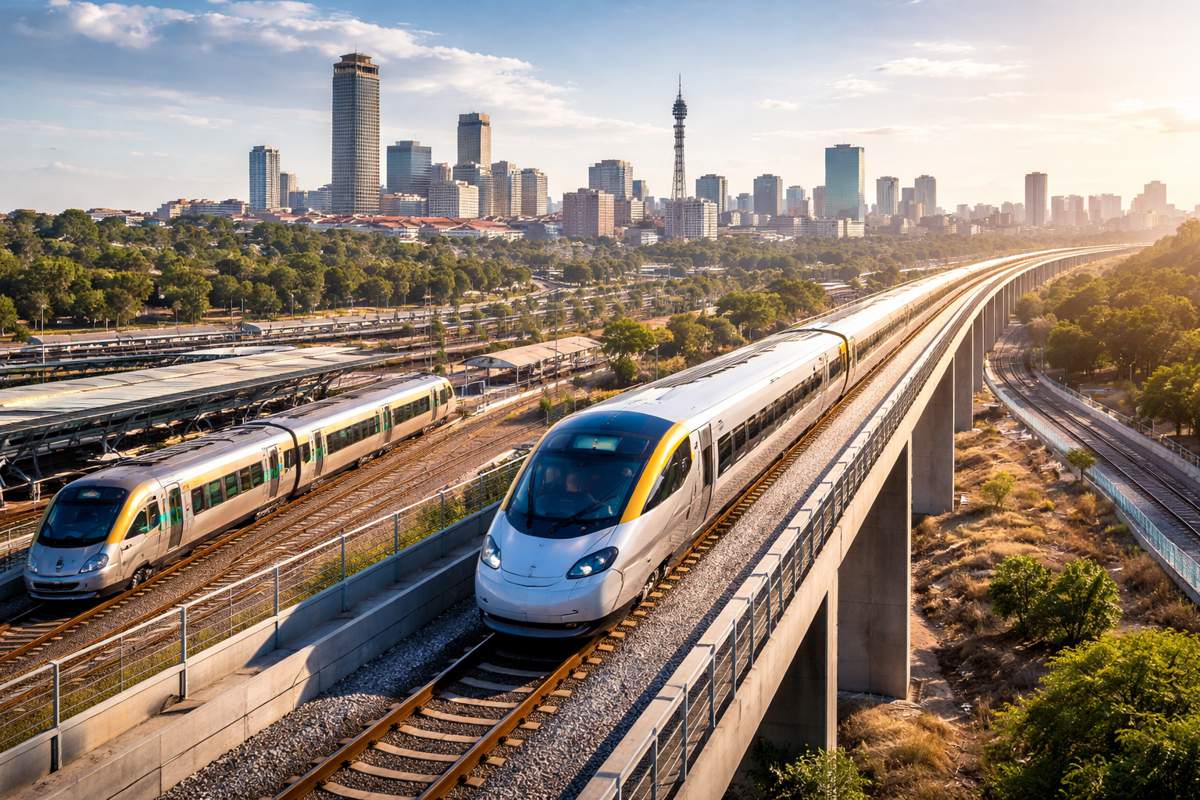
While high-speed rail captures headlines, the experience of the Gautrain Rapid Rail Link provides a grounded reference point. Developed between 2007 and 2010 and fully operational by 2012, the system connects Johannesburg, Pretoria, Sandton and OR Tambo International Airport through an 80 km network supported by feeder services.
What stands out is how quickly the system exceeded expectations. Passenger demand grew beyond initial projections within just a few years of operation, placing pressure on both rolling stock capacity and supporting infrastructure. Peak-hour congestion became a persistent challenge, signalling not a failure of planning, but a success in attracting ridership in a car-dependent urban environment.
This surge in demand has reinforced a broader lesson for infrastructure planners. When rail systems are designed with reliability, integration and user experience in mind, uptake can accelerate rapidly. That creates both an opportunity and a challenge. Scaling capacity quickly enough to match demand becomes critical, particularly where contractual frameworks were not originally designed to accommodate large mid-term expansions.
Financing Innovation Unlocks Capacity Expansion
Addressing Gautrain’s capacity constraints required more than operational adjustments. It demanded a financing solution capable of bridging the gap between an expiring concession and the need for immediate investment. The original concession structure, due to end in March 2026, limited the operator’s appetite for taking on additional long-term debt.
To overcome this constraint, the Development Bank of Southern Africa stepped in as Mandated Lead Arranger. Its role was to design a financing model that could deliver new rolling stock and infrastructure upgrades without disrupting the existing operational framework. The result was a ZAR 3.5 billion facility structured through a special purpose vehicle, enabling repayment over a 15-year horizon.
This approach is notable for its flexibility. By decoupling financing from the original concession timeline, the structure avoids placing undue strain on the incumbent operator while ensuring that capacity upgrades can proceed without delay. It also demonstrates how development finance institutions can act as catalysts, absorbing complexity and aligning stakeholders in projects that might otherwise stall.
Beyond rolling stock, the financing package supports critical infrastructure enhancements required to maintain service quality. In urban rail systems, additional trains alone are rarely sufficient. Signalling, depot capacity and station throughput must all evolve in tandem, requiring coordinated investment across multiple components.
De Risking Projects Through Targeted Support
Financing alone does not guarantee project momentum. Early-stage costs and bid preparation risks can deter participation, particularly in complex infrastructure projects. Recognising this, the Infrastructure Investment Programme for South Africa has provided a project preparation grant to support the Gautrain expansion.
This funding covers transaction costs and partially reimburses bidders for design expenses, reducing barriers to entry and encouraging more robust proposals. It is a relatively modest intervention in financial terms, yet its impact on procurement efficiency can be substantial. By lowering upfront risk, governments can attract a wider pool of qualified bidders and improve the overall quality of submissions.
The model reflects a broader shift in infrastructure delivery. Rather than relying solely on large-scale financing packages, policymakers are increasingly focusing on targeted interventions that address specific bottlenecks within the project lifecycle. Preparation funding, technical assistance and risk-sharing mechanisms are becoming standard tools in accelerating project pipelines.
Expanding Gautrain Beyond Its Original Footprint
Looking ahead, the Gautrain is not standing still. Plans are underway to extend the network into new suburbs and emerging economic zones within Gauteng. These future phases aim to build on the system’s success by improving accessibility and reducing reliance on road transport across a wider urban footprint.
Such expansion carries both opportunities and complexities. On one hand, extending rail connectivity can support urban densification, reduce emissions and enhance labour mobility. On the other, it requires careful coordination with land use planning, municipal transport systems and long-term funding strategies.
The experience gained from the current expansion and refinancing effort will likely inform these future phases. If the financing structures and institutional partnerships prove effective, they could serve as a template for scaling the network without overburdening public finances or private operators.
Strategic Implications For The Infrastructure Sector
Taken together, South Africa’s high-speed rail ambitions and Gautrain expansion efforts highlight a broader recalibration in infrastructure delivery. There is a growing recognition that large-scale transport projects must balance ambition with financial realism, leveraging both public and private capital in ways that distribute risk appropriately.
For contractors, investors and technology providers, the emerging pipeline presents significant opportunities. High-speed rail projects will demand expertise in civil engineering, signalling systems, rolling stock manufacturing and digital integration. Meanwhile, urban rail expansions will continue to drive demand for maintenance solutions, data analytics and capacity optimisation technologies.
Yet, the real significance lies in how these projects are being structured. The combination of development finance, special purpose vehicles and targeted project preparation support points to a more sophisticated approach to infrastructure funding. It suggests that South Africa is not merely pursuing new projects, but refining the mechanisms through which those projects are delivered.
Building Momentum Across The Rail Ecosystem
Momentum is clearly building, albeit incrementally. The transition from planning to procurement in high-speed rail marks a critical inflection point, while the Gautrain’s expansion underscores the importance of sustaining and enhancing existing assets. Each initiative reinforces the other, creating a more coherent and resilient rail ecosystem.
There is still work to be done. Regulatory clarity, investor confidence and long-term policy consistency will all play decisive roles in determining how quickly these ambitions translate into operational infrastructure. However, the direction of travel is becoming increasingly clear.
South Africa is positioning rail not as a legacy mode of transport, but as a central pillar of its future mobility strategy. By aligning financial innovation with practical delivery, it is laying the groundwork for a transport network capable of supporting economic growth, regional integration and urban development for decades to come.