Rethinking Corrosion Protection with Smarter Packaging Solutions
Corrosion rarely grabs headlines, yet it quietly drains billions from the global economy each year. According to estimates from organisations such as NACE International, the annual cost of corrosion runs into trillions of dollars worldwide when factoring in maintenance, downtime, and premature asset replacement. For construction, transport, and manufacturing sectors, the implications are immediate and tangible, affecting everything from structural steel to precision-engineered components.
Incremental improvements in corrosion protection methods can deliver disproportionate gains. Materials handling, storage, and transport all play a role, and packaging is often the first and last line of defence. That’s where solutions such as CorShield® VpCI®-146 Paper from Cortec Corporation are gaining renewed attention, not as a novelty, but as a practical response to long-standing inefficiencies in corrosion prevention workflows.
The renewed focus is not simply about performance. It reflects broader pressures across industry, including sustainability targets, automation in manufacturing, and the need to simplify processes without compromising reliability. In many respects, corrosion protection is being re-evaluated through the same lens as other industrial systems: reduce waste, eliminate unnecessary steps, and ensure compatibility with modern production environments.
Briefing
- Corrosion remains a multi-trillion-dollar global issue affecting infrastructure and manufacturing
- Vapour phase corrosion inhibitor (VpCI) packaging offers clean, residue-free protection
- Double-sided corrosion protection supports automation and reduces handling complexity
- Biobased and recyclable materials align with sustainability targets
- Integration with automated packaging lines improves efficiency and consistency
The Hidden Cost of Corrosion in Infrastructure and Industry
Corrosion is often underestimated because it unfolds gradually, yet its cumulative impact is profound. In infrastructure projects, corrosion can shorten the lifespan of bridges, pipelines, and transport systems, leading to increased capital expenditure and safety risks. In manufacturing, it compromises precision components, disrupts supply chains, and leads to costly rework or rejection of parts.
Industries such as automotive, heavy equipment, and rail are particularly exposed. Components frequently move through multiple environments before installation, from factory floors to warehouses and across international shipping routes. Each stage introduces variables such as humidity, temperature fluctuations, and exposure to contaminants, all of which accelerate corrosion if not properly managed.
Historically, corrosion protection relied heavily on oil-based coatings and greases. While effective in certain conditions, these methods introduce their own inefficiencies. Cleaning requirements, disposal challenges, and compatibility issues with downstream processes often offset their benefits. As manufacturing becomes more precise and time-sensitive, these legacy approaches are increasingly out of step with operational needs.
Vapour Phase Corrosion Inhibitors Enter the Mainstream
Vapour phase corrosion inhibitor technology has gradually moved from niche applications into broader industrial use. The concept is straightforward yet effective. Instead of coating metal surfaces directly, VpCI materials release molecules that form a protective layer on exposed metal surfaces within an enclosed environment.
This approach eliminates the need for direct application of oils or greases. Components remain clean and ready for immediate use upon unpacking, which is particularly valuable in assembly lines where time and cleanliness are critical. It also reduces the risk of contamination in sensitive systems, including hydraulic and braking components.
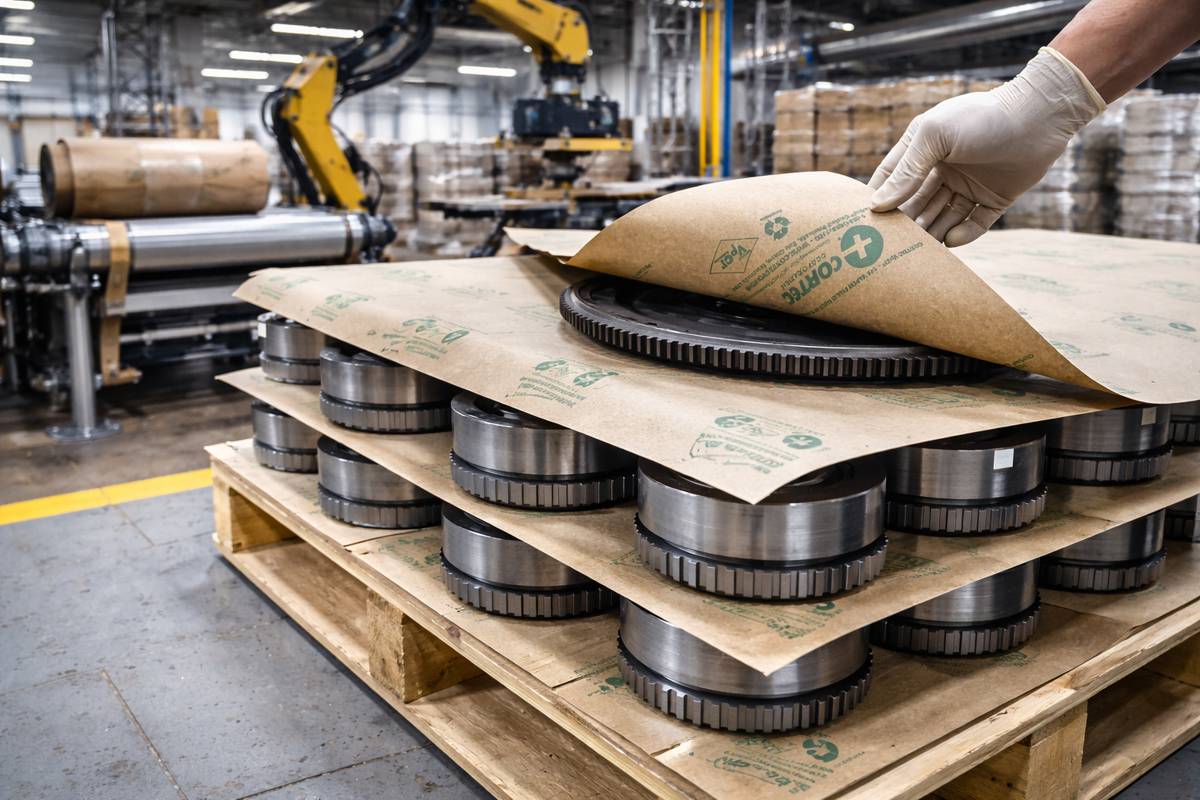
CorShield® VpCI®-146 Paper builds on this principle by emitting inhibitors from both sides of the paper. This double-sided functionality ensures more consistent protection, especially when parts are stacked, layered, or tightly packed. The result is a more uniform protective environment, reducing the likelihood of corrosion hotspots.
Simplicity as an Operational Advantage
In industrial settings, simplicity often translates directly into cost savings. Complex corrosion protection systems require training, monitoring, and quality control, all of which introduce opportunities for error. By contrast, wrapping a component or interleaving layers with treated paper is a straightforward process that can be standardised across facilities.
This simplicity extends to logistics. Components can be packaged at the point of production and remain protected throughout storage and transport without additional intervention. Once the packaging is removed, the protective layer dissipates naturally, eliminating the need for cleaning or degreasing.
For sectors such as construction equipment manufacturing, where large volumes of parts move through supply chains, these efficiencies can accumulate quickly. Reduced handling time, fewer rejected components, and streamlined workflows all contribute to improved productivity.
Supporting Automation in Modern Manufacturing
Automation continues to reshape manufacturing environments, from robotics on assembly lines to fully integrated packaging systems. Corrosion protection methods must align with this shift, and packaging-based solutions are particularly well suited to automated processes.
One example cited by Cortec Corporation involves a manufacturer using automated systems to package brake rotors. In this setup, paper is unrolled, cut to size, and placed between layers by robotic systems before final wrapping. The process requires consistent material performance and compatibility with machinery, both of which are critical for maintaining throughput.
Automation also reduces variability. Human error in applying coatings or handling components can lead to inconsistent protection. By integrating corrosion protection directly into the packaging process, manufacturers can achieve more predictable outcomes while reducing labour requirements.
Sustainability Moves from Aspiration to Requirement
Sustainability is no longer a secondary consideration. Regulatory frameworks, investor expectations, and corporate commitments are driving tangible changes in how materials are selected and used. Packaging plays a significant role, particularly in industries with high material throughput.
CorShield® VpCI®-146 Paper is described as a USDA Certified Biobased Product and can be recycled into new paper products after use. This aligns with broader efforts to reduce reliance on petroleum-based materials and minimise waste streams. For manufacturers, the ability to integrate corrosion protection with recyclable packaging offers a practical route to meeting sustainability targets.
The shift also reflects changing expectations from end users. Automotive manufacturers, for example, are under pressure to reduce the environmental footprint of their supply chains. Materials that combine functionality with environmental credentials are increasingly preferred, particularly when they do not introduce additional complexity.
Mike Gabor of Cortec Corporation highlighted this trend, noting: “It’s very rewarding to see automotive companies focused on sustainability and knowing that Cortec® 146 paper is part of the solution.” The comment reflects a broader industry movement rather than a single product narrative.
Enhancing Protection for Sensitive Components
While basic wrapping may suffice for many applications, certain components require additional safeguards. Parts that are packaged while still warm, or those exposed to fluctuating environmental conditions, are particularly vulnerable.
In these cases, combining VpCI paper with sealed packaging, such as specialised bags, can provide enhanced protection. The paper adds an extra layer of corrosion inhibitors while also offering cushioning and limited moisture absorption. This multi-layered approach is especially useful for high-value or precision components where failure is not an option.
The flexibility of this method allows manufacturers to tailor protection levels to specific requirements without redesigning entire packaging systems. It also supports incremental improvements, enabling companies to enhance protection without significant capital investment.
Moving Away from Legacy Specifications
Despite the availability of more efficient solutions, some organisations remain tied to legacy specifications that favour traditional corrosion prevention methods. These specifications are often based on historical performance rather than current operational needs.
Updating these standards requires a shift in mindset as much as a change in materials. Decision-makers must balance proven practices with the potential benefits of newer approaches. In many cases, the transition can be gradual, starting with specific components or processes before expanding across operations.
The challenge lies in demonstrating reliability. Corrosion protection is inherently risk-averse, and any change must be supported by evidence and real-world performance. As more manufacturers adopt packaging-based solutions, the body of evidence continues to grow, making it easier for others to follow suit.
A Practical Path Forward for Industry
Corrosion may never be eliminated entirely, but its impact can be significantly reduced through smarter approaches to protection. Packaging-based solutions such as VpCI-treated paper offer a compelling combination of simplicity, efficiency, and environmental compatibility.
For construction and infrastructure sectors, where durability and lifecycle costs are paramount, these improvements can translate into meaningful long-term benefits. Reduced maintenance, improved reliability, and streamlined logistics all contribute to more resilient systems.
As industries continue to modernise, corrosion protection is unlikely to remain an afterthought. Instead, it will increasingly be integrated into broader strategies for efficiency and sustainability, ensuring that even the smallest components are protected with the same level of attention as the structures they support.