Geothermal Monitoring Breakthrough Reaches New Depths
The global push for reliable, low-carbon energy has long faced a stubborn constraint. Solar and wind have scale, but not always consistency. Hydropower depends on geography. Nuclear delivers stability, yet remains politically and financially complex. In that landscape, geothermal energy has quietly held a unique position, offering steady baseload power drawn from the Earth itself. Now, advances in enhanced geothermal systems are beginning to shift it from niche to scalable infrastructure.
At the centre of that shift sits a collaboration between Lawrence Berkeley National Laboratory and Fervo Energy, where scientists have achieved a milestone in subsurface monitoring under extreme conditions. Working nearly 7,000 feet below ground at the Cape Station site in Utah, researchers have completed the longest continuous high-temperature seismic monitoring ever recorded in an engineered geothermal reservoir. The work signals a step change in how geothermal systems can be understood, controlled and expanded at scale.
This is not simply a scientific curiosity. It addresses one of the core challenges facing geothermal deployment worldwide. Without precise, real-time understanding of how rock fractures behave deep underground, scaling geothermal safely has always been constrained. The ability to monitor these systems continuously, even in temperatures approaching 338°F, opens the door to more predictable performance, improved safety and ultimately, wider commercial adoption.
Briefing
- Continuous seismic monitoring achieved for seven months at nearly 7,000 feet depth in extreme heat
- Temperatures reached 338°F, exceeding previous long-duration measurement benchmarks
- Enhanced geothermal systems rely on engineered fractures to extract heat efficiently
- Improved monitoring supports safer reservoir management and reduces seismic risk
- Cape Station aims to deliver up to 500 MW of continuous geothermal power by 2026
Unlocking the Subsurface for Scalable Energy
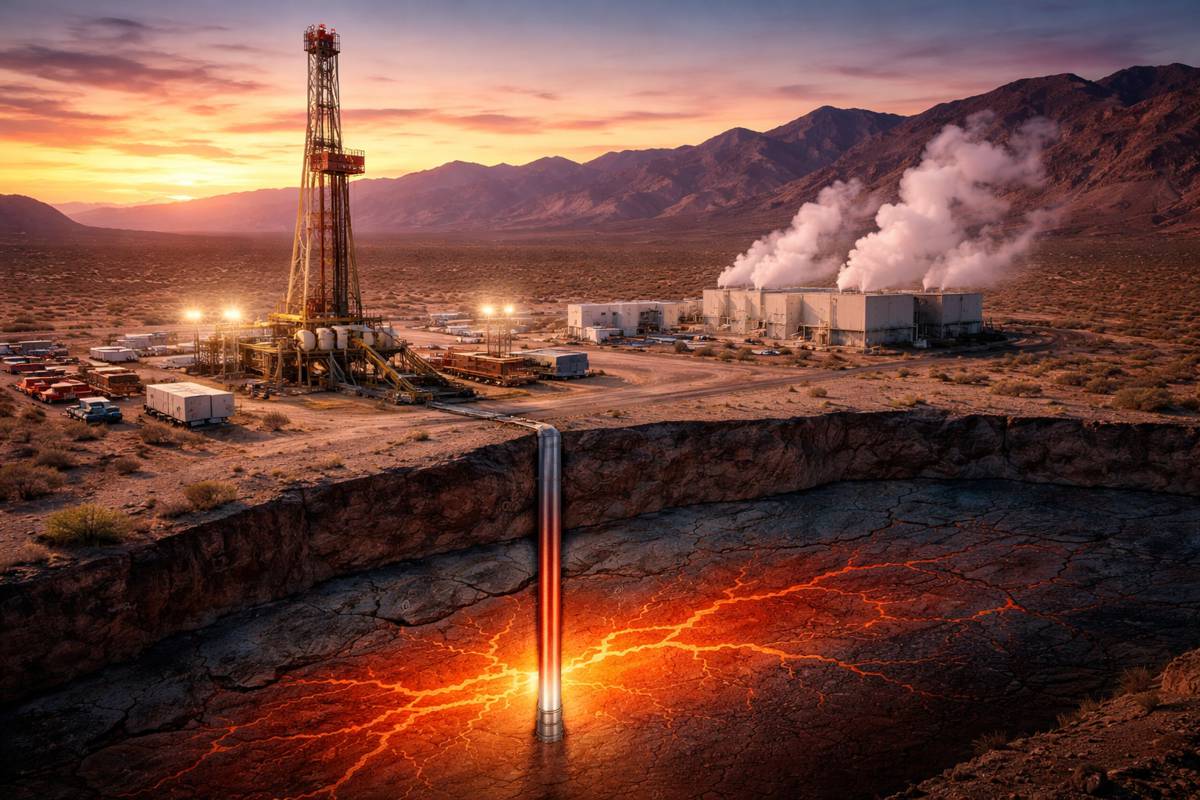
Enhanced geothermal systems, often referred to as EGS, represent a significant evolution from traditional geothermal energy. Conventional systems depend on naturally occurring reservoirs where heat, permeability and fluid already align. Those conditions are geographically limited. EGS, by contrast, engineers the reservoir itself, creating pathways in hot rock so water can circulate, absorb heat and return to the surface as steam for power generation.
This engineered approach dramatically expands the geographic potential of geothermal energy. Heat exists almost everywhere beneath the Earth’s surface, but accessing it requires overcoming the lack of natural permeability in many rock formations. By inducing fractures and controlling fluid flow, EGS creates a controlled heat exchange system deep underground.
Yet that control has always been the sticking point. Microseismic activity, generated as fractures form and evolve, provides critical clues about what is happening below the surface. These events are typically very small and rarely felt, but they act as a real-time map of how the reservoir is behaving. Without continuous, high-quality data from these events, operators have been working with only partial visibility.
Pushing Monitoring into Extreme Conditions
The recent field deployment at Cape Station represents a technical leap forward. A specially designed high-temperature seismometer, developed by Berkeley Lab’s Geosciences Measurement Facility, was installed nearly 6,995 feet underground. Operating continuously from late July 2025 through February, it recorded seismic activity in conditions that would typically degrade or destroy conventional instruments.
Temperatures reached 338°F, surpassing previous long-duration monitoring benchmarks in the region, where earlier measurements peaked at around 302°F. This matters because the most productive geothermal zones often exist at precisely these higher temperatures and depths. Monitoring them effectively has been a long-standing barrier.
“Such high-temperature measurements are critical for geothermal energy production, and as far as we know, this is the world’s longest recorded measurement at this temperature,” said Nori Nakata, a staff scientist at Berkeley Lab involved in the project. “If we can advance the science needed to achieve round-the-clock monitoring of EGS operations, it will help expand EGS effectively and safely.”
The instrument itself reflects a pragmatic engineering approach. Measuring just under 10 feet in length, it was designed to withstand extreme heat, resist water ingress and operate reliably over extended periods without failure. In environments where maintenance is impractical and failure is costly, simplicity and durability become essential design principles.
From Data to Control in Geothermal Reservoirs
Continuous seismic monitoring does more than record events. It enables operators to understand how fractures evolve, how fluids move through the reservoir and how pressure changes influence system behaviour. That knowledge feeds directly into operational decisions, particularly around fluid injection and circulation.
With more complete datasets, operators can refine how they manage the reservoir, improving efficiency while reducing risks. Microseismic monitoring helps build a detailed catalogue of subsurface events, allowing researchers to distinguish between normal operational behaviour and anomalies that may require intervention.
This is particularly relevant when considering induced seismicity. While most events are too small to be felt, understanding their patterns is essential for maintaining public confidence and regulatory approval. Better monitoring supports more precise control, reducing the likelihood of larger events that could reach the surface.
“Continuous seismic recording is important to expanding EGS operations,” Nakata explained. “With more information about microseismicity at greater depths, we can control fluid injection and circulation within the reservoir so it efficiently produces the steam that is converted to electricity.”
Cape Station as a Commercial Testbed
Fervo Energy’s Cape Station in southwest Utah has emerged as a focal point for geothermal innovation. Since 2023, it has served as a research and development hub, combining field-scale operations with advanced scientific monitoring. Its location is no accident. The region’s subsurface conditions mirror those found across much of the geothermal-rich western United States.
The project’s commercial ambitions are significant. Fervo plans to begin delivering 100 MW of continuous geothermal power from the site by 2026, with expansion to 500 MW over time. That level of output positions geothermal as a serious contributor to grid stability, particularly as intermittent renewables continue to expand.
The site also sits adjacent to Utah FORGE, the U.S. Department of Energy’s flagship geothermal research initiative. This proximity creates a feedback loop between research and commercial deployment, accelerating the pace at which new technologies can be tested and refined.
“Developing sensors that can reliably operate at high temperatures is a game-changer for geothermal energy,” said Sireesh Dadi, Manager of Data Acquisition and Advanced Analytics at Fervo Energy. “We’re advancing tools for microseismic monitoring, pressure sensing, and strain sensing that help us better understand reservoir behaviour in real time.”
The Role of Advanced Modelling and AI
Monitoring alone is not enough. The real value emerges when data is combined with advanced modelling and analytics. Berkeley Lab has been developing simulation tools for geothermal reservoirs for decades, allowing researchers to predict how systems will behave under different conditions.
These models are increasingly being paired with machine learning and data fusion techniques. By integrating seismic data, pressure readings and thermal measurements, researchers can identify patterns that would otherwise remain hidden. This leads to more informed decision-making and better optimisation of reservoir performance.
Artificial intelligence is playing a growing role in this process. It helps process vast volumes of data, detect subtle trends and support predictive modelling. In complex subsurface environments where direct observation is impossible, these tools provide a virtual window into reservoir dynamics.
The combination of robust sensors and advanced analytics is creating a more complete picture of geothermal systems. It allows operators to move from reactive management to proactive optimisation, improving both efficiency and reliability.
Building a Foundation for Global Deployment
Geothermal energy has often been described as underutilised rather than unavailable. The limiting factor has not been the resource itself, but the ability to access and manage it effectively. Enhanced geothermal systems, supported by advances in monitoring and modelling, are beginning to address that gap.
The implications extend beyond the United States. Regions with high geothermal potential, including parts of Europe, East Africa and Southeast Asia, could benefit from similar approaches. As technology matures, the cost and complexity of EGS deployment are expected to decline, making it a more viable option for a wider range of markets.
Historically, geothermal development has been concentrated in areas with favourable natural conditions, such as The Geysers in California, where Berkeley Lab began its early research nearly 50 years ago. The shift toward engineered systems represents a move from opportunistic development to scalable infrastructure.
At the same time, regulatory frameworks and public perception will play a role. Transparent monitoring and demonstrated control over induced seismicity will be essential for gaining acceptance. The ability to provide detailed, continuous data strengthens the case for geothermal as a safe and reliable energy source.
A Clearer View Beneath the Surface
Understanding what happens inside a geothermal reservoir has always been a challenge. Unlike surface infrastructure, where inspection and maintenance are straightforward, subsurface systems operate out of sight and under extreme conditions. That has made uncertainty a defining feature of geothermal projects.
“We want to know the true conditions inside a geothermal reservoir, but that’s difficult to see directly,” Nakata said. “For EGS to become a major U.S. energy source, we need a clear understanding of rock stress, permeability, fluid pathways, and fracture growth.”
This latest achievement does not eliminate that uncertainty entirely, but it reduces it significantly. Continuous, high-temperature monitoring provides a more complete dataset, enabling better modelling, improved control and more predictable outcomes.
For the construction and infrastructure sectors, this translates into greater confidence in geothermal as a long-term investment. Reliable baseload power supports industrial operations, stabilises grids and complements other renewable sources. As energy systems become more complex, that stability becomes increasingly valuable.